Basith Shaherin, Manavalan Balachandran, Shin Tae Hwan, Park Chan Bae, Lee Wang-Soo, Kim Jaetaek, Lee Gwang
Department of Physiology, Ajou University School of Medicine, Suwon 16499, Korea.
Computational Biology and Bioinformatics Laboratory, Department of Integrative Biotechnology, College of Biotechnology and Bioengineering, Sungkyunkwan University, Suwon 16419, Korea.
Nanomaterials (Basel). 2022 Aug 2;12(15):2656. doi: 10.3390/nano12152656.
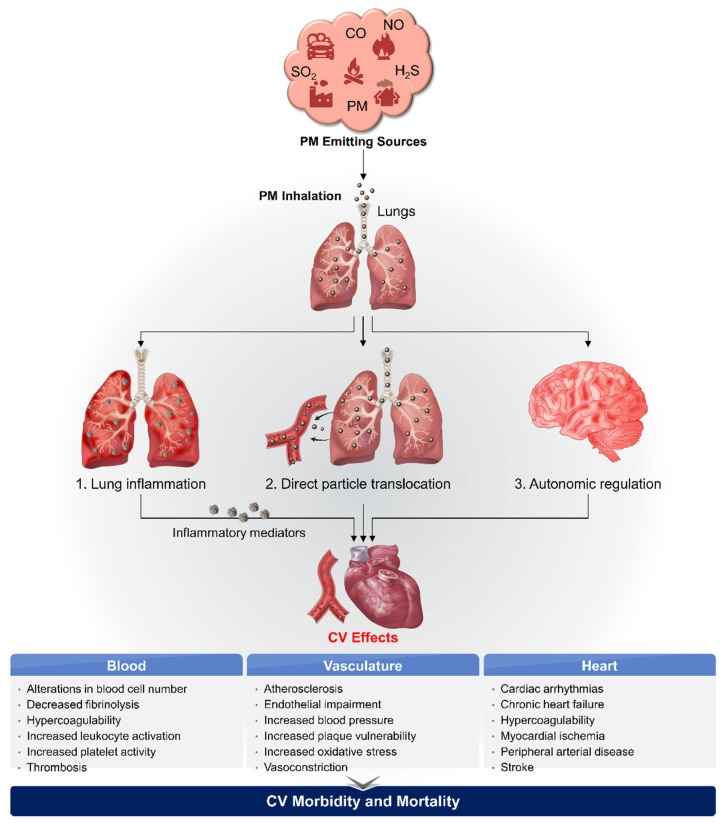
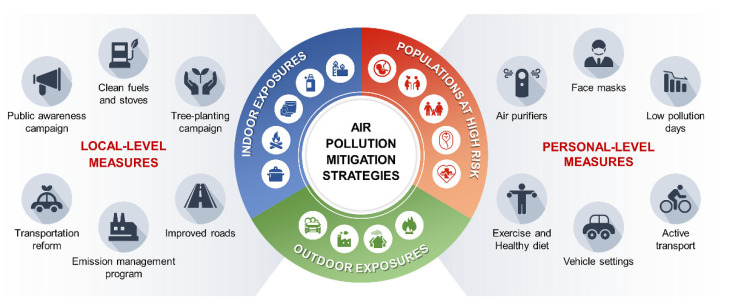
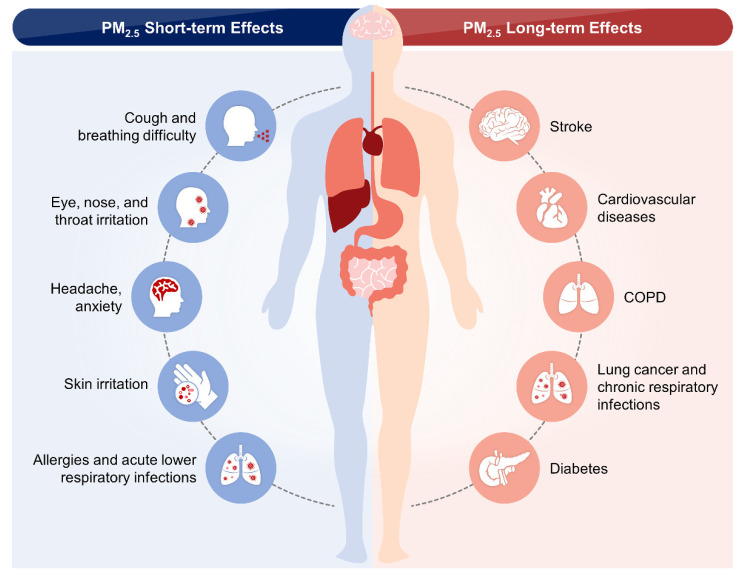
Air pollution exerts several deleterious effects on the cardiovascular system, with cardiovascular disease (CVD) accounting for 80% of all premature deaths caused by air pollution. Short-term exposure to particulate matter 2.5 (PM) leads to acute CVD-associated deaths and nonfatal events, whereas long-term exposure increases CVD-associated risk of death and reduces longevity. Here, we summarize published data illustrating how PM may impact the cardiovascular system to provide information on the mechanisms by which it may contribute to CVDs. We provide an overview of PM, its associated health risks, global statistics, mechanistic underpinnings related to mitochondria, and hazardous biological effects. We elaborate on the association between PM exposure and CVD development and examine preventive PM exposure measures and future strategies for combating PM-related adverse health effects. The insights gained can provide critical guidelines for preventing pollution-related CVDs through governmental, societal, and personal measures, thereby benefitting humanity and slowing climate change.
空气污染对心血管系统有多种有害影响,心血管疾病(CVD)占空气污染导致的所有过早死亡的80%。短期接触细颗粒物2.5(PM)会导致与急性心血管疾病相关的死亡和非致命事件,而长期接触会增加与心血管疾病相关的死亡风险并缩短寿命。在这里,我们总结已发表的数据,说明细颗粒物如何影响心血管系统,以提供有关其可能导致心血管疾病的机制的信息。我们概述了细颗粒物、其相关的健康风险、全球统计数据、与线粒体相关的机制基础以及有害的生物学效应。我们详细阐述了细颗粒物暴露与心血管疾病发展之间的关联,并研究了预防细颗粒物暴露的措施以及应对与细颗粒物相关的不良健康影响的未来策略。所获得的见解可为通过政府、社会和个人措施预防与污染相关的心血管疾病提供关键指导方针,从而造福人类并减缓气候变化。