Department of Public Health Sciences, Karolinska Institutet, 17177 Stockholm, Sweden.
Center for Assessment of Medical Technology, Örebro University Hospital, Örebro University, 70182 Örebro, Sweden.
Int J Environ Res Public Health. 2020 Feb 10;17(3):1111. doi: 10.3390/ijerph17031111.
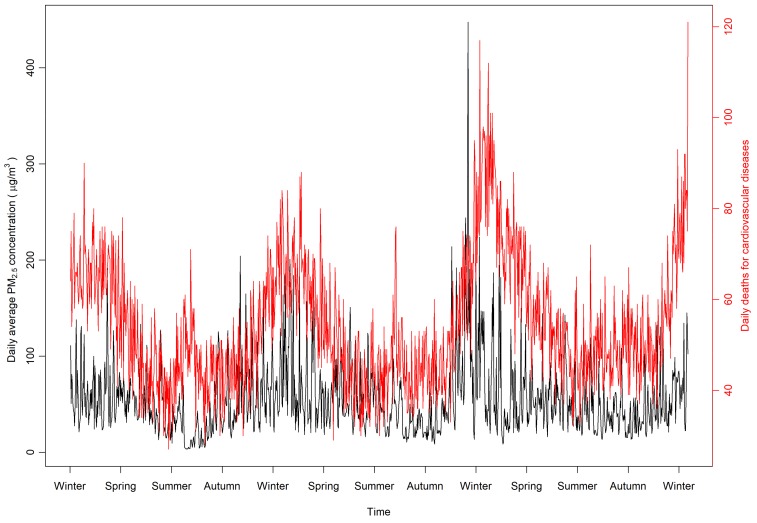
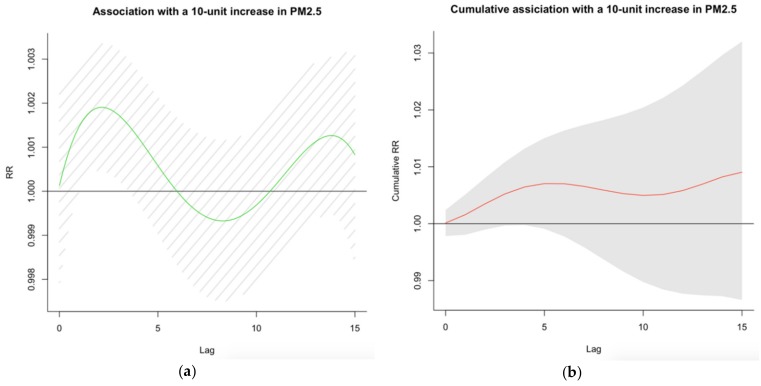
: Exposures to both ambient fine particulate matter (PM) and extreme weather conditions have been associated with cardiovascular disease (CVD) deaths in numerous epidemiologic studies. However, evidence on the associations with CVD deaths for interaction effects between PM and weather conditions is still limited. This study aimed to investigate associations of exposures to PM and weather conditions with cardiovascular mortality, and further to investigate the synergistic or antagonistic effects of ambient air pollutants and synoptic weather types (SWTs). : Information on daily CVD deaths, air pollution, and meteorological conditions between 1 January 2012 and 31 December 2014 was obtained in Shanghai, China. Generalized additive models were used to assess the associations of daily PM concentrations and meteorological factors with CVD deaths. A 15-day lag analysis was conducted using a polynomial distributed lag model to access the lag patterns for associations with PM. : During the study period, the total number of CVD deaths in Shanghai was 59,486, with a daily mean of 54.3 deaths. The average daily PM concentration was 55.0 µg/m. Each 10 µg/m increase in PM concentration was associated with a 1.26% (95% confidence interval (CI): 0.40%, 2.12%) increase in CVD mortality. No SWT was statistically significantly associated with CVD deaths. For the interaction between PM and SWT, statistically significant interactions were found between PM and cold weather, with risk for PM in cold dry SWT decreasing by 1.47% (95% CI: 0.54%, 2.39%), and in cold humid SWT the risk decreased by 1.45% (95% CI: 0.52%, 2.36%). In the lag effect analysis, statistically significant positive associations were found for PM in the 1-3 lag days, while no statistically significant effects were found for other lag day periods. : Exposure to PM was associated with short-term increased risk of cardiovascular deaths with some lag effects, while the cold weather may have an antagonistic effect with PM. However, the ecological study design limited the possibility to identify a causal relationship, so prospective studies with individual level data are warranted.
: 多项流行病学研究表明,环境细颗粒物(PM)和极端天气条件暴露与心血管疾病(CVD)死亡有关。然而,关于 PM 与天气条件之间相互作用对 CVD 死亡影响的证据仍然有限。本研究旨在调查 PM 和天气条件暴露与心血管死亡率的关联,并进一步探讨环境空气污染物和天气类型(SWT)之间的协同或拮抗作用。 : 本研究在中国上海获取了 2012 年 1 月 1 日至 2014 年 12 月 31 日期间每日 CVD 死亡、空气污染和气象条件的信息。使用广义加性模型评估了每日 PM 浓度和气象因素与 CVD 死亡的关联。使用多项式分布滞后模型进行了 15 天滞后分析,以评估与 PM 相关的滞后模式。 : 在研究期间,上海 CVD 死亡总人数为 59486 人,每日平均死亡 54.3 人。平均每日 PM 浓度为 55.0 µg/m。PM 浓度每增加 10 µg/m,CVD 死亡率增加 1.26%(95%置信区间(CI):0.40%,2.12%)。没有 SWT 与 CVD 死亡有统计学显著关联。对于 PM 和 SWT 之间的相互作用,在 PM 与寒冷天气之间发现了统计学显著的相互作用,寒冷干燥 SWT 中 PM 的风险降低了 1.47%(95%CI:0.54%,2.39%),寒冷潮湿 SWT 中风险降低了 1.45%(95%CI:0.52%,2.36%)。在滞后效应分析中,在滞后 1-3 天内,PM 呈统计学显著正相关,而在其他滞后天期间未发现统计学显著效应。 : 暴露于 PM 与短期心血管死亡风险增加有关,存在一定的滞后效应,而寒冷天气可能与 PM 存在拮抗作用。然而,生态研究设计限制了确定因果关系的可能性,因此需要进行具有个体水平数据的前瞻性研究。