Department of Physics, Naval Postgraduate School, Monterey, CA 93943, USA.
Sensors (Basel). 2022 Jul 28;22(15):5635. doi: 10.3390/s22155635.
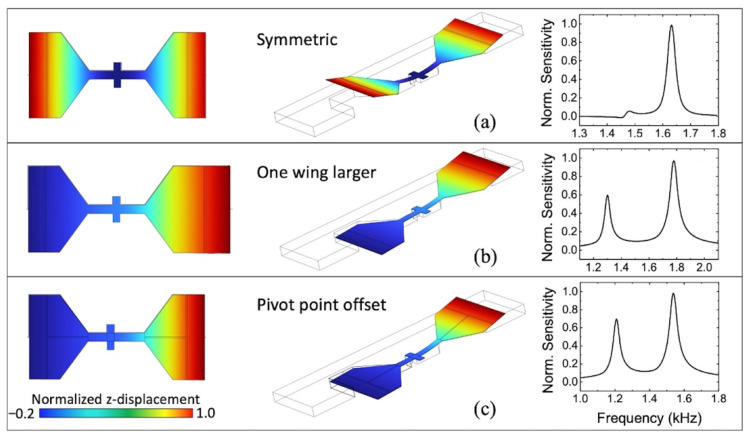
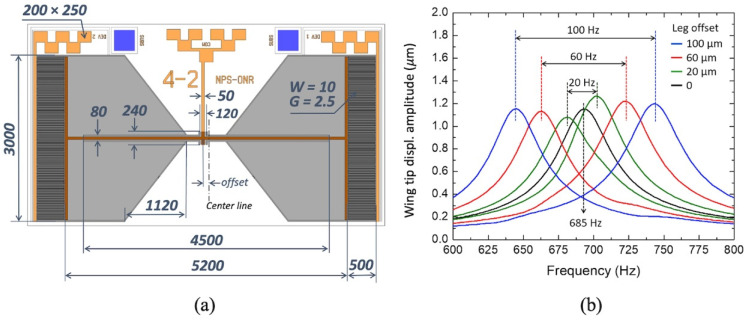
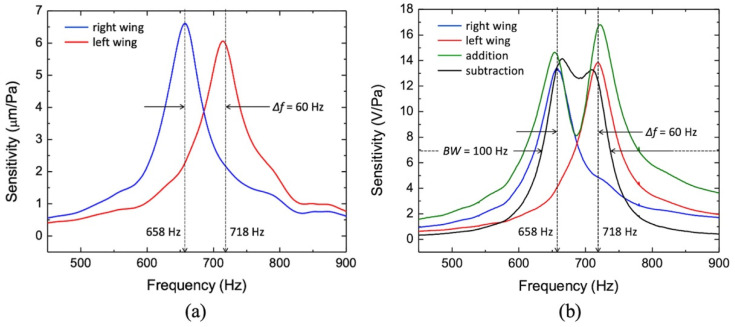
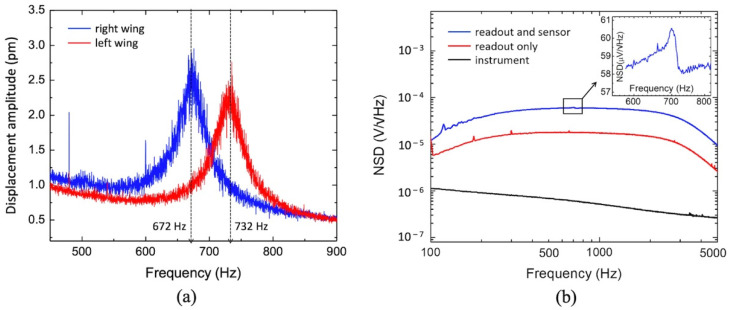
In this paper, we report on the design and characterization of a microelectromechanical systems (MEMS) directional sensor inspired by the tympana configuration of the parasitic fly . The sensor is meant to be operated at resonance and act as a natural filter for the undesirable frequency bands. By means of breaking the symmetry of a pair of coupled bridged membranes, two independent bending vibrational modes can be excited. The electronic output, obtained by the transduction of the vibration to differential capacitance and then voltage through charge amplifiers, can be manipulated to tailor the frequency response of the sensor. Four different frequency characteristics were demonstrated. The sensor exhibits, at resonance, mechanical sensitivity around 6 μm/Pa and electrical sensitivity around 13 V/Pa. The noise was thoroughly characterized, and it was found that the sensor die, rather than the fundamental vibration, induces the predominant part of the noise. The computed average signal-to-noise (SNR) ratio in the pass band is about 91 dB. This result, in combination with an accurate dipole-like directional response, indicates that this type of directional sensor can be designed to exhibit high SNR and selectable frequency responses demanded by different applications.
在本文中,我们报告了一种受寄生蝇鼓膜结构启发的微机电系统(MEMS)方向传感器的设计和特性。该传感器旨在共振工作,并作为对不需要的频带的自然滤波器。通过打破一对耦合桥接膜的对称性,可以激发出两个独立的弯曲振动模式。通过将振动转换为差分电容,然后通过电荷放大器转换为电压,就可以获得电子输出,从而可以调整传感器的频率响应。展示了四种不同的频率特性。在共振时,传感器具有约 6μm/Pa 的机械灵敏度和约 13V/Pa 的电灵敏度。对噪声进行了彻底的表征,发现传感器芯片而不是基本振动引起了噪声的主要部分。在通带内计算出的平均信噪比(SNR)约为 91dB。这一结果,再加上精确的偶极子式方向响应,表明这种类型的方向传感器可以设计为具有高 SNR 和不同应用所需的可选频率响应。