Liu Hua, Zong Chenyu, Sun Jiacheng, Li Haiyang, Qin Guangzhen, Wang Xiaojian, Zhu Jianwei, Yang Yang, Xue Qiang, Liu Xianchen
Department of Radiation Oncology, Affiliated Hospital of Nantong University, Nantong, China.
Department of Orthopedics, Haian Hospital of Traditional Chinese Medicine, Haian, China.
Transl Pediatr. 2022 Jul;11(7):1182-1198. doi: 10.21037/tp-22-253.
Osteosarcoma (OS) is a disease with high mortality in children and adolescents, and metastasis is one of its important clinical features. However, the molecular mechanism of OS occurrence is not completely clear. Thus, we screened potential biomarkers of OS and analyze their prognostic value.
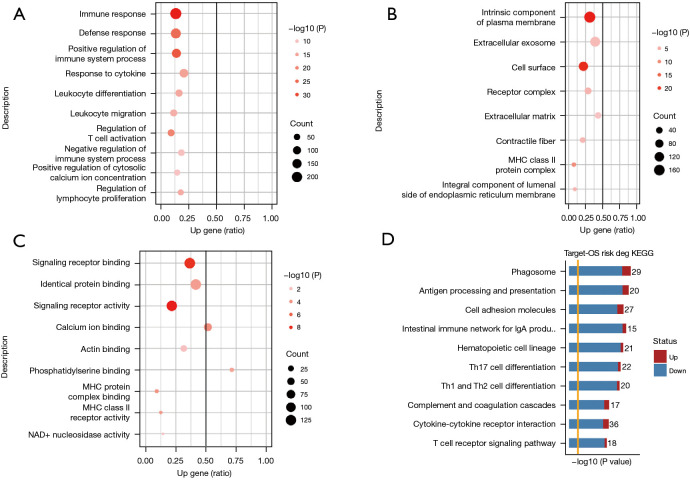
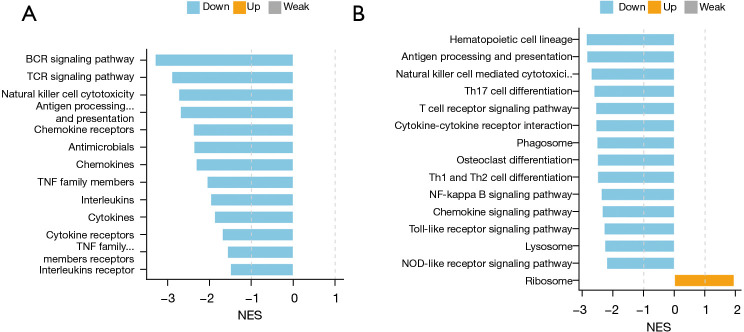
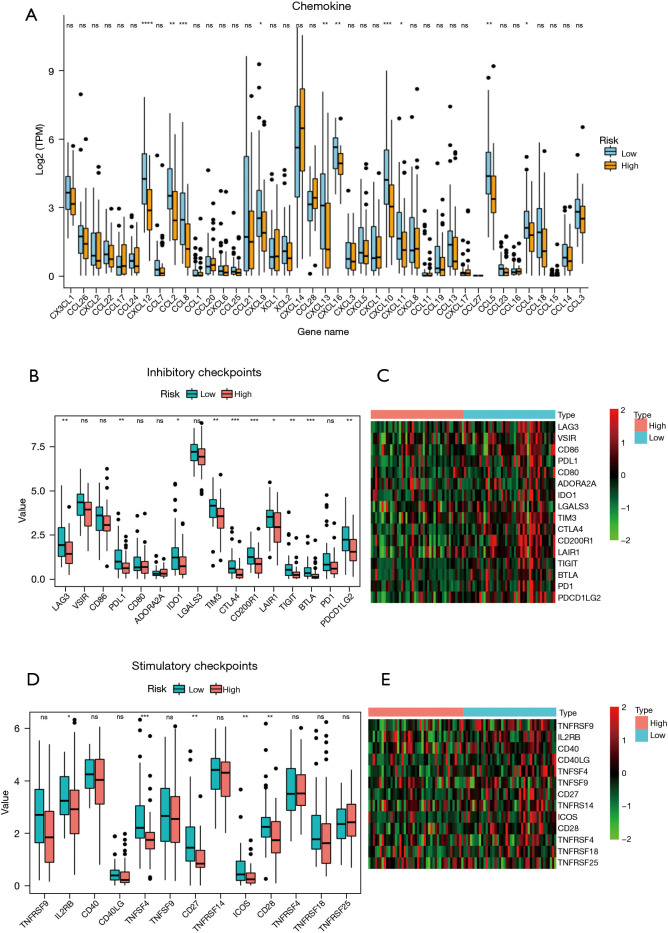
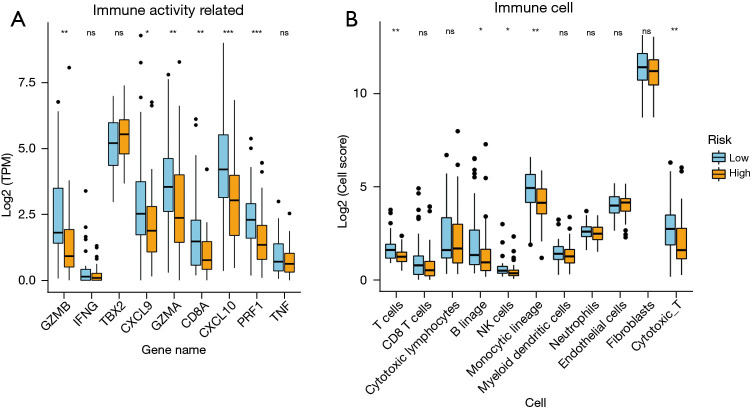
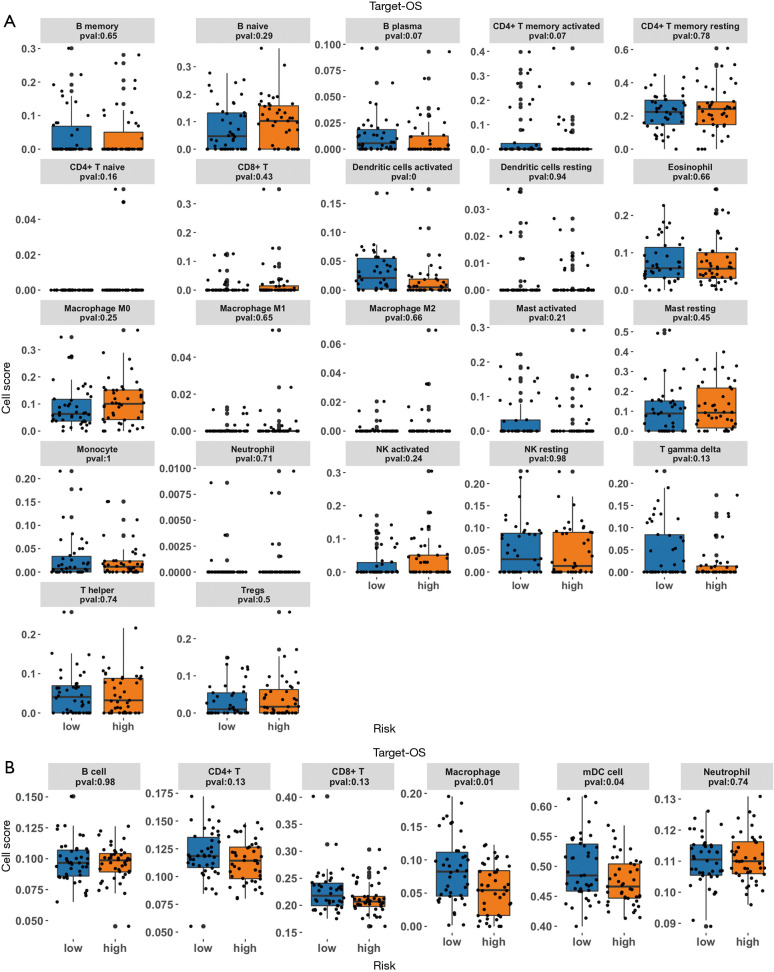
The Cancer Genome Atlas (TCGA) datasets were used to analyze the differential lncRNAs in patients with OS of different immune score and the lncRNAs expressed by immune cells. Cox regression was used to develop the prognosis prediction model and specify the prognosis outcomes. Risk-proportional regression model was constructed, and the samples were divided into high and low groups based on the risk scores for the survival analysis. The areas under the receiver operating characteristic (ROC) curve were calculated and the risk-score model was verified. Finally, using 4 gene sets (comprising chemokines, immune checkpoint blockades, immune activity-related genes, and immune cells), and 4 analysis tools (CIBERSORT, TIMER, XCELL and MCP) to evaluated tumor immune infiltration.
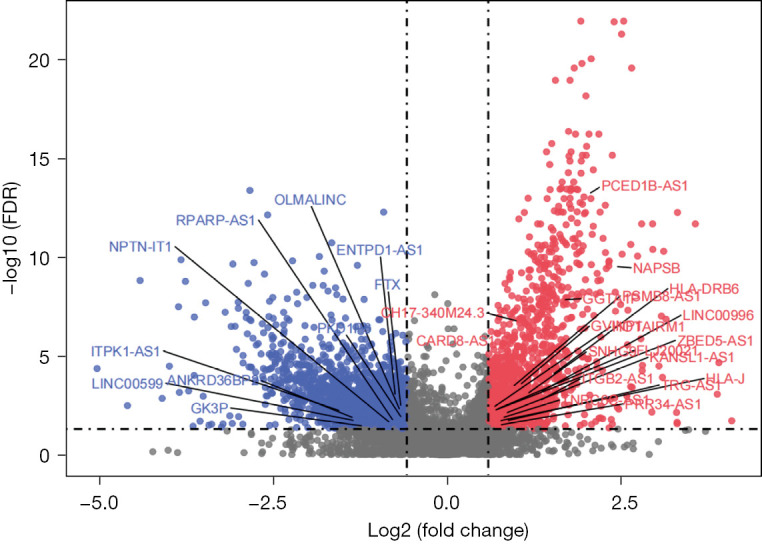
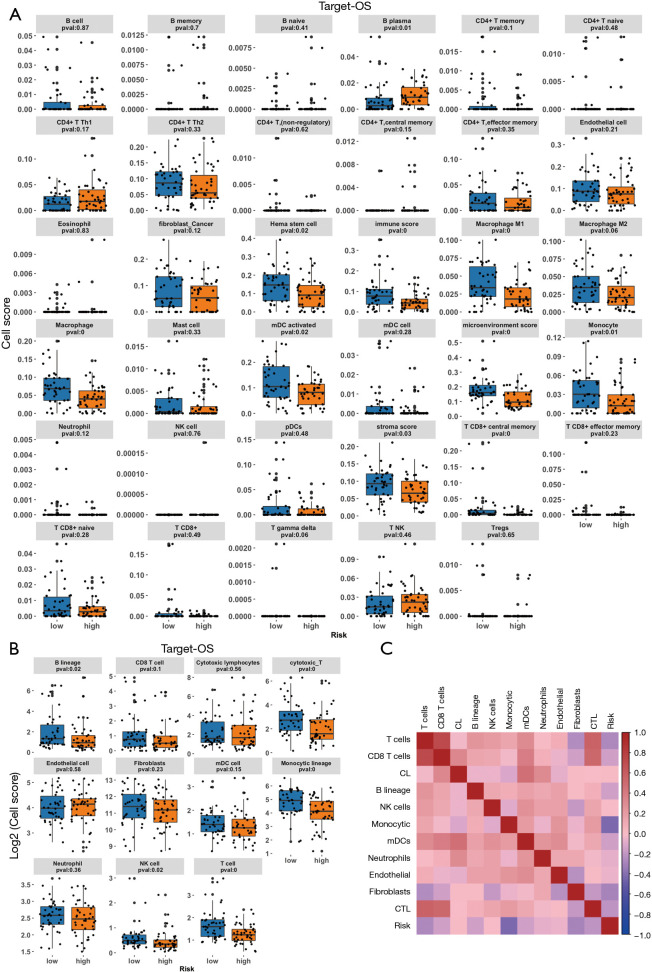
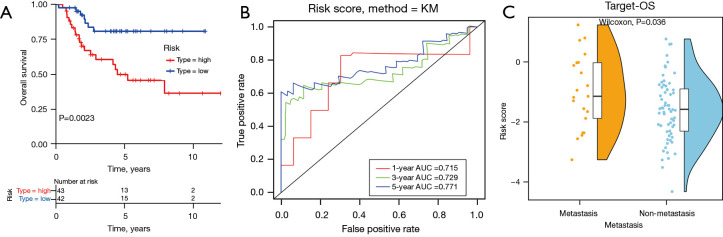
Twenty-nine long non-coding ribonucleic acids (lncRNAs) were obtained from the intersection of the screened lncRNAs. Caspase recruitment domain-containing protein 8-antisense RNA 1 (CARD8-AS1), lncRNA five prime to Xist (FTX), KAT8 regulatory NSL complex unit 1-antisense RNA 1 (KANSL1-AS1), Neuroplastin Intronic Transcript 1 (NPTN-IT1), oligodendrocyte maturation-associated long intervening non-coding RNA (OLMALINC) and RPARP Antisense RNA 1 (RPARP-AS1) were found to be correlated with survival. Univariate and multivariate regression analysis showed risk score [HR (hazard ratio) 3.5, P value 0.0043; HR 3.7, P value 0.0033] and metastasis (HR 4.7, P value 6.60E-05; HR 4.8, P value 8.36E-05) were the key factors of patients with OS. The areas under curves (AUCs) of the 1-, 3-, and 5-year ROC curves of the prognostic model were 0.715, 0.729, and 0.771. The low-risk patients tended to have a high abundance of immune cells.
This study showed that a risk score based on 6 lncRNAs has potential value in the prognosis of OS, and patients with low-risk scores have high immune cell infiltration and good prognosis. This study may enrich understandings of underlying mechanisms related to the occurrence and development of OS.
骨肉瘤(OS)是一种在儿童和青少年中死亡率较高的疾病,转移是其重要的临床特征之一。然而,骨肉瘤发生的分子机制尚不完全清楚。因此,我们筛选了骨肉瘤的潜在生物标志物并分析其预后价值。
利用癌症基因组图谱(TCGA)数据集分析不同免疫评分的骨肉瘤患者中差异表达的长链非编码RNA(lncRNA)以及免疫细胞表达的lncRNA。采用Cox回归建立预后预测模型并明确预后结果。构建风险比例回归模型,根据风险评分将样本分为高风险组和低风险组进行生存分析。计算受试者工作特征(ROC)曲线下面积并验证风险评分模型。最后,使用4个基因集(包括趋化因子、免疫检查点阻断剂、免疫活性相关基因和免疫细胞)以及4种分析工具(CIBERSORT、TIMER、XCELL和MCP)评估肿瘤免疫浸润情况。
从筛选出的lncRNA的交集处获得了29个长链非编码核糖核酸(lncRNA)。发现含半胱天冬酶招募结构域蛋白8反义RNA1(CARD8-AS1)、Xist上游长链非编码RNA(FTX)、KAT8调节性NSL复合体亚基1反义RNA1(KANSL1-AS1)、神经纤连蛋白内含子转录本1(NPTN-IT1)、少突胶质细胞成熟相关长链居间非编码RNA(OLMALINC)和RPARP反义RNA1(RPARP-AS1)与生存相关。单因素和多因素回归分析显示风险评分[风险比(HR)3.5,P值0.0043;HR 3.7,P值0.0033]和转移(HR 4.7,P值6.60E-05;HR 4.8,P值8.36E-05)是骨肉瘤患者的关键因素。预后模型的1年、3年和5年ROC曲线下面积(AUC)分别为0.715、0.729和0.771。低风险患者往往具有较高丰度的免疫细胞。
本研究表明基于6种lncRNA的风险评分在骨肉瘤预后方面具有潜在价值,低风险评分患者免疫细胞浸润高且预后良好。本研究可能丰富对骨肉瘤发生发展相关潜在机制的认识。