Cui Yuqing, Zhang Lu, Lu Chunyu, Dou Mengmeng, Jiao Yulan, Bao Yongzhan, Shi Wanyu
College of Veterinary Medicine, Institute of Traditional Chinese Veterinary Medicine, Hebei Agricultural University, Baoding, China.
Research and Development Department, Ringpu (Baoding) Biological Pharmaceutical Co., Ltd, Baoding, China.
Front Microbiol. 2022 Jul 25;13:959726. doi: 10.3389/fmicb.2022.959726. eCollection 2022.
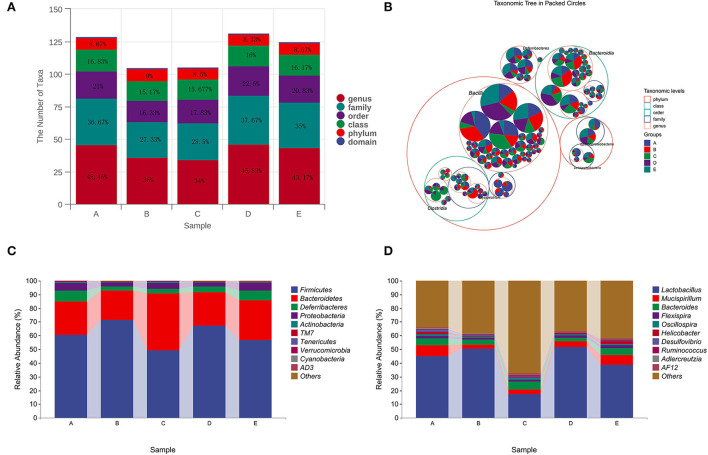
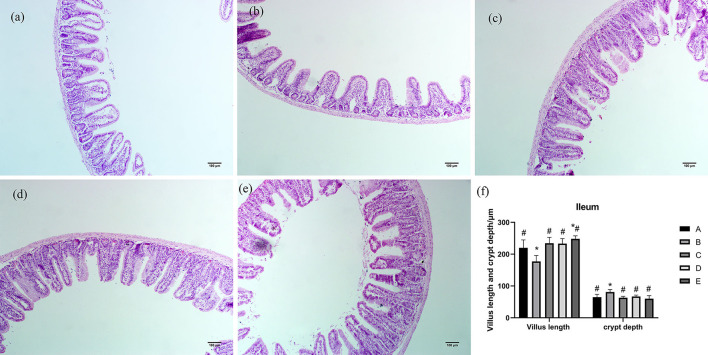
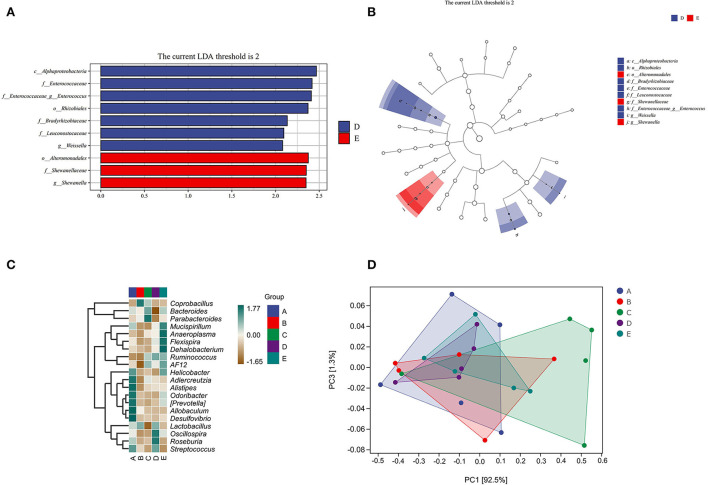
The study was designed to explore the improvement effect of CSPCM (compound small peptide of Chinese medicine) on intestinal immunity and microflora through the treatment of different doses of CSPCM. A total of 100 male Kunming mice were weighed and divided into five groups, namely, group A (control group), group B (model group), group C (0.1 g/kg·bw CSPCM), group D (0.2 g/kg·bw CSPCM), and group E (0.4 g/kg·bw CSPCM). The use of CTX (cyclophosphamide) caused a series of negative effects: the secretion of IL-2, IL-22, TNF-α, sIgA, length of the villi, and the area of Pey's node were significantly reduced ( < 0.05); the depth of crypt and the percent of CD3 and CD4 cells were significantly increased ( < 0.05); the cecal flora taxa decreased; the abundance of and increased; and the abundance of , and decreased. The addition of CSPCM improved the secretion of cytokines and the development of intestinal villi, crypts, and Pey's node. The number of CD3 and CD4 cells in groups C, D, and E was significantly higher than that in group B ( < 0.05). Compared with group B, the abundance of in groups C, D, and E was decreased, and the , and increased. The abundance of decreased, while that of , and increased. It is concluded that cyclophosphamide is extremely destructive to the intestinal area and has a great negative impact on the development of the small intestine, the intestinal immune system, and the intestinal flora. The CSPCM can improve the negative effects of CTX.
本研究旨在通过不同剂量的复方中药小肽(CSPCM)治疗,探讨其对肠道免疫和微生物群的改善作用。共称取100只雄性昆明小鼠,分为五组,即A组(对照组)、B组(模型组)、C组(0.1 g/kg·bw CSPCM)、D组(0.2 g/kg·bw CSPCM)和E组(0.4 g/kg·bw CSPCM)。使用环磷酰胺(CTX)会产生一系列负面影响:白细胞介素-2(IL-2)、白细胞介素-22(IL-22)、肿瘤坏死因子-α(TNF-α)、分泌型免疫球蛋白A(sIgA)的分泌、绒毛长度和派伊尔结面积显著降低(P<0.05);隐窝深度以及CD3和CD4细胞百分比显著增加(P<0.05);盲肠菌群分类群减少;[具体菌种名称1]和[具体菌种名称2]丰度增加;[具体菌种名称3]、[具体菌种名称4]和[具体菌种名称5]丰度降低。添加CSPCM可改善细胞因子分泌以及肠绒毛、隐窝和派伊尔结的发育。C组、D组和E组的CD3和CD4细胞数量显著高于B组(P<0.05)。与B组相比,C组、D组和E组中[具体菌种名称1]丰度降低,[具体菌种名称2]、[具体菌种名称3]和[具体菌种名称4]丰度增加。[具体菌种名称5]丰度降低,而[具体菌种名称6]和[具体菌种名称7]丰度增加。结论是环磷酰胺对肠道区域具有极大的破坏性,对小肠发育、肠道免疫系统和肠道菌群有很大的负面影响。CSPCM可改善CTX的负面影响。