You Jianquan, Qian Fei, Huang Yu, Guo Yingxuan, Lv Yaqian, Yang Yuqi, Lu Xiupan, Guo Ting, Wang Jun, Gu Bin
Emergency Department, Taizhou People's Hospital, Taizhou Pharmaceutical High-Tech Zone, Taizhou 225300, Jiangsu Province, China.
Emergency Department, Taizhou People's Hospital, No. 366 Taihu Road, Taizhou Pharmaceutical High-Tech Zone, Taizhou 225300, Jiangsu Province, China.
Open Med (Wars). 2022 Jul 25;17(1):1338-1349. doi: 10.1515/med-2022-0528. eCollection 2022.
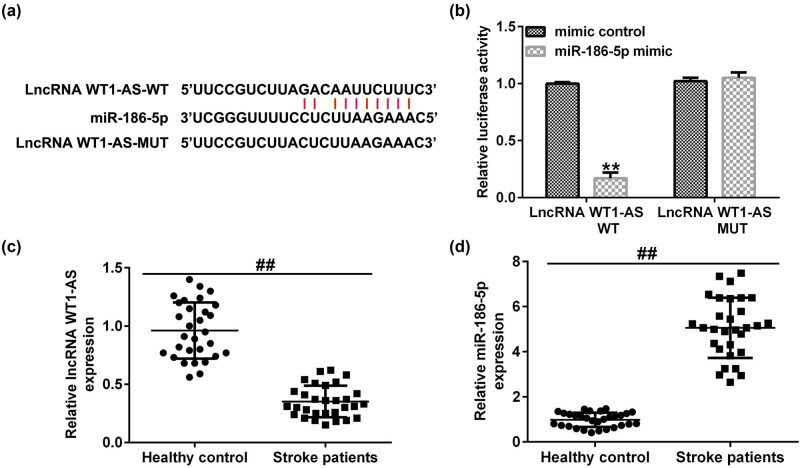
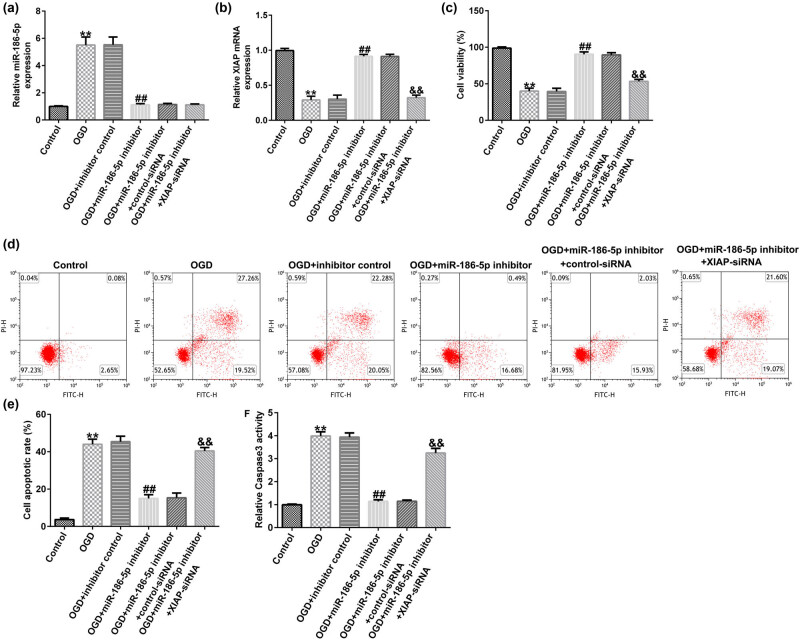
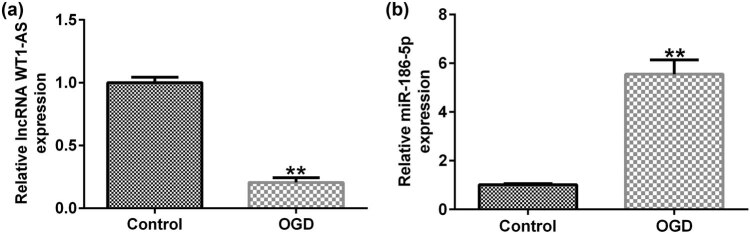
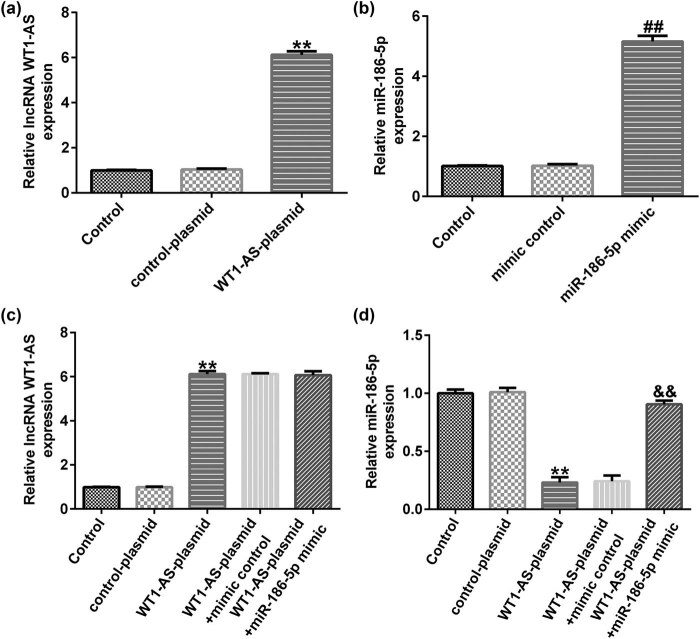
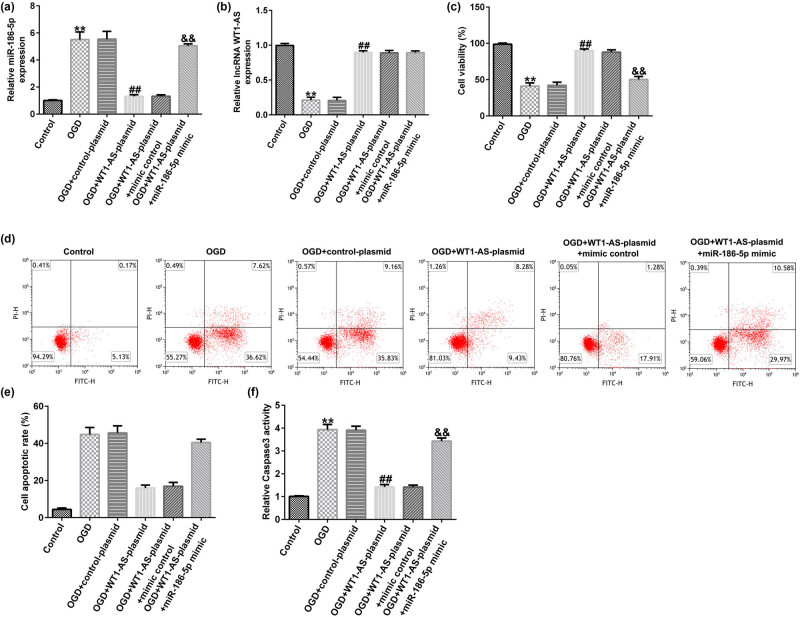
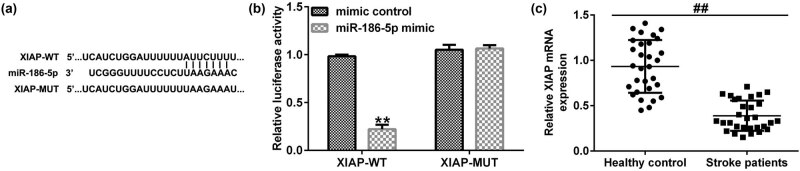
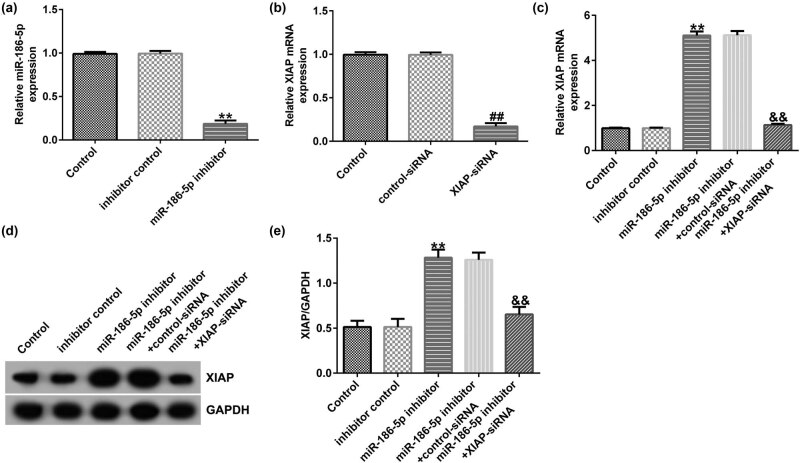
This study aimed to investigate the role and mechanism of long non-coding RNA (lncRNA) WT1 antisense RNA (WT1-AS) in cerebral ischemic stroke. The Starbase database and dual-luciferase reporter gene assay were used to analyze the interaction between lncRNA WT1 antisense RNA (lncRNA WT1-AS) and microRNA-186-5p (miR-186-5p). Reverse transcription-quantitative PCR analysis was performed to determine lncRNA WT1-AS and miR-186-5p levels. An oxygen glucose deprivation (OGD)-induced SH-SY5Y cell injury model was established. Cell viability and apoptosis were determined using 3-(4,5-dimethylthiazol-2-yl)-2,5-diphenyl tetrazolium bromide and flow cytometric assays, respectively. Caspase 3 activity was evaluated using a caspase 3 activity detection kit. The results showed that miR-186-5p is a direct target of the lncRNA WT1-AS. In addition, lncRNA WT1-AS levels were downregulated and miR-186-5p levels were upregulated in the blood samples of patients with ischemic stroke and OGD-induced SH-SY5Y cells. WT1-AS overexpression promoted OGD-induced cell viability and reduced the cell apoptosis and caspase 3 activity. However, these effects were reversed by miR-186-5p overexpression. Furthermore, the results demonstrated that the X-linked inhibitor of apoptosis (XIAP) was directly targeted by miR-186-5p. Similarly, transfection with the miR-186-5p inhibitor reduced OGD-induced neuronal damage by upregulating XIAP expression. In conclusion, lncRNA WT1-AS attenuates hypoxia/ischemia-induced neuronal injury in cerebral ischemic stroke through the miR-186-5p/XIAP axis.
本研究旨在探讨长链非编码RNA(lncRNA)WT1反义RNA(WT1-AS)在脑缺血性卒中中的作用及机制。利用Starbase数据库和双荧光素酶报告基因检测分析lncRNA WT1反义RNA(lncRNA WT1-AS)与微小RNA-186-5p(miR-186-5p)之间的相互作用。采用逆转录定量PCR分析来测定lncRNA WT1-AS和miR-186-5p的水平。建立氧糖剥夺(OGD)诱导的SH-SY5Y细胞损伤模型。分别使用3-(4,5-二甲基噻唑-2-基)-2,5-二苯基四氮唑溴盐和流式细胞术检测来测定细胞活力和凋亡情况。使用半胱天冬酶3活性检测试剂盒评估半胱天冬酶3的活性。结果显示,miR-186-5p是lncRNA WT1-AS的直接靶点。此外,缺血性卒中患者的血液样本和OGD诱导的SH-SY5Y细胞中,lncRNA WT1-AS水平下调,miR-186-5 p水平上调。WT1-AS过表达促进了OGD诱导的细胞活力,降低了细胞凋亡和半胱天冬酶3活性。然而,miR-186-5p过表达逆转了这些作用。此外,结果表明X连锁凋亡抑制蛋白(XIAP)是miR-186-5p的直接靶点。同样,用miR-186-5p抑制剂转染通过上调XIAP表达减轻了OGD诱导的神经元损伤。总之,lncRNA WT1-AS通过miR-186-5p/XIAP轴减轻脑缺血性卒中中缺氧/缺血诱导的神经元损伤。