Retired.
Environment and Climate Change Canada, Vancouver, British Columbia, Canada.
Environ Toxicol Chem. 2022 Nov;41(11):2649-2657. doi: 10.1002/etc.5462. Epub 2022 Sep 30.
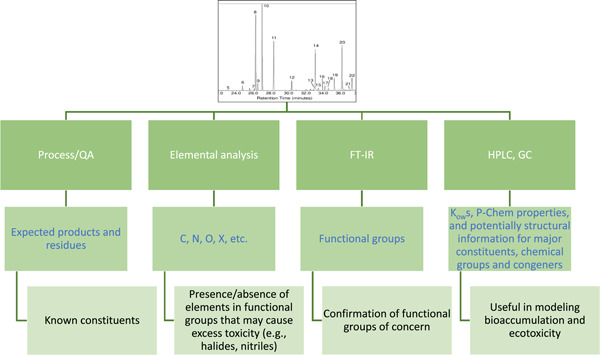
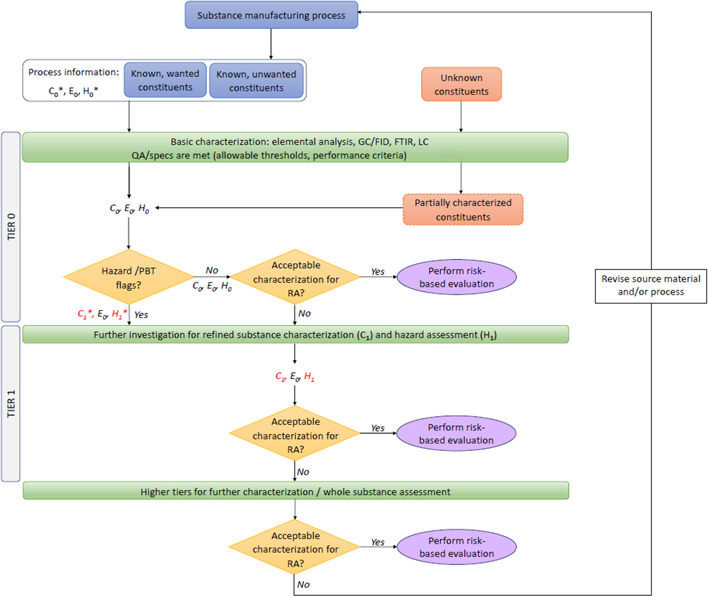
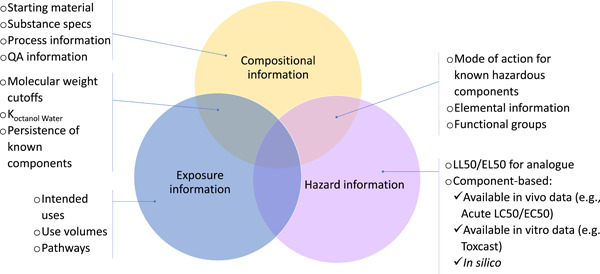
Substances of unknown or variable composition, complex reaction products, and biological materials (UVCBs) pose a unique challenge to regulators and to product registrants, who are required to characterize their fate, exposure, hazard, and potential risks to human health and the environment. To address these challenges and ensure an efficient and fit-for-purpose process, it is proposed that the ecological risks of UVCBs be assessed following a tiered strategy. The development of this approach required exploring how substance composition ties into hazard and exposure information and determining the extent to which a UVCB needs to be characterized to ensure a robust risk assessment. The present study highlights the key aspects of this new method. It presents how a tiered substance characterization approach can be integrated into broader UVCB risk-assessment schemes to encourage an examination of data needs before a full substance characterization is performed. The first tier of the characterization process, Tier 0, is a fundamental step that includes data from basic, lower-resolution compositional analyses. Tier 0 assessments can be used to inform hazard and exposure for any substance of interest. The need for more sophisticated, higher-tier characterization is determined by the level of uncertainty of the risk assessment. The next step will integrate a tiered exposure assessment into the characterization scheme featured in the present study, to create a more complete risk-assessment framework. Environ Toxicol Chem 2022;41:2649-2657. © 2022 Her Majesty the Queen in Right of Canada, Health and Environmental Sciences Institute and The Authors. Environmental Toxicology and Chemistry published by Wiley Periodicals LLC on behalf of SETAC. Reproduced with the permission of the Minister of Environment and Climate Change Canada.
未知或可变成分物质、复杂反应产物和生物材料(UVCBs)给监管机构和产品注册人带来了独特的挑战,他们需要对这些物质的命运、暴露、危害以及对人类健康和环境的潜在风险进行特征描述。为了应对这些挑战并确保高效且适合目的的流程,建议按照分层策略评估 UVCBs 的生态风险。开发这种方法需要探索物质成分如何与危害和暴露信息相关联,并确定需要对 UVCB 进行多大程度的特征描述以确保稳健的风险评估。本研究强调了这种新方法的关键方面。它展示了分层物质特征描述方法如何融入更广泛的 UVCB 风险评估方案,以鼓励在进行全面物质特征描述之前检查数据需求。特征描述过程的第一级,即 Tier 0,是一个基本步骤,包括基本的、低分辨率的成分分析数据。Tier 0 评估可用于为任何感兴趣的物质提供危害和暴露信息。风险评估不确定性的程度决定了是否需要进行更复杂的、更高层次的特征描述。下一步将把分层暴露评估纳入本研究中特征描述方案,以创建更完整的风险评估框架。Environ Toxicol Chem 2022;41:2649-2657. © 2022 加拿大女王陛下、健康与环境科学协会和作者。环境毒理学和化学由 Wiley Periodicals LLC 代表 SETAC 出版。经加拿大环境与气候变化部部长许可转载。