University of California San Francisco Helen Diller Family Comprehensive Cancer Center, San Francisco, USA.
IRCCS Ospedale San Raffaele, Milan, Italy; Università Vita-Salute San Raffaele, Milan, Italy.
ESMO Open. 2022 Aug;7(4):100553. doi: 10.1016/j.esmoop.2022.100553. Epub 2022 Aug 11.
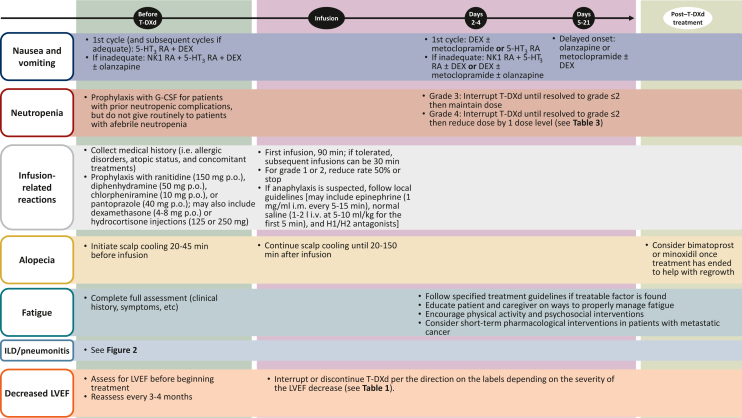
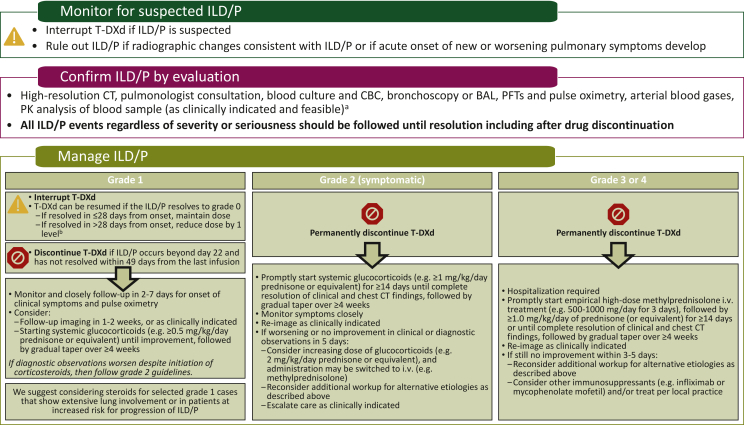
The antibody-drug conjugate trastuzumab deruxtecan (T-DXd) targets human epidermal growth factor receptor 2 (HER2) and has been evaluated in patients with HER2-positive unresectable/metastatic breast cancer in the phase II DESTINY-Breast01 trial (NCT03248492; DS8201-A-U201) and the randomized phase III DESTINY-Breast03 trial (NCT03529110; DS8201-A-U302). Approximately 20 additional studies are ongoing in breast cancer, including HER2-low breast cancer, and other solid tumor types within the DESTINY trial program. T-DXd has demonstrated a generally manageable safety profile, with low-grade hematologic and gastrointestinal adverse events (AEs) among the most common; interstitial lung disease (ILD)/pneumonitis has been observed in patients receiving T-DXd and can be severe. This review discusses the management of common AEs and AEs of special interest in patients with HER2-positive unresectable/metastatic breast cancer, including nausea and vomiting, neutropenia, infusion-related reactions, alopecia, fatigue, ILD/pneumonitis, and left ventricular dysfunction.
Expert opinions, institutional protocols, and strategies to help optimize AE management and maximize the potential benefits of T-DXd in patients with breast cancer from five oncologists treating patients with T-DXd in North America and Europe are discussed.
Prophylaxis for nausea and vomiting and proactive management of ILD/pneumonitis are especially important in treating patients with T-DXd. Management strategies for other T-DXd-related AEs of interest (e.g. neutropenia, infusion-related reactions, alopecia, fatigue, and left ventricular dysfunction) are also discussed.
This review provides context for understanding the usage, monitoring, and management practices of other health care providers and institutions with experience using T-DXd to help with safe and effective management of T-DXd-related AEs, particularly since the duration of T-DXd treatment may be quite long. Proper management of T-DXd-related AEs will allow optimal exposure and benefit from T-DXd and will help avoid premature discontinuation or improper dose reductions.
抗体药物偶联物 trastuzumab deruxtecan(T-DXd)针对人表皮生长因子受体 2(HER2),在 II 期 DESTINY-Breast01 试验(NCT03248492;DS8201-A-U201)和随机 III 期 DESTINY-Breast03 试验(NCT03529110;DS8201-A-U302)中已评估其用于 HER2 阳性不可切除/转移性乳腺癌患者。大约有 20 项额外的研究正在进行中,包括 HER2 低表达乳腺癌以及 DESTINY 试验项目中的其他实体瘤类型。T-DXd 表现出总体可管理的安全性特征,最常见的是低级别血液学和胃肠道不良事件(AE);接受 T-DXd 治疗的患者观察到间质性肺病(ILD)/肺炎,并且可能很严重。本文讨论了 HER2 阳性不可切除/转移性乳腺癌患者中常见 AE 和特殊关注 AE 的管理,包括恶心和呕吐、中性粒细胞减少、输注相关反应、脱发、疲劳、ILD/肺炎和左心室功能障碍。
来自北美和欧洲的五位治疗 T-DXd 患者的肿瘤学家讨论了他们的专家意见、机构方案和策略,以帮助优化 AE 管理并最大限度地提高 T-DXd 在乳腺癌患者中的潜在获益。
预防恶心和呕吐以及积极管理 ILD/肺炎在治疗 T-DXd 患者时尤为重要。还讨论了其他 T-DXd 相关关注 AE(例如中性粒细胞减少、输注相关反应、脱发、疲劳和左心室功能障碍)的管理策略。
本文为了解其他医疗保健提供者和机构使用 T-DXd 的用法、监测和管理实践提供了背景,有助于安全有效地管理 T-DXd 相关 AE,特别是因为 T-DXd 治疗的持续时间可能很长。适当管理 T-DXd 相关 AE 将使 T-DXd 获得最佳暴露和获益,并有助于避免过早停药或剂量不当减少。