UCSF Helen Diller Family Comprehensive Cancer Center, University of California, San Francisco, San Francisco, CA.
Huntsman Cancer Institute at the University of Utah, Salt Lake City, UT.
JCO Oncol Pract. 2023 Aug;19(8):539-546. doi: 10.1200/OP.22.00480. Epub 2023 May 19.
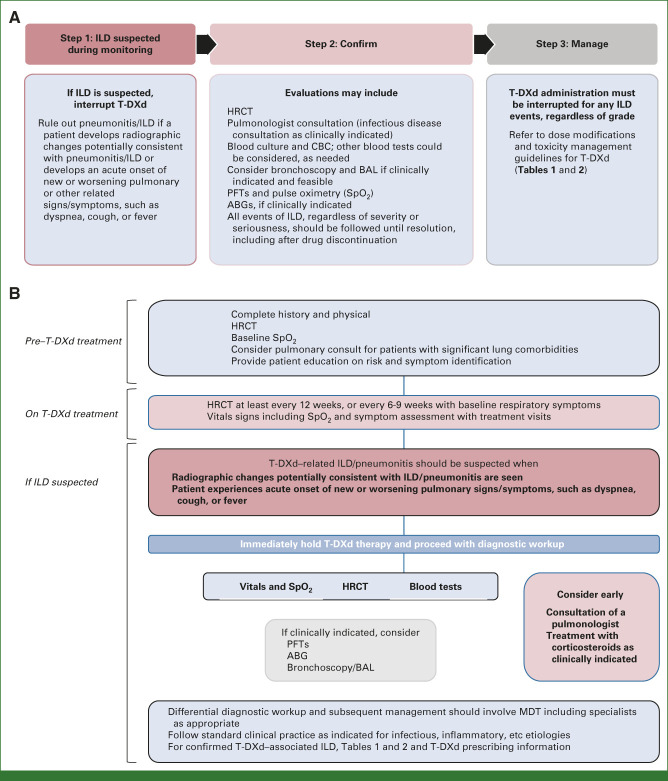
Trastuzumab deruxtecan (T-DXd) is an antibody drug conjugate with a topoisomerase I payload that targets the human epidermal growth factor receptor 2 (HER2). T-DXd is approved for patients with previously treated HER2-positive or HER2-low (immunohistochemistry [IHC] 1+ or IHC 2+/ISH-) metastatic/unresectable breast cancer (BC). In a second-line HER2-positive metastatic BC (mBC) population (DESTINY-Breast03 [ClinicalTrials.gov identifier: NCT03529110]), T-DXd demonstrated significantly improved progression-free survival (PFS) over ado-trastuzumab emtansine (12-month rate: 75.8% 34.1%; hazard ratio, 0.28; < .001), and in patients with HER2-low mBC treated with one prior line of chemotherapy (DESTINY-Breast04 [ClinicalTrials.gov identifier: NCT03734029]), T-DXd demonstrated significantly longer PFS and overall survival than physician's choice chemotherapy (10.1 5.4 months; hazard ratio, 0.51; < .001, and 23.4 16.8 months; hazard ratio, 0.64; < .001, respectively).Interstitial lung disease (ILD) is an umbrella term used for a group of diseases characterized by lung injury including pneumonitis, which can lead to irreversible lung fibrosis. ILD is a well-described adverse event associated with certain anticancer therapies, including T-DXd. An important part of T-DXd therapy for mBC consists of monitoring for and managing ILD. Although information on ILD management strategies is included in the prescribing information, additional information on patient selection, monitoring, and treatment can be beneficial in routine clinical practice. The objective of this review is to describe real-world, multidisciplinary clinical practices and institutional protocols used for patient selection/screening, monitoring, and management related to T-DXd-associated ILD.
曲妥珠单抗-美坦新偶联物(T-DXd)是一种抗体药物偶联物,含有拓扑异构酶 I 有效载荷,靶向人表皮生长因子受体 2(HER2)。T-DXd 获批用于治疗先前接受过治疗的 HER2 阳性或 HER2 低表达(免疫组织化学 [IHC] 1+或 IHC 2+/ISH-)转移性/不可切除乳腺癌(BC)患者。在二线 HER2 阳性转移性 BC(mBC)人群(DESTINY-Breast03[ClinicalTrials.gov 标识符:NCT03529110])中,与 ado-曲妥珠单抗emtansine(12 个月率:75.8%比 34.1%;风险比,0.28;<.001)相比,T-DXd 显著改善了无进展生存期(PFS),在接受过一线化疗的 HER2 低表达 mBC 患者中(DESTINY-Breast04[ClinicalTrials.gov 标识符:NCT03734029]),T-DXd 与医生选择的化疗相比,PFS 和总生存期显著延长(10.1 比 5.4 个月;风险比,0.51;<.001,和 23.4 比 16.8 个月;风险比,0.64;<.001)。间质性肺病(ILD)是一组以肺损伤为特征的疾病的总称,包括肺炎,可导致不可逆转的肺纤维化。ILD 是与某些抗癌疗法相关的一种已充分描述的不良事件,包括 T-DXd。mBC 中 T-DXd 治疗的一个重要部分包括监测和管理ILD。尽管ILD 管理策略的信息包含在处方信息中,但有关患者选择、监测和治疗的其他信息在常规临床实践中可能会有所帮助。本综述的目的是描述用于 T-DXd 相关 ILD 患者选择/筛查、监测和管理的真实世界、多学科临床实践和机构方案。