Sabatier Renaud, Garnier Séverine, Guille Arnaud, Carbuccia Nadine, Pakradouni Jihane, Adelaide José, Provansal Magali, Cappiello Maria, Rousseau Frédérique, Chaffanet Max, Birnbaum Daniel, Mamessier Emilie, Gonçalves Anthony, Bertucci François
Aix-Marseille Univ, Inserm, CNRS, Institut Paoli-Calmettes, CRCM-Predictive Oncology Laboratory, Marseille, France.
Aix-Marseille Univ, Inserm, CNRS, Institut Paoli-Calmettes-Department of Medical Oncology, CRCM, Marseille, France.
Front Oncol. 2022 Jul 29;12:946257. doi: 10.3389/fonc.2022.946257. eCollection 2022.
The poor prognosis of ovarian carcinoma (OvC) is due to the advanced stage at diagnosis, a high risk of relapse after first-line therapies, and the lack of efficient treatments in the recurrence setting. Circulating tumor DNA (ctDNA) analysis is a promising tool to assess treatment-resistant OvC and may avoid iterative tissue biopsies. We aimed to evaluate the genomic profile of recurrent heavily pre-treated OvC.
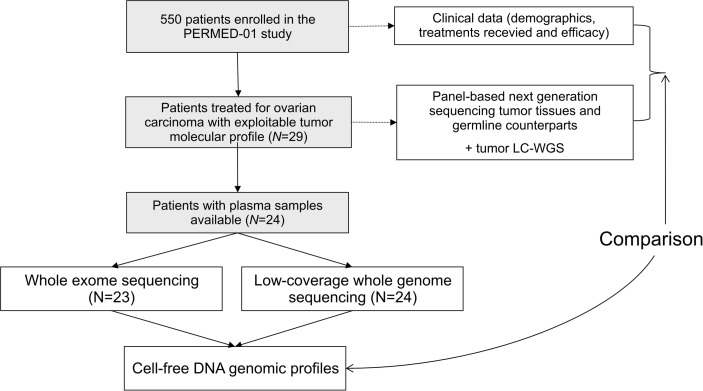
We performed tumor panel-based sequencing as well as low-coverage whole-genome sequencing (LC-WGS) of tumor and plasma collected in patients with ovarian cancer included in the PERMED-01 trial. Whole-exome sequencing (WES) data of plasma samples were also analyzed and compared to mutation and copy number alteration (CNA) tumor profiles. The prognostic value [progression-free survival (PFS)] of these alterations was assessed in an exploratory analysis.
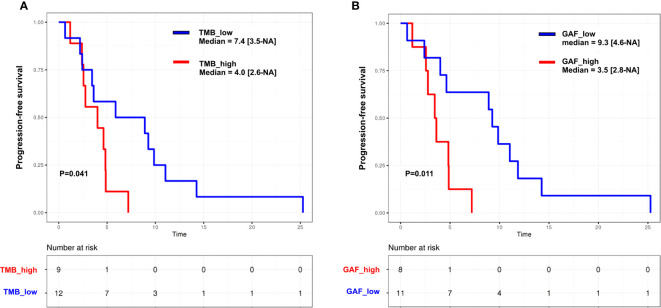
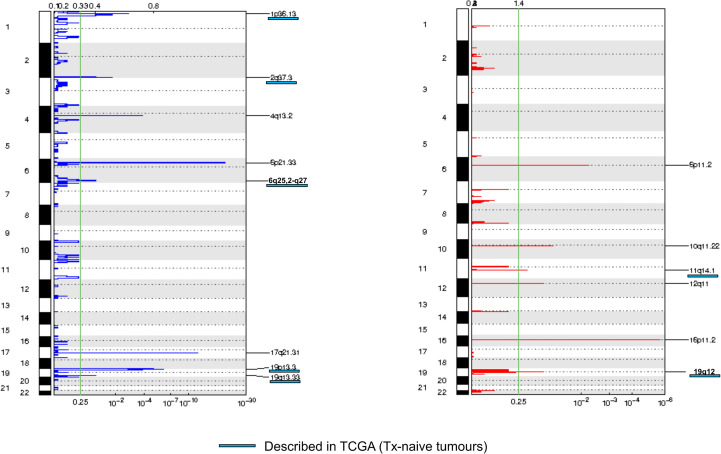
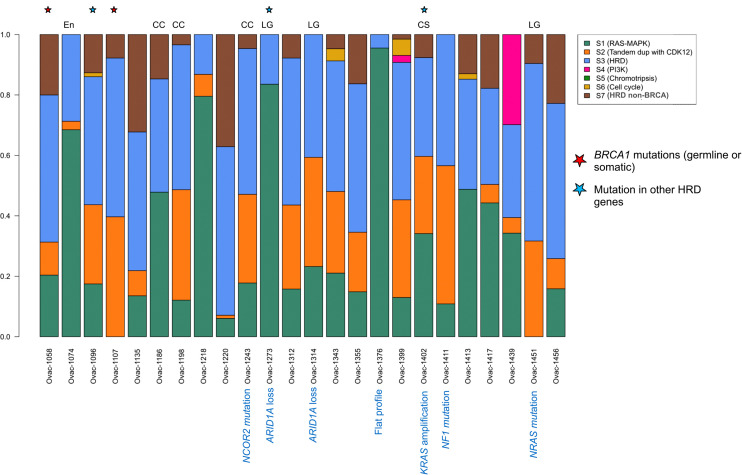
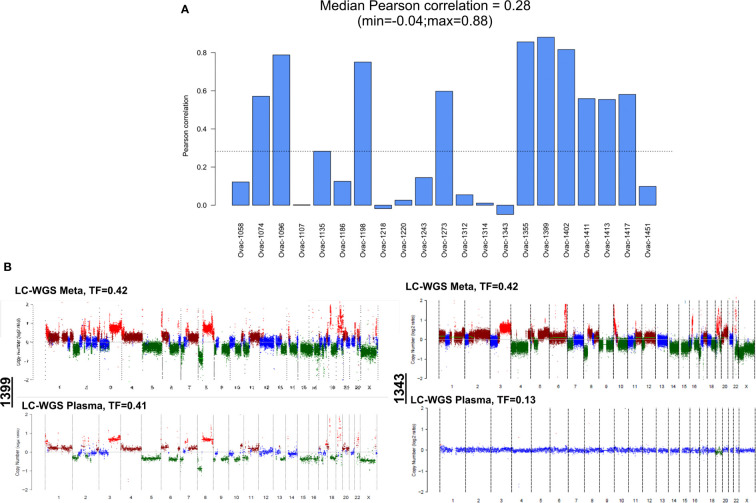
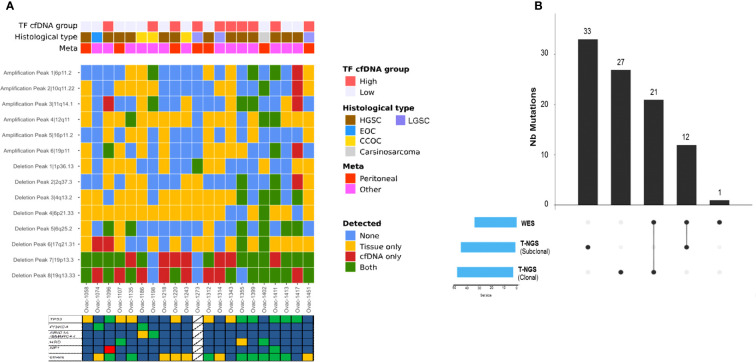
Tumor and plasma genomic analyses were done for 24 patients with heavily pretreated OvC [67% high-grade serous carcinoma (HGSC)]. Tumor mutation burden was low (median 2.04 mutations/Mb) and the most frequent mutated gene was (94% of HGSC). Tumor CNAs were frequent with a median of 50% of genome altered fraction. Plasma LC-WGS and WES detected ctDNA in 21/24 cases (88%) with a median tumor fraction of 12.7%. We observed a low correlation between plasma and tumor CNA profiles. However, this correlation was significant in cases with the highest circulating tumor fraction. Plasma genome altered fraction and plasma mutation burden ( = 0.011 and = 0.041, respectively, log-rank tests) were associated with PFS.
Combination of LC-WGS and WES can detect ctDNA in most pre-treated OvCs. Some ctDNA characteristics, such as genome altered fraction and plasma mutation burden, showed prognostic value. ctDNA assessment with LC-WGS may be a promising and non-expansive tool to evaluate disease evolution in this disease with high genomic instability.
https://clinicaltrials.gov/ct2/show/NCT02342158, identifier NCT02342158.
卵巢癌(OvC)预后较差,原因在于诊断时已处于晚期、一线治疗后复发风险高以及复发时缺乏有效的治疗方法。循环肿瘤DNA(ctDNA)分析是评估耐药性卵巢癌的一种有前景的工具,并且可以避免反复进行组织活检。我们旨在评估经过大量前期治疗的复发性卵巢癌的基因组特征。
我们对纳入PERMED - 01试验的卵巢癌患者所采集的肿瘤组织和血浆进行了基于肿瘤基因panel的测序以及低覆盖度全基因组测序(LC - WGS)。还分析了血浆样本的全外显子测序(WES)数据,并与肿瘤的突变和拷贝数改变(CNA)图谱进行比较。在探索性分析中评估了这些改变的预后价值[无进展生存期(PFS)]。
对24例经过大量前期治疗的卵巢癌患者进行了肿瘤和血浆基因组分析[67%为高级别浆液性癌(HGSC)]。肿瘤突变负荷较低(中位数为2.04个突变/Mb),最常发生突变的基因是 (94%的HGSC)。肿瘤CNA常见,基因组改变部分的中位数为50%。血浆LC - WGS和WES在21/24例(88%)中检测到ctDNA,肿瘤分数中位数为12.7%。我们观察到血浆和肿瘤CNA图谱之间的相关性较低。然而,在循环肿瘤分数最高的病例中这种相关性显著。血浆基因组改变部分和血浆突变负荷(对数秩检验,分别为 = 0.011和 = 0.041)与PFS相关。
LC - WGS和WES相结合能够在大多数经过前期治疗的卵巢癌中检测到ctDNA。一些ctDNA特征,如基因组改变部分和血浆突变负荷,显示出预后价值。采用LC - WGS进行ctDNA评估可能是一种有前景且成本不高的工具,用于评估这种具有高基因组不稳定性疾病的病情进展。
https://clinicaltrials.gov/ct2/show/NCT02342158,标识符NCT02342158。