Teller Johannes, Jung Carolin, Wilke Justus B H, Schimmelpfennig Svea-Dorothée, Hindermann Martin, Hinken Lukas, Gabriel Maria M, Fegbeutel Christine, Schäfer Andreas, Laser Hans, Lichtinghagen Ralf, Worthmann Hans, Weissenborn Karin, Ehrenreich Hannelore
Department of Neurology, Hannover Medical School, Hannover, Germany.
Department of Anesthesiology and Intensive Care Medicine, Hannover Medical School, Hannover, Germany.
Brain Behav Immun Health. 2022 Aug 4;24:100494. doi: 10.1016/j.bbih.2022.100494. eCollection 2022 Oct.
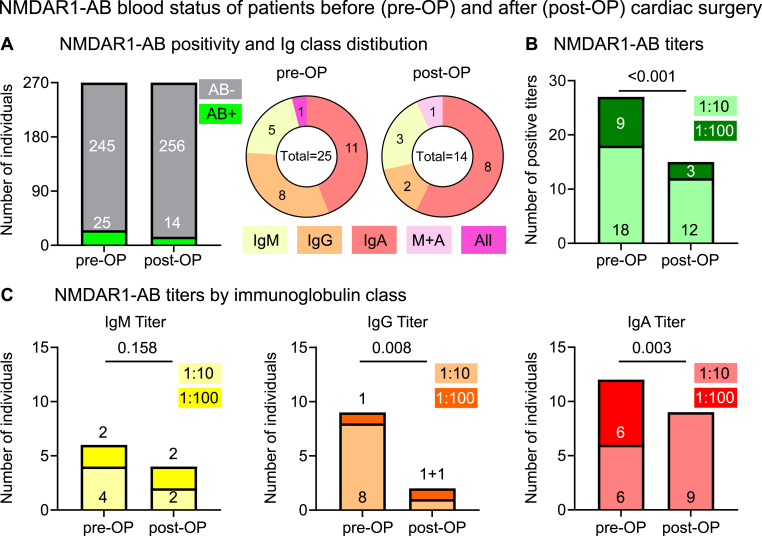
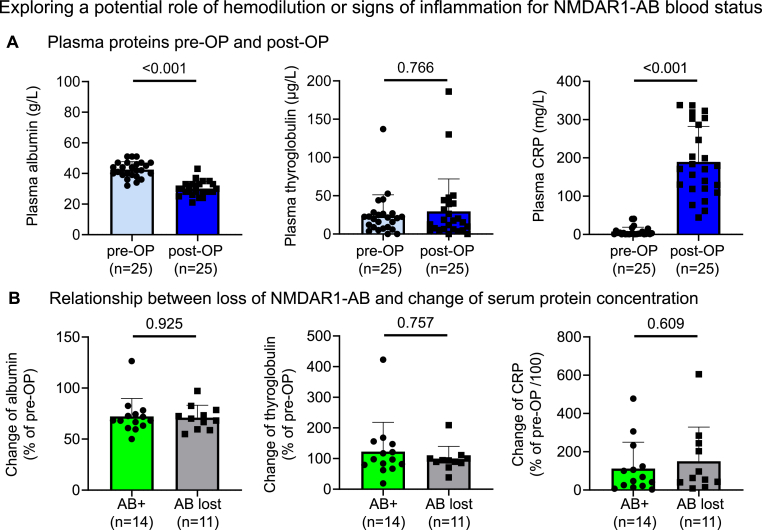
Anesthetics penetrate the blood-brain-barrier (BBB) and - as confirmed preclinically - transiently disrupt it. An analogous consequence in humans has remained unproven. In mice, we previously reported that upon BBB dysfunction, the brain acts as 'immunoprecipitator' of autoantibodies against N-methyl-D-aspartate-receptor subunit-NR1 (NMDAR1-AB). We thus hypothesized that during human anesthesia, pre-existing NMDAR1-AB will specifically bind to brain. Screening of N = 270 subjects undergoing general anesthesia during cardiac surgery for serum NMDAR1-AB revealed N = 25 NMDAR1-AB seropositives. Only N = 14 remained positive post-surgery. No changes in albumin, thyroglobulin or CRP were associated with reduction of serum NMDAR1-AB. Thus, upon anesthesia, BBB opening likely occurs also in humans.
麻醉剂可穿透血脑屏障(BBB),并且正如临床前研究所证实的那样,会使其暂时遭到破坏。在人类身上是否会出现类似后果尚无定论。我们之前在小鼠身上发现,血脑屏障功能障碍时,大脑会成为抗N-甲基-D-天冬氨酸受体亚基-NR1(NMDAR1-AB)自身抗体的“免疫沉淀剂”。因此我们推测,在人类麻醉期间,预先存在的NMDAR1-AB会特异性地与大脑结合。对270名接受心脏手术全身麻醉的受试者的血清NMDAR1-AB进行筛查,发现有25名NMDAR1-AB血清阳性者。术后只有14人仍为阳性。白蛋白、甲状腺球蛋白或CRP的变化与血清NMDAR1-AB的减少无关。因此,在麻醉时,人类可能也会出现血脑屏障开放的情况。