Zhang Jie, Wang Xinyi, Tian Wende, Wang Tongxin, Jia Jundi, Lai Runmin, Wang Tong, Zhang Zihao, Song Luxia, Ju Jianqing, Xu Hao
National Clinical Research Center for Chinese Medicine Cardiology, Xiyuan Hospital, China Academy of Chinese Medical Sciences, Beijing, China.
Graduate School, Beijing University of Chinese Medicine, Beijing, China.
Front Cardiovasc Med. 2022 Jul 27;9:936817. doi: 10.3389/fcvm.2022.936817. eCollection 2022.
The objective of this study was to measure the efficacy of various types and dosages of statins on C-reactive protein (CRP) levels in patients with dyslipidemia or coronary heart disease.
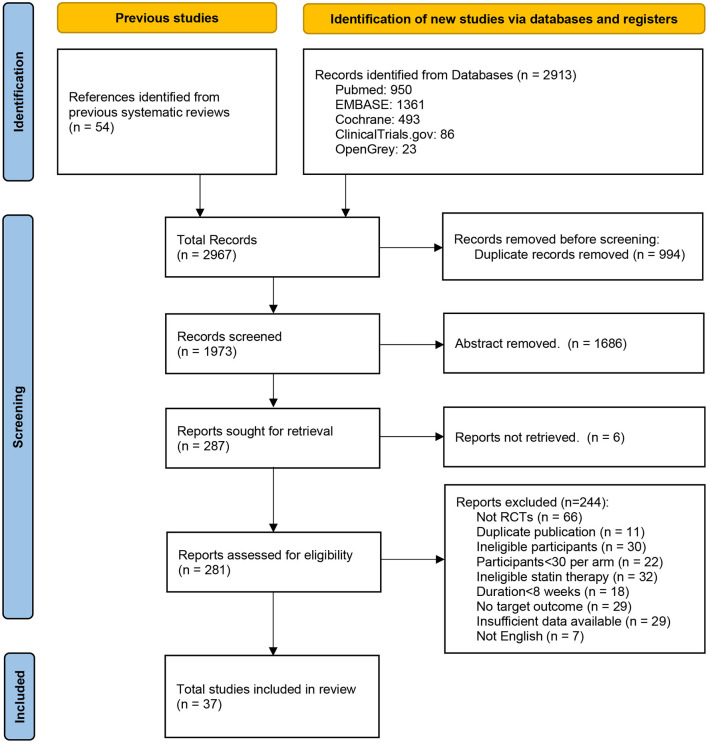
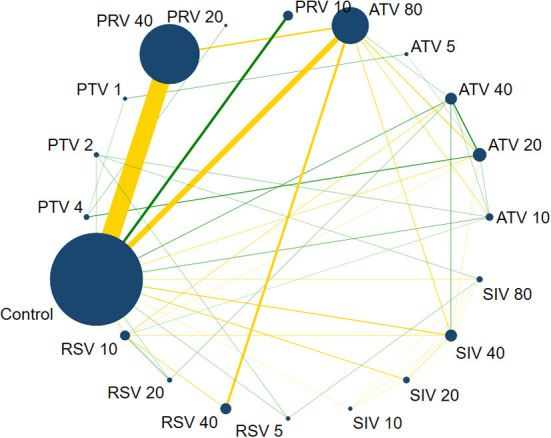
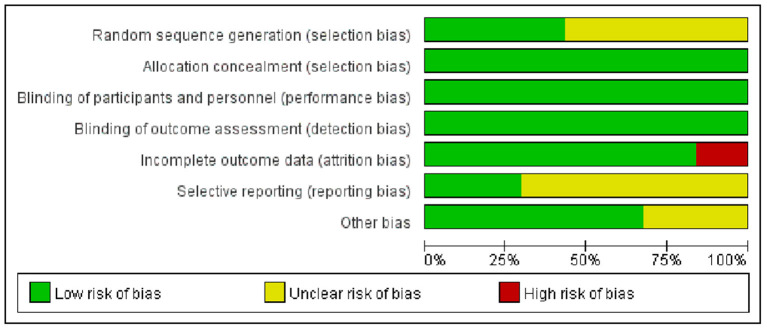
Randomized controlled trials were searched from PubMed, Embase, Cochrane Library, OpenGray, and ClinicalTrials.gov. We followed the Preferred Reporting Items for Systematic Reviews and Meta-Analyses guidelines for data extraction and synthesis. The pairwise meta-analysis compared statins and controls using a random-effects model, and a network meta-analysis compared the types and dosages of statins using the Bayesian random-effects model. The PROSPERO registration number is CRD42021242067.
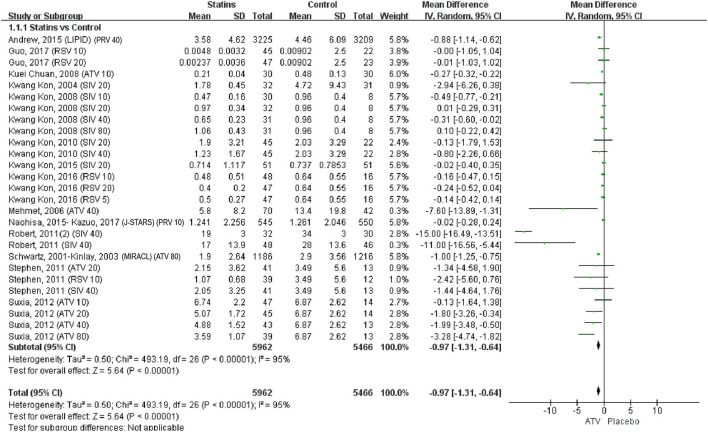
The study included 37 randomized controlled trials with 17,410 participants and 20 interventions. According to the pairwise meta-analysis, statins significantly decreased CRP levels compared to controls (weighted mean difference [WMD] = -0.97, 95% confidence interval [CI] [-1.31, -0.64], < 0.0001). In the network meta-analysis, simvastatin 40 mg/day appeared to be the best strategy for lowering CRP (Rank = 0.18, WMD = -4.07, 95% CI = [-6.52, -1.77]). The same was true for the high-sensitivity CRP, non-acute coronary syndrome (ACS), <12 months duration, and clear measurement subgroups. In the CRP subgroup (rank = 0.79, WMD = -1.23, 95% CI = [-2.48, -0.08]) and ≥12-month duration subgroup (Rank = 0.40, WMD = -2.13, 95% CI = [-4.24, -0.13]), atorvastatin 80 mg/day was most likely to be the best. There were no significant differences in the dyslipidemia and ACS subgroups ( > 0.05). Node-splitting analysis showed no significant inconsistency ( > 0.05), except for the coronary heart disease subgroup.
Statins reduced serum CRP levels in patients with dyslipidemia or coronary heart disease. Simvastatin 40 mg/day might be the most effective therapy, and atorvastatin 80 mg/day showed the best long-term effect. This study provides a reference for choosing statin therapy based on LDL-C and CRP levels.
本研究旨在测定不同类型和剂量的他汀类药物对血脂异常或冠心病患者C反应蛋白(CRP)水平的疗效。
从PubMed、Embase、Cochrane图书馆、OpenGray和ClinicalTrials.gov检索随机对照试验。我们遵循系统评价和Meta分析的首选报告项目指南进行数据提取和综合分析。成对Meta分析使用随机效应模型比较他汀类药物和对照组,网络Meta分析使用贝叶斯随机效应模型比较他汀类药物的类型和剂量。PROSPERO注册号为CRD42021242067。
该研究纳入了37项随机对照试验,共17410名参与者和20种干预措施。根据成对Meta分析,与对照组相比,他汀类药物显著降低了CRP水平(加权平均差[WMD]=-0.97,95%置信区间[CI][-1.31,-0.64],P<0.0001)。在网络Meta分析中,辛伐他汀40mg/天似乎是降低CRP的最佳策略(排序=0.18,WMD=-4.07,95%CI=[-6.52,-1.77])。高敏CRP、非急性冠状动脉综合征(ACS)、病程<12个月和测量明确的亚组也是如此。在CRP亚组(排序=0.79,WMD=-1.23,95%CI=[-2.48,-0.08])和病程≥12个月亚组(排序=0.40,WMD=-2.13,95%CI=[-4.24,-0.13])中,阿托伐他汀80mg/天最有可能是最佳选择。在血脂异常和ACS亚组中无显著差异(P>0.05)。节点拆分分析显示除冠心病亚组外无显著不一致性(P>0.05)。
他汀类药物可降低血脂异常或冠心病患者的血清CRP水平。辛伐他汀40mg/天可能是最有效的治疗方法,阿托伐他汀80mg/天显示出最佳的长期效果。本研究为根据低密度脂蛋白胆固醇和CRP水平选择他汀类药物治疗提供了参考。