Wei Yong, Zeng Qingye, Cai Lidong, Wang Xingjie, Wang Bin, Shen Chaoying, Li Chao, Wang Caihong, Shen Yahong, Yang Shunhong, Wu Xiaoyu, Liu Yan, Xu Juan, Lu Xiaofeng, Chen Songwen, Zhou Genqing, Liu Shaowen
Department of Cardiology, Shanghai General Hospital, Shanghai Jiao Tong University School of Medicine, Shanghai, China.
Shihudang Community Health Care Center, Shanghai, China.
Front Cardiovasc Med. 2022 Jul 27;9:911393. doi: 10.3389/fcvm.2022.911393. eCollection 2022.
The understanding of death in patients with atrial fibrillation (AF) in China is limited. This study aimed to assess the contemporary survival of AF patients in China and to explore risk factors for deaths.
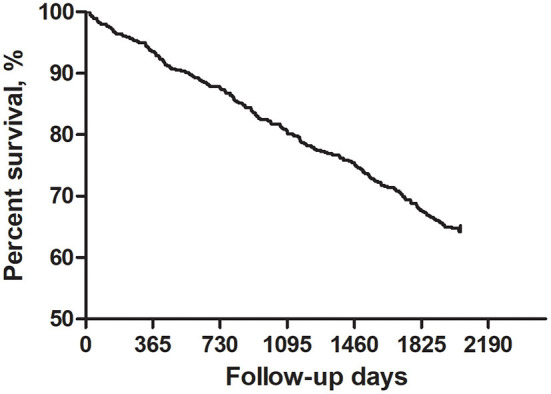
This was a prospective community-based cohort study including 559 AF patients, who were followed-up from July 2015 to December 2020.
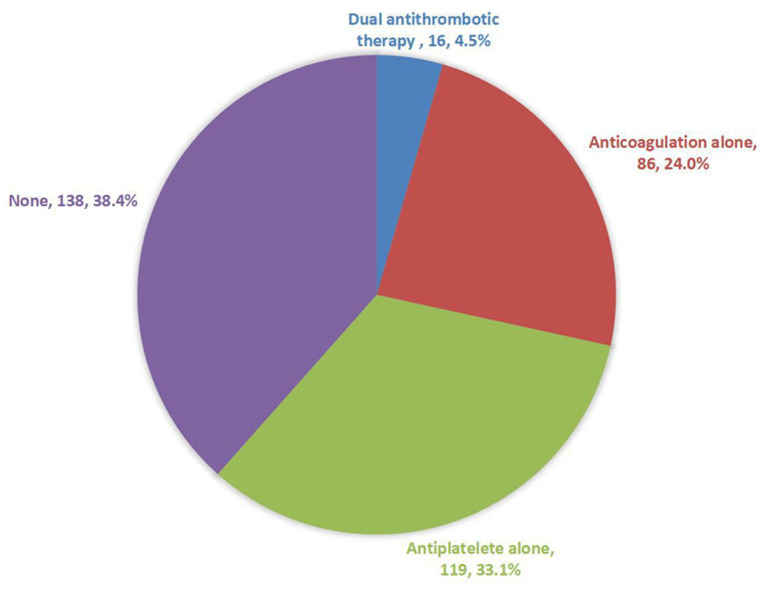
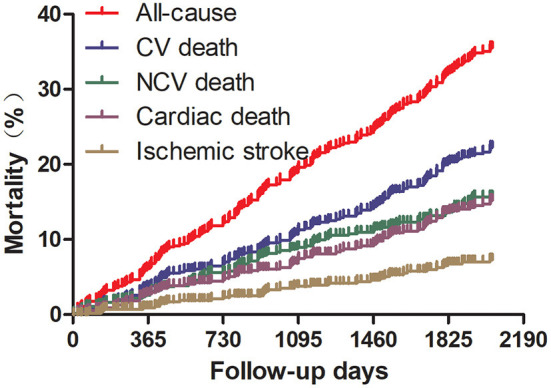
During 66-month follow-up, there were 200 deaths (56.5% cardiovascular, 40.0% non-cardiovascular, and 3.5% unknown causes) among 559 AF patients with the median age of 76 years. The top three causes of death were heart failure (33.0%), ischemic stroke (17.0%) and cancer (16.5%). Multivariate Cox regression analysis indicated baseline variables positively associated with all-cause death were age (HR: 1.10, 95% CI: 1.08-1.13), AF subtype (HR: 1.37, 95% CI: 1.08-1.73), prior myocardial infarction (HR: 3.40, 95% CI: 1.48-7.78), previous tumor (HR: 2.61, 95% CI: 1.37-4.98), hypoglycemic therapy at baseline (HR: 1.81, 95% CI: 1.13-2.91), but body weight (HR: 0.98, 95% CI: 0.97-1.00) and use of calcium channel blocker (CCB) (HR: 0.62, 95% CI: 0.41-0.95) played a protective role to all-cause death. Of patients who were alive at the end of follow-up, 24.0% were on oral anticoagulants (OAC) alone, 4.5% on dual antithrombotic therapy, 33.1% on antiplatelet agents alone and 38.4% weren't on any antithrombotic medication.
Ischemic stroke still remains one of the leading causes of death and OAC is seriously underused in AF patients in China. Independent risk factors for death are age, AF subtype, previous tumor, prior myocardial infarction, hypoglycemic therapy, low body weight and no CCB use.
http://www.chictr.org.cn/ (ChiCTR-ICR-15007036).
中国对心房颤动(AF)患者死亡情况的了解有限。本研究旨在评估中国AF患者的当代生存率,并探讨死亡的危险因素。
这是一项基于社区的前瞻性队列研究,纳入559例AF患者,随访时间为2015年7月至2020年12月。
在66个月的随访期间,559例AF患者中有200例死亡(心血管原因占56.5%,非心血管原因占40.0%,原因不明占3.5%),中位年龄为76岁。死亡的前三大原因是心力衰竭(33.0%)、缺血性卒中(17.0%)和癌症(16.5%)。多变量Cox回归分析表明,与全因死亡呈正相关的基线变量包括年龄(HR:1.10,95%CI:1.08-1.13)、AF亚型(HR:1.37,95%CI:1.08-1.73)、既往心肌梗死(HR:3.40,95%CI:1.48-7.78)、既往肿瘤(HR:2.61,95%CI:1.37-4.98)、基线时的降糖治疗(HR:1.81,95%CI:1.13-2.91),但体重(HR:0.98,95%CI:0.97-1.00)和使用钙通道阻滞剂(CCB)(HR:0.62,95%CI:0.41-0.95)对全因死亡起保护作用。随访结束时仍存活的患者中,24.0%仅接受口服抗凝药(OAC)治疗,4.5%接受双重抗栓治疗,33.1%仅接受抗血小板药物治疗,38.4%未接受任何抗栓药物治疗。
缺血性卒中仍然是主要死亡原因之一,中国AF患者中OAC的使用严重不足。死亡的独立危险因素包括年龄、AF亚型、既往肿瘤、既往心肌梗死、降糖治疗、低体重和未使用CCB。