Department of Internal Medicine, Seoul National University Hospital, Seoul, Republic of Korea.
Department of Biostatistics, College of Medicine, The Catholic University of Korea, Seoul, Republic of Korea.
PLoS One. 2018 Dec 26;13(12):e0209687. doi: 10.1371/journal.pone.0209687. eCollection 2018.
Patients with atrial fibrillation are known to have a high risk of mortality. There is a paucity of population-based studies about the impact of atrial fibrillation on the mortality risk stratified by age, sex, and detailed causes of death.
A total of 15,411 patients with atrial fibrillation from the Korean National Health Insurance Service-National Sample Cohort were enrolled, and causes of death were identified according to codes of the 10th revision of the International Classification of Diseases.
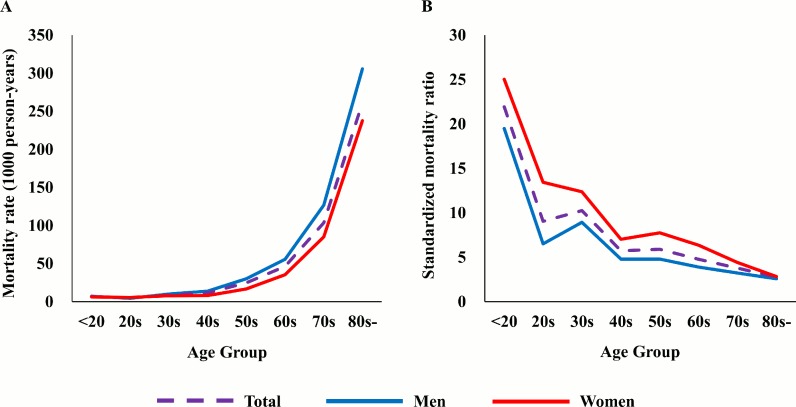
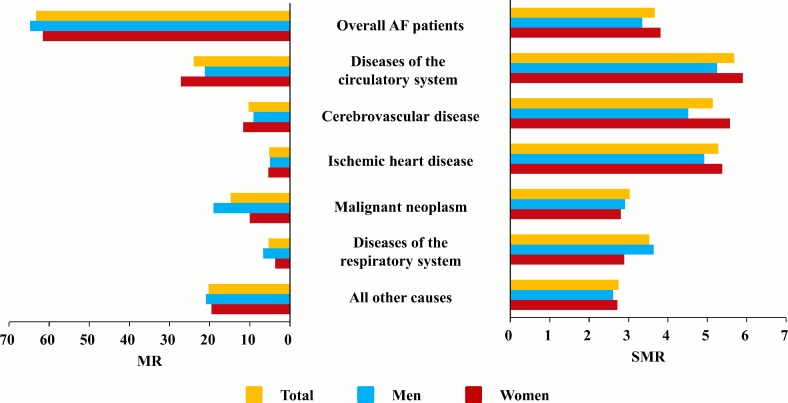
From 2002 to 2013, a total of 4,479 (29%) deaths were confirmed, and the crude mortality rate for all-cause death was 63.3 per 1,000 patient-years. Patients with atrial fibrillation had a 3.7-fold increased risk of all-cause death compared with the general population. The standardized mortality ratio for all-cause death was the highest in young patients and decreased with increasing age (standardized mortality ratio 21.93, 95% confidence interval 7.60-26.26 in patients aged <20 years; standardized mortality ratio 2.77, 95% confidence interval 2.63-2.91 in patients aged ≥80 years). Women with atrial fibrillation exhibited a greater excess mortality risk than men (standardized mortality ratio 3.81, 95% confidence interval 3.65-3.98 in women; standardized mortality ratio 3.35, 95% confidence interval 3.21-3.48 in men). Cardiovascular disease was the leading cause of death (38.5%), and cerebral infarction was the most common specific disease. Patients with atrial fibrillation had an about 5 times increased risk of death due to cardiovascular disease compared with the general population.
Patients with atrial fibrillation had a 4 times increased risk of mortality compared with the general population. However, the impact of atrial fibrillation on mortality decreased with age and in men. Cerebral infarction was the most common cause of death, and more attention should be paid to reducing the risk of stroke.
已知房颤患者的死亡率较高。但是,关于房颤对死亡率的影响,按年龄、性别和死亡的详细原因分层的基于人群的研究很少。
共纳入 15411 例来自韩国国家健康保险服务-国家样本队列的房颤患者,并根据国际疾病分类第 10 版的代码确定死因。
2002 年至 2013 年期间,共确认 4479 例(29%)死亡,全因死亡率为每 1000 人年 63.3 例。与普通人群相比,房颤患者的全因死亡风险增加了 3.7 倍。全因死亡的标准化死亡率在年轻患者中最高,并随年龄增长而降低(标准化死亡率 21.93,95%置信区间 7.60-26.26,年龄<20 岁的患者;标准化死亡率 2.77,95%置信区间 2.63-2.91,年龄≥80 岁的患者)。患有房颤的女性比男性有更大的超额死亡风险(标准化死亡率 3.81,95%置信区间 3.65-3.98,女性;标准化死亡率 3.35,95%置信区间 3.21-3.48,男性)。心血管疾病是主要死因(38.5%),脑梗死是最常见的特定疾病。与普通人群相比,房颤患者死于心血管疾病的风险增加了约 5 倍。
与普通人群相比,房颤患者的死亡率增加了 4 倍。然而,房颤对死亡率的影响随年龄和男性而降低。脑梗死是最常见的死因,应更加重视降低卒中风险。