Del Monte Alvise, Pannone Luigi, Bisignani Antonio, Osório Thiago G, Iacopino Saverio, Chierchia Gian-Battista, de Asmundis Carlo
Heart Rhythm Management Centre, Postgraduate Program in Cardiac Electrophysiology and Pacing, Universitair Ziekenhuis Brussel - Vrije Universiteit Brussel, European Reference Networks Guard-Heart, Brussels, Belgium.
Arrhythmology Department, Maria Cecilia Hospital, Cotignola, Italy.
Front Cardiovasc Med. 2022 Jul 28;9:958316. doi: 10.3389/fcvm.2022.958316. eCollection 2022.
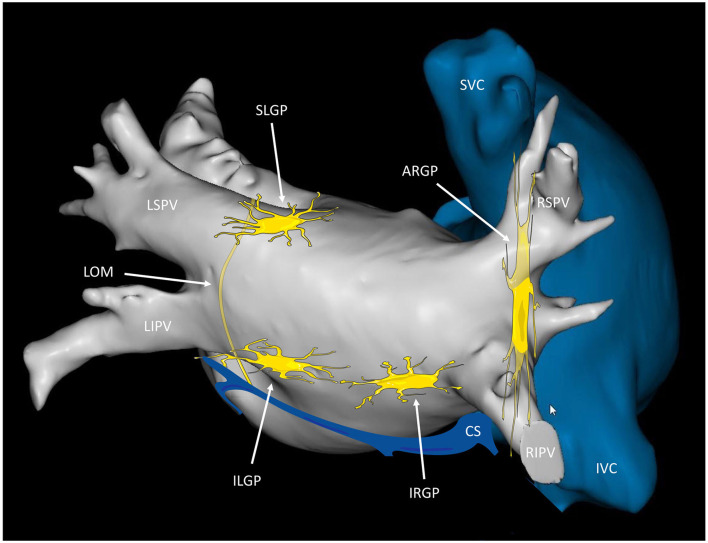
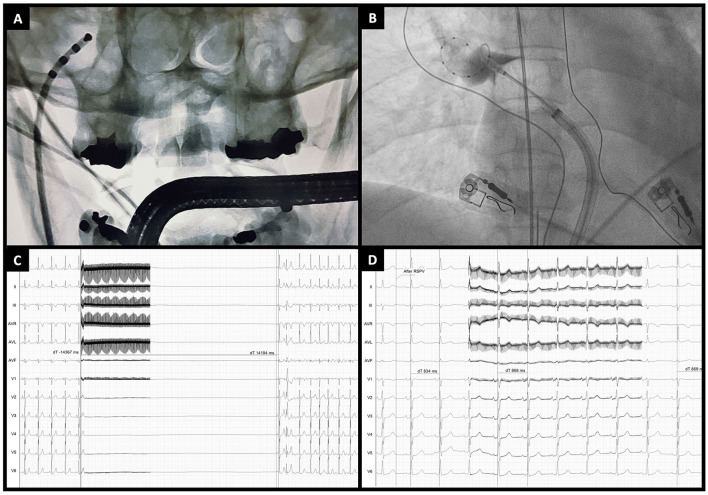
Pulmonary vein isolation (PVI) represents the mainstay of atrial fibrillation (AF) ablation, and PVI with cryoballoon catheter (CB) ablation (CB-A) has proven to be as effective and safe as radiofrequency ablation (RF-A). Although AF is initiated by triggers arising from the pulmonary veins (PV) and non-PV foci, the intrinsic cardiac nervous system (ICNS) plays a significant role in the induction and maintenance of AF. The ICNS is an epicardial neural system composed of ganglionated plexi (GPs) and a complex network of interconnecting neurons. In the left atrium, the major GPs are located in proximity to the PV-left atrial junction. Vagal reactions have been described as markers of autonomic modulation during PVI with both RF-A and CB-A. The occurrence of neuromodulation during PVI with CB-A may be explained by both the anatomical relationship between the GPs and the PVs and the characteristics of the CB. Due to the CB/PV size mismatch, the CB creates a wide ablation area that extends from the PV ostium toward the antrum, possibly including the GPs. Although targeted GPs ablation, as a supplemental strategy to PVI, has been associated with a better AF outcome in patients undergoing RF-A, the additional clinical benefit of neuromodulation during PVI with CB-A remains a matter of debate. In this review, we provide an overview of the anatomy of the ICNS, the relationship between the ICNS and AF pathophysiology, and the current evidence on the clinical relevance of neuromodulation during PVI with CB-A.
肺静脉隔离(PVI)是心房颤动(AF)消融的主要手段,事实证明,使用冷冻球囊导管(CB)进行PVI消融(CB-A)与射频消融(RF-A)同样有效且安全。尽管AF由肺静脉(PV)和非PV病灶产生的触发因素引发,但心脏固有神经系统(ICNS)在AF的诱发和维持中起着重要作用。ICNS是一个由神经节丛(GPs)和相互连接的神经元组成的复杂网络构成的心外膜神经系统。在左心房,主要的GPs位于PV与左心房交界处附近。迷走神经反应已被描述为RF-A和CB-A进行PVI期间自主调节的标志物。CB-A进行PVI期间神经调节的发生可能由GPs与PVs之间的解剖关系以及CB的特性来解释。由于CB与PV大小不匹配,CB会形成一个从PV开口向窦部延伸的广泛消融区域,可能包括GPs。尽管作为PVI的补充策略,靶向GPs消融已被证明对于接受RF-A的患者有更好的AF治疗效果,但CB-A进行PVI期间神经调节的额外临床益处仍存在争议。在本综述中,我们概述了ICNS的解剖结构、ICNS与AF病理生理学之间的关系,以及目前关于CB-A进行PVI期间神经调节临床相关性的证据。