Avcı Öyküm N, Sementa Luca, Fortunelli Alessandro
CNR-ICCOM, Consiglio Nazionale delle Ricerche, Via G. Moruzzi 1, Pisa 56124, Italy.
Department of Chemistry and Industrial Chemistry, DSCM, University of Pisa, Via G. Moruzzi 13, Pisa 56124, Italy.
ACS Catal. 2022 Aug 5;12(15):9058-9073. doi: 10.1021/acscatal.2c01534. Epub 2022 Jul 13.
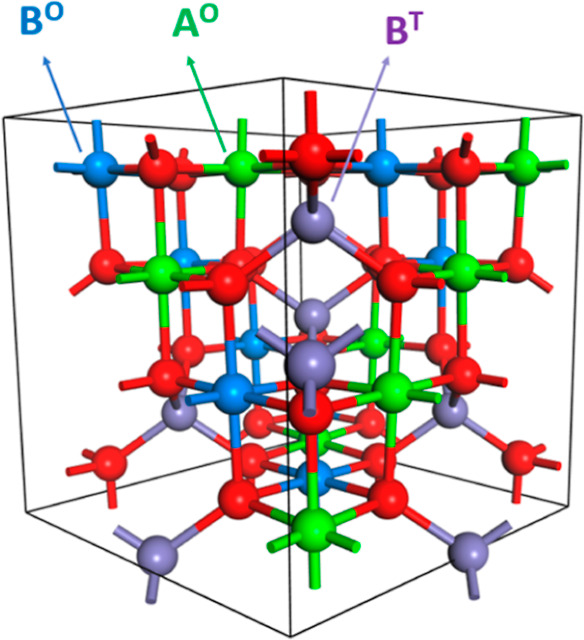
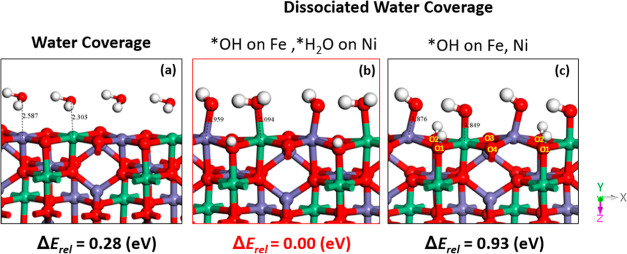
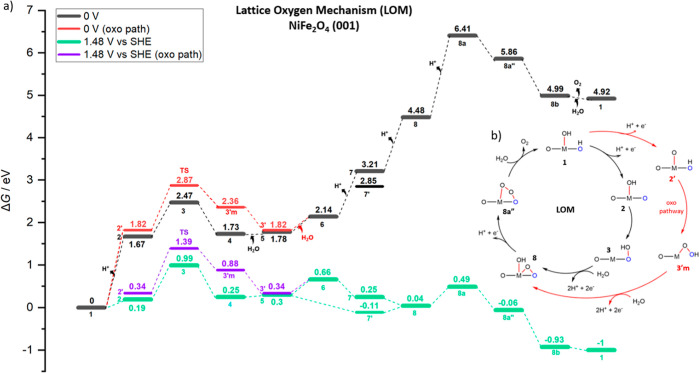
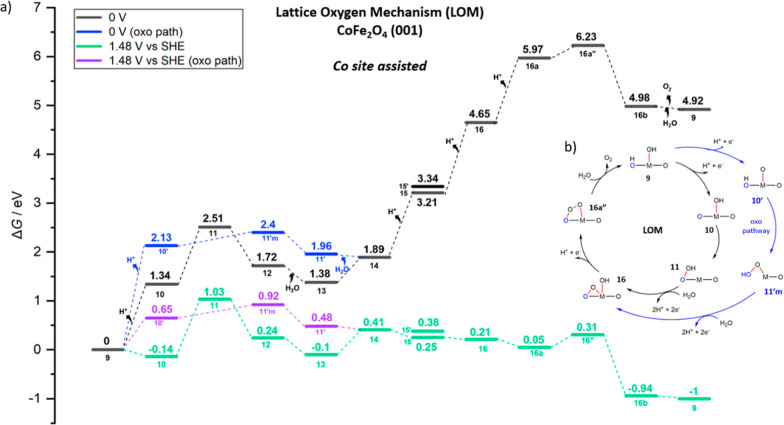
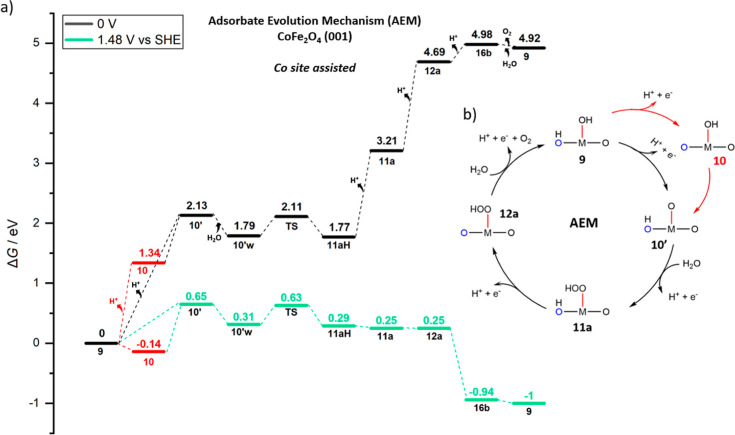
Spinel ferrites, especially Nickel ferrite, NiFeO, and Cobalt ferrite, CoFeO, are efficient and promising anode catalyst materials in the field of electrochemical water splitting. Using density functional theory, we extensively investigate and quantitatively model the mechanism and energetics of the oxygen evolution reaction (OER) on the (001) facets of their inverse-spinel structure, thought as the most abundant orientations under reaction conditions. We catalogue a wide set of intermediates and mechanistic pathways, including the lattice oxygen mechanism (LOM) and adsorbate evolution mechanism (AEM), along with critical (rate-determining) O-O bond formation barriers and transition-state structures. In the case of NiFeO, we predict a Fe-site-assisted LOM pathway as the preferred OER mechanism, with a barrier (Δ ) of 0.84 eV at = 1.63 V versus SHE and a turnover frequency (TOF) of 0.26 s at 0.40 V overpotential. In the case of CoFeO, we find that a Fe-site-assisted LOM pathway (Δ = 0.79 eV at = 1.63 V SHE, TOF = 1.81 s at 0.40 V overpotential) and a Co-site-assisted AEM pathway (Δ = 0.79 eV at bias > = 1.34 V SHE, TOF = 1.81 s at bias >1.34 V) could both play a role, suggesting a coexistence of active sites, in keeping with experimental observations. The computationally predicted turnover frequencies exhibit a fair agreement with experimentally reported data and suggest CoFeO as a more promising OER catalyst than NiFeO in the pristine case, especially for the Co-site-assisted OER pathway, and may offer a basis for further progress and optimization.
尖晶石铁氧体,尤其是镍铁氧体(NiFe₂O₄)和钴铁氧体(CoFe₂O₄),是电化学水分解领域中高效且有前景的阳极催化材料。利用密度泛函理论,我们广泛研究并定量模拟了它们反尖晶石结构(001)晶面上析氧反应(OER)的机理和能量学,该晶面被认为是反应条件下最丰富的取向。我们梳理了一系列广泛的中间体和反应机理途径,包括晶格氧机理(LOM)和吸附质演化机理(AEM),以及关键的(速率决定)O - O键形成能垒和过渡态结构。对于NiFe₂O₄,我们预测Fe位点辅助的LOM途径是首选的OER机理,在相对于标准氢电极(SHE)为1.63 V时,能垒(ΔG)为0.84 eV,在过电位为0.40 V时,周转频率(TOF)为0.26 s⁻¹。对于CoFe₂O₄,我们发现Fe位点辅助的LOM途径(在相对于SHE为1.63 V时,ΔG = 0.79 eV,在过电位为0.40 V时,TOF = 1.81 s⁻¹)和Co位点辅助的AEM途径(在偏压>相对于SHE为1.34 V时,ΔG = 0.79 eV,在偏压>1.34 V时,TOF = 1.81 s⁻¹)都可能起作用,这表明活性位点共存,与实验观察结果一致。计算预测的周转频率与实验报道的数据有较好的一致性,并表明在原始情况下,CoFe₂O₄比NiFe₂O₄是更有前景的OER催化剂,特别是对于Co位点辅助的OER途径,这可能为进一步的进展和优化提供基础。