Habibi Nazima, Uddin Saif, Behbehani Montaha, Al Salameen Fadila, Razzack Nasreem Abdul, Zakir Farhana, Shajan Anisha, Alam Faiz
Environment and Life Science Research Centre, Kuwait Institute for Scientific Research, Kuwait City, Kuwait.
Front Microbiol. 2022 Jul 28;13:955913. doi: 10.3389/fmicb.2022.955913. eCollection 2022.
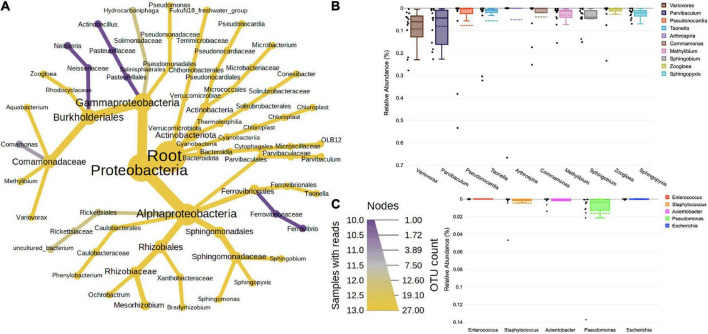
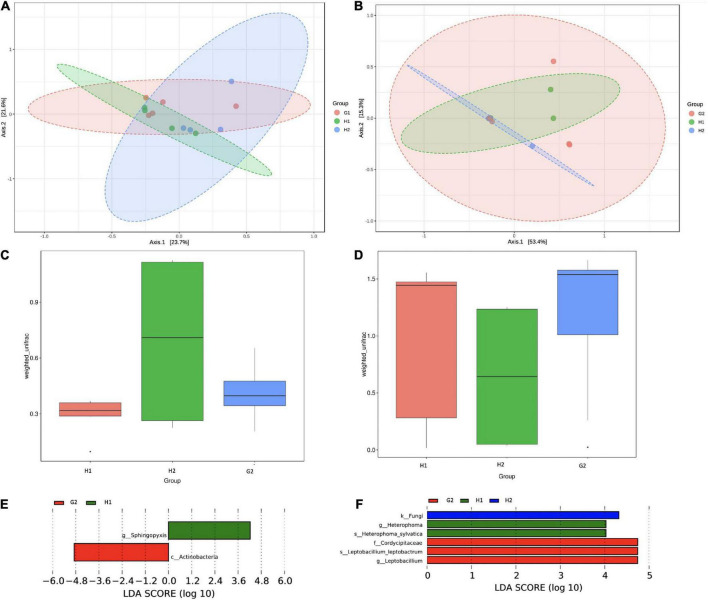
The airborne transmission of COVID-19 has drawn immense attention to bioaerosols. The topic is highly relevant in the indoor hospital environment where vulnerable patients are treated and healthcare workers are exposed to various pathogenic and non-pathogenic microbes. Knowledge of the microbial communities in such settings will enable precautionary measures to prevent any hospital-mediated outbreak and better assess occupational exposure of the healthcare workers. This study presents a baseline of the bacterial and fungal population of two major hospitals in Kuwait dealing with COVID patients, and in a non-hospital setting through targeted amplicon sequencing. The predominant bacteria of bioaerosols were (9.44%), (8.27%), (8.04%), (5.74%), (4.58%), (3.84%), (3.13%), (4.46%), (2.20%), and (2.56%). ESKAPEE pathogens, such as , , , , and , were also found in lower abundances. The fungi were represented by (64.38%), (9.11%), (3.89%), (3.20%), (2.99%), (1.42%), (0.74%), (0.49%), (0.46%), and (0.23%). Some common and unique operational taxonomic units (OTUs) of bacteria and fungi were also recorded at each site; this inter-site variability shows that exhaled air can be a source of this variation. The alpha-diversity indices suggested variance in species richness and abundance in hospitals than in non-hospital sites. The community structure of bacteria varied spatially (ANOSIM = 0.181-0.243; < 0.05) between the hospital and non-hospital sites, whereas fungi were more or less homogenous. Key taxa specific to the hospitals were Defluvicoccales, fungi, Ganodermataceae, , and compared to Actinobacteria, , , and Cordycipitaceae at the non-hospital site (LefSe, FDR q ≤ 0.05). The hospital/non-hospital MD index > 1 indicated shifts in the microbial communities of indoor air in hospitals. These findings highlight the need for regular surveillance of indoor hospital environments to prevent future outbreaks.
新型冠状病毒肺炎(COVID-19)的空气传播引起了人们对生物气溶胶的极大关注。在收治脆弱患者且医护人员接触各种致病和非致病微生物的室内医院环境中,该话题高度相关。了解此类环境中的微生物群落将有助于采取预防措施,防止任何由医院介导的疫情爆发,并更好地评估医护人员的职业暴露情况。本研究通过靶向扩增子测序,给出了科威特两家收治COVID患者的主要医院以及非医院环境中细菌和真菌种群的基线数据。生物气溶胶中的主要细菌为(9.44%)、(8.27%)、(8.04%)、(5.74%)、(4.58%)、(3.84%)、(3.13%)、(4.46%)、(2.20%)和(2.56%)。还发现了低丰度的ESKAPEE病原体,如、、、和。真菌以(64.38%)、(9.11%)、(3.89%)、(3.20%)、(2.99%)、(1.42%)、(0.74%)、(0.49%)、(0.46%)和(0.23%)为代表。每个位点还记录了一些细菌和真菌的常见和独特的可操作分类单元(OTU);这种位点间的变异性表明呼出的空气可能是这种变异的一个来源。α多样性指数表明,医院中的物种丰富度和丰度比非医院场所存在差异。医院和非医院场所之间细菌的群落结构在空间上存在差异(ANOSIM = 0.181 - 0.243;< 0.05),而真菌或多或少是均匀的。与非医院场所的放线菌、、和虫草科相比,医院特有的关键分类群是脱硫球菌目、真菌、灵芝科、和(线性判别分析效应大小法,FDR q≤0.05)。医院/非医院的MD指数>1表明医院室内空气微生物群落发生了变化。这些发现凸显了定期监测医院室内环境以预防未来疫情爆发的必要性。