Mendes Gabriel, Ramalho João F, Duarte Aida, Pedrosa Adriana, Silva Ana Cristina, Méndez Lucía, Caneiras Cátia
Microbiology Research Laboratory on Environmental Health (EnviHealthMicro Lab), Institute of Environmental Health (ISAMB), Faculty of Medicine, Universidade de Lisboa (ULisboa), 1649-026 Lisboa, Portugal.
Faculty of Pharmacy, Universidade de Lisboa (ULisboa), 1649-033 Lisboa, Portugal.
Microorganisms. 2022 Jan 23;10(2):251. doi: 10.3390/microorganisms10020251.
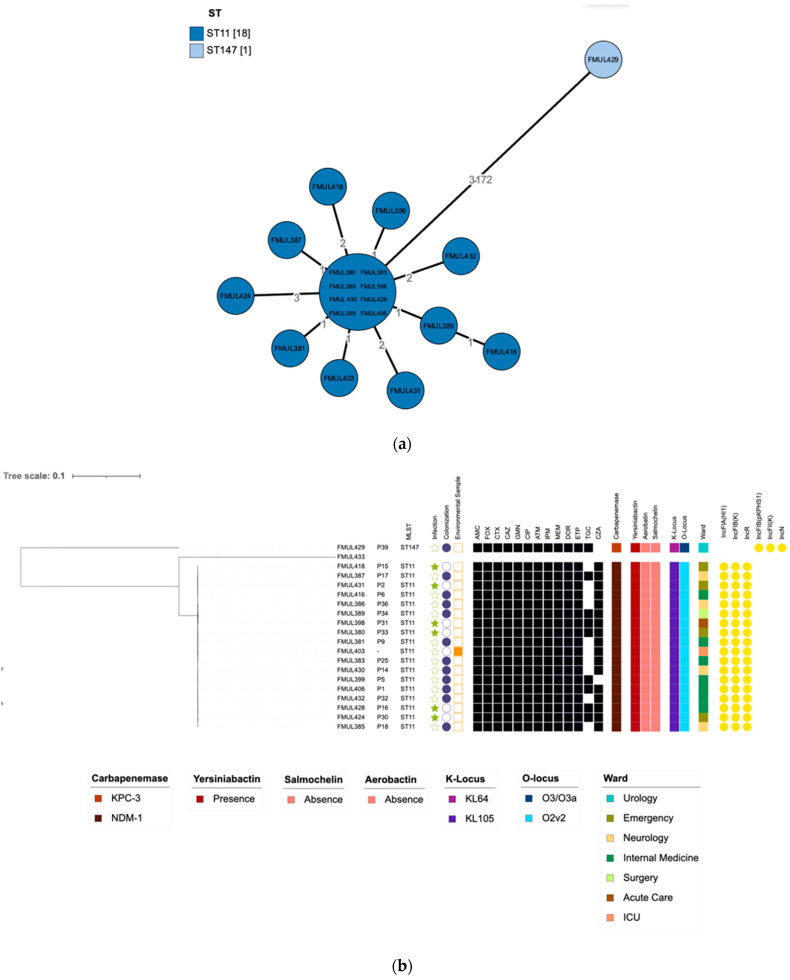
New Delhi metallo-β-lactamase (NDM) carbapenemase has been considered a global threat due to its worldwide widespread in recent years. In Portugal, a very low number of infections with NDM-producing Enterobacterales has been reported. A total of 52 strains from 40 patients and 1 environmental sample isolated during COVID-19 pandemic were included in this study. Wholegenome sequencing (WGS) was performed on 20 carbapenemase-producing strains, including 17 NDM-1-producing ST11-KL105 lineage strains, one NDM-1-producing ST58 strain and one KPC-3-producing ST147 strain, recovered from a total of 19 patients. Of interest, also one NDM-1-producing ST11-KL105 was collected from the hospital environment. Genome-wide phylogenetic analysis revealed an ongoing dissemination of NDM-1-producing ST11 strains ( = 18) with the same genetic features seen across multiple wards. Furthermore, the ST58 strain, collected from a patient rectal swab that was also colonised with a strain, also showed the IncFIA plasmid replicon and the gene (preceded by IS30 and followed by genes , , , , and ). The is part of Tn identical to those reported in Poland, Italy and India. The ST147-KL64 strain has the genetic environment Tn isoform. In conclusion, herein we report the molecular epidemiology, resistome, virulome and mobilome of the first NDM-1 carbapenemase outbreak caused by ST11-KL105 lineage during the COVID-19 pandemic in Portugal. Moreover, the outbreak strains characterised included seventeen different patients (infected and colonised) and one environmental sample which also emphasises the role of commensal and hospital environment strains in the dissemination of the outbreak.
新德里金属β-内酰胺酶(NDM)碳青霉烯酶近年来在全球广泛传播,已被视为一种全球威胁。在葡萄牙,产NDM肠杆菌科细菌感染的报告数量非常少。本研究纳入了在新冠疫情期间从40名患者和1份环境样本中分离出的52株菌株。对从19名患者中分离出的20株产碳青霉烯酶菌株进行了全基因组测序,其中包括17株产NDM-1的ST11-KL105谱系菌株、1株产NDM-1的ST58菌株和1株产KPC-3的ST147菌株。有趣的是,还从医院环境中收集到1株产NDM-1的ST11-KL105菌株。全基因组系统发育分析显示,产NDM-1的ST11菌株(n = 18)正在传播,多个病房中可见相同的遗传特征。此外,从一名患者直肠拭子中分离出的ST58菌株,该患者同时还被一株[未提及的菌株]定植,该菌株也显示出IncFIA质粒复制子和[未提及的基因](前面有IS30,后面有基因[未提及的多个基因])。[未提及的基因]是Tn的一部分,与波兰、意大利和印度报道的相同。ST147-KL64菌株具有Tn异构体的遗传环境。总之,我们在此报告了葡萄牙新冠疫情期间由ST11-KL105谱系引起的首例NDM-1碳青霉烯酶暴发的分子流行病学、耐药基因组、毒力基因组和可移动基因组。此外,所鉴定的暴发菌株包括17名不同的患者(感染和定植)和1份环境样本,这也强调了共生菌和医院环境菌株在暴发传播中的作用。