Rimondi Agustina, Olivera Valeria S, Soria Ivana, Parisi Gustavo D, Rumbo Martin, Perez Daniel R
Instituto de Virología e Innovaciones Tecnológicas, Centro de Investigaciones en Ciencias Veterinarias y Agronómicas, INTA-CONICET, Castelar, Argentina.
Departamento de Ciencia y Tecnología, CONICET, Universidad Nacional de Quilmes, Bernal, Argentina.
Front Microbiol. 2022 Jul 27;13:953738. doi: 10.3389/fmicb.2022.953738. eCollection 2022.
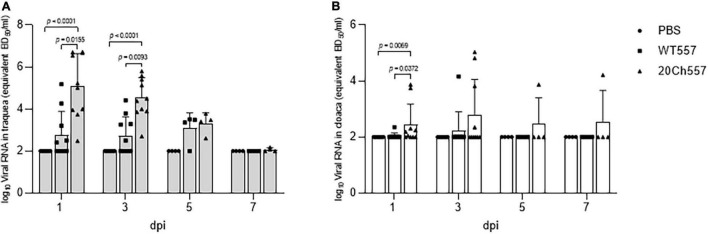
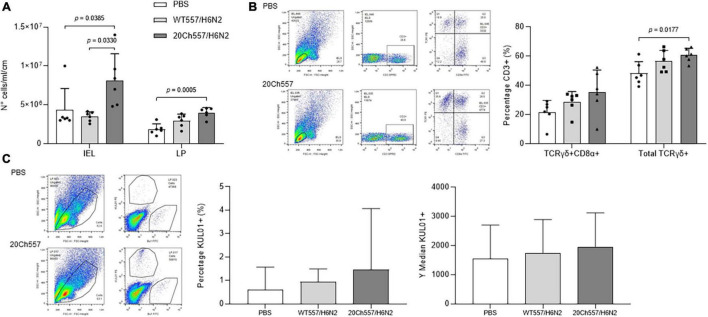
In chickens, infections due to influenza A virus (IAV) can be mild to severe and lethal. The study of IAV infections in poultry has been mostly limited to strains from the North American and Eurasian lineages, whereas limited information exists on similar studies with strains from the South American lineage (SAm). To better evaluate the risk of introduction of a prototypical SAm IAV strain into poultry, chickens were infected with a wild-type SAm origin strain (WT557/H6N2). The resulting virus progeny was serially passaged in chickens 20 times, and the immunopathological effects of the last passage virus, 20Ch557/H6N2, in chickens were compared to those of the parental strain. A comparison of complete viral genome sequences indicated that the 20Ch557/H6N2 strain contained 13 amino acid differences compared to the wild-type strain. Five of these mutations are in functionally relevant regions of the viral surface glycoproteins hemagglutinin (HA) and neuraminidase (NA). However, despite higher and more prolonged virus shedding in chickens inoculated with the 20Ch557/H6N2 strain compared to those that received the WT557/H6N2 strain, transmission to naïve chickens was not observed for either group. Analyses by flow cytometry of mononuclear cells and lymphocyte subpopulations from the lamina propria and intraepithelial lymphocytic cells (IELs) from the ileum revealed a significant increase in the percentages of CD3TCRγδ IELs in chickens inoculated with the 20Ch557/H6N2 strain compared to those inoculated with the WT557/H6N2 strain.
在鸡中,甲型流感病毒(IAV)感染的严重程度可从轻度到致命。对家禽中IAV感染的研究大多局限于北美和欧亚谱系的毒株,而关于南美谱系(SAm)毒株的类似研究信息有限。为了更好地评估引入一种典型的SAm IAV毒株到家禽中的风险,用一株野生型SAm来源毒株(WT557/H6N2)感染鸡。将产生的子代病毒在鸡中连续传代20次,并将最后一代传代病毒20Ch557/H6N2在鸡中的免疫病理效应与亲代毒株的效应进行比较。完整病毒基因组序列的比较表明,20Ch557/H6N2毒株与野生型毒株相比有13个氨基酸差异。其中5个突变位于病毒表面糖蛋白血凝素(HA)和神经氨酸酶(NA)的功能相关区域。然而,尽管与接种WT557/H6N2毒株的鸡相比,接种20Ch557/H6N2毒株的鸡的病毒排泄量更高且持续时间更长,但两组均未观察到向未感染鸡的传播。对来自固有层的单核细胞和淋巴细胞亚群以及来自回肠的上皮内淋巴细胞(IEL)进行流式细胞术分析发现,与接种WT557/H6N2毒株的鸡相比,接种20Ch557/H6N2毒株的鸡中CD3TCRγδ IEL的百分比显著增加。