Poultry Diagnostic and Research Center, The University of Georgia, Athens, Georgia, United States of America.
Southeast Poultry Research Laboratory, Agricultural Research Service, U.S. Department of Agriculture, Athens, Georgia, United States of America.
PLoS One. 2018 Apr 26;13(4):e0196394. doi: 10.1371/journal.pone.0196394. eCollection 2018.
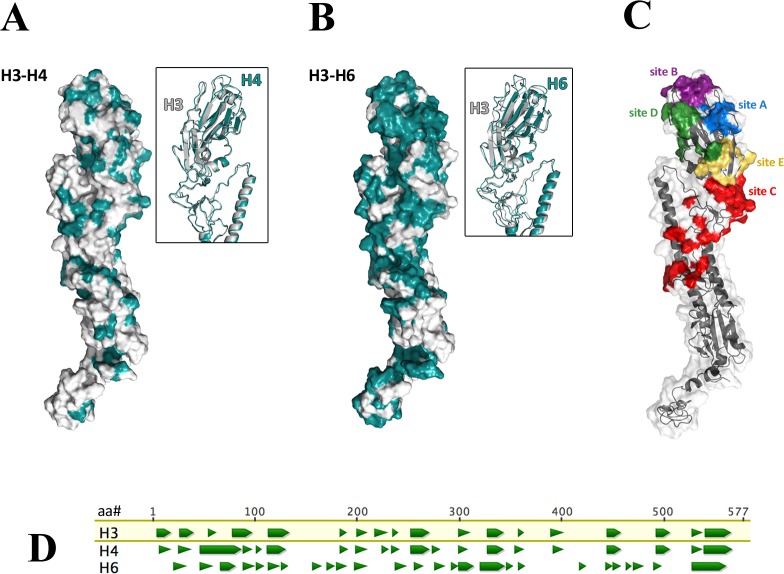
Previous field and experimental studies have demonstrated that heterosubtypic immunity (HSI) is a potential driver of Influenza A virus (IAV) prevalence and subtype diversity in mallards. Prior infection with IAV can reduce viral shedding during subsequent reinfection with IAV that have genetically related hemagglutinins (HA). In this experiment, we evaluated the effect of HSI conferred by an H3N8 IAV infection against increasing challenge doses of closely (H4N6) and distantly (H6N2) related IAV subtypes in mallards. Two groups of thirty 1-month-old mallards each, were inoculated with 105.9 50% embryo infectious doses (EID50) of an H3N8 virus or a mock-inoculum. One month later, groups of five birds each were challenged with increasing doses of H4N6 or H6N2 virus; age-matched, single infection control ducks were included for all challenges. Results demonstrate that naïve birds were infected after inoculation with 103 and 104 EID50 doses of the H4N6 or H6N2 virus, but not with 102 EID50 doses of either IAV. In contrast, with birds previously infected with H3N8 IAV, only one duck challenged with 104 EID50 of H4N6 IAV was shedding viral RNA at 2 days post-inoculation, and with H6N2 IAV, only birds challenged with the 104 EID50 dose were positive to virus isolation. Viral shedding in ducks infected with H6N2 IAV was reduced on days 2 and 3 post-inoculation compared to control birds. To explain the differences in the dose necessary to produce infection among H3-primed ducks challenged with H4N6 or H6N2 IAV, we mapped the amino acid sequence changes between H3 and H4 or H6 HA on predicted three-dimensional structures. Most of the sequence differences occurred between H3 and H6 at antigenic sites A, B, and D of the HA1 region. These findings demonstrate that the infectious dose necessary to infect mallards with IAV can increase as a result of HSI and that this effect is most pronounced when the HA of the viruses are genetically related.
先前的野外和实验研究表明,异源免疫(HSI)是鸭源甲型流感病毒(IAV)流行和亚型多样性的潜在驱动因素。先前感染 IAV 可以减少随后与遗传上相关血凝素(HA)的 IAV 再次感染时的病毒脱落。在这项实验中,我们评估了 H3N8 IAV 感染引起的 HSI 对鸭源密切(H4N6)和远距离(H6N2)相关 IAV 亚型递增挑战剂量的影响。将每组 30 只 1 月龄的鸭,每组接种 105.9 50%胚胎感染剂量(EID50)的 H3N8 病毒或模拟接种物。一个月后,每组 5 只鸭分别接受递增剂量的 H4N6 或 H6N2 病毒挑战;所有挑战均包括年龄匹配的单感染对照鸭。结果表明,未感染的鸭在接种 103 和 104 EID50 剂量的 H4N6 或 H6N2 病毒后被感染,但接种 102 EID50 剂量的任何 IAV 均未被感染。相比之下,对于先前感染 H3N8 IAV 的鸟类,只有一只用 104 EID50 的 H4N6 IAV 接种的鸭在接种后 2 天出现病毒 RNA 脱落,而用 H6N2 IAV 接种的鸭中,只有用 104 EID50 剂量接种的鸭对病毒分离呈阳性。感染 H6N2 IAV 的鸭的病毒脱落量在接种后第 2 天和第 3 天比对照鸭减少。为了解释 H3 免疫鸭用 H4N6 或 H6N2 IAV 进行挑战时所需剂量产生感染的差异,我们根据预测的三维结构对 H3 和 H4 或 H6 HA 之间的 HA1 区域抗原位点 A、B 和 D 的氨基酸序列变化进行了映射。HA1 区域的大多数序列差异发生在 H3 和 H6 之间。这些发现表明,感染鸭源 IAV 所需的感染剂量会由于 HSI 而增加,并且当病毒的 HA 在遗传上相关时,这种影响最为明显。