Wang Ming-Liang, Sun Zheng, Li Wen-Bin, Zou Qiao-Qiao, Li Peng-Yang, Wu Xue, Li Yue-Hua
Department of Radiology, Shanghai Jiao Tong University Affiliated Sixth People's Hospital, Shanghai, China.
Division of Cardiology, Pauley Heart Center, Virginia Commonwealth University, Richmond, VA, United States.
Front Aging Neurosci. 2022 Jul 28;14:923193. doi: 10.3389/fnagi.2022.923193. eCollection 2022.
The aim of this study was to investigate the distribution characteristics of enlarged perivascular spaces (EPVS) and white matter hyperintensities (WMH) and their associations with disease severity across the frontotemporal lobar degeneration (FTLD) syndromes spectrum.
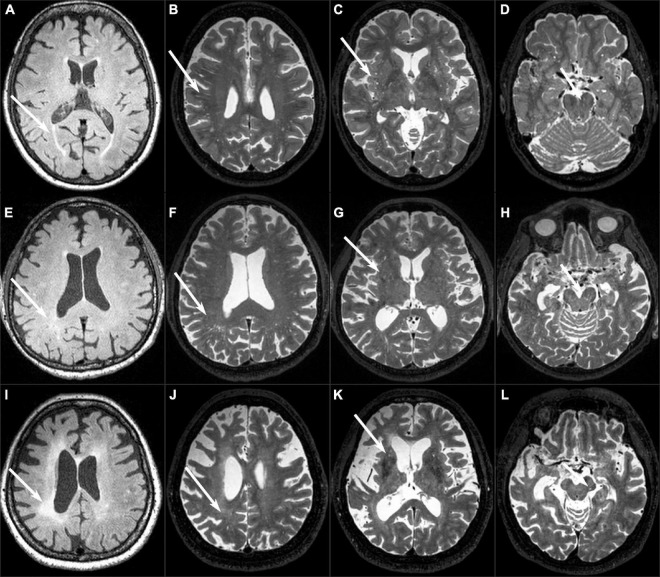
This study included 73 controls, 39 progressive supranuclear palsy Richardson's syndrome (PSP-RS), 31 corticobasal syndrome (CBS), 47 behavioral variant frontotemporal dementia (bvFTD), 36 non-fluent variant primary progressive aphasia (nfvPPA), and 50 semantic variant primary progressive aphasia (svPPA). All subjects had brain magnetic resonance imaging (MRI) and neuropsychological tests, including progressive supranuclear palsy rating scale (PSPRS) and FTLD modified clinical dementia rating sum of boxes (FTLD-CDR). EPVS number and grade were rated on MRI in the centrum semiovale (CSO-EPVS), basal ganglia (BG-EPVS), and brain stem (BS-EPVS). Periventricular (PWMH) and deep (DWMH) were also graded on MRI. The distribution characteristics of EPVS and WMH were compared between control and disease groups. Multivariable linear regression analysis was performed to evaluate the association of EPVS and WMH with disease severity.
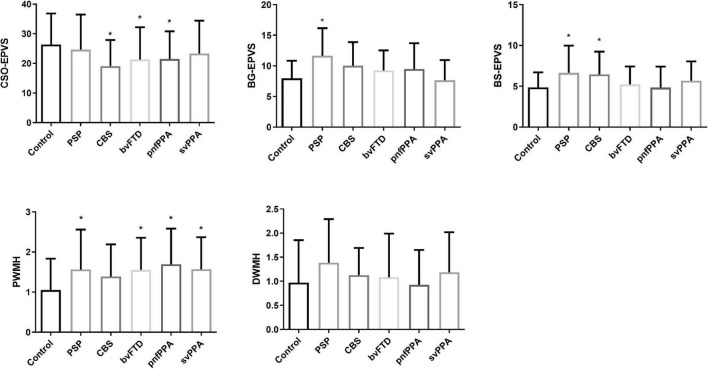
Compared with control subjects, PSP-RS and CBS had more BS-EPVS; CBS, bvFTD, and nfvPPA had less CSO-EPVS; all disease groups except CBS had higher PWMH ( < 0.05). BS-EPVS was associated with PSPRS in PSP-RS (β = 2.395, 95% CI 0.888-3.901) and CBS (β = 3.115, 95% CI 1.584-4.647). PWMH was associated with FTLD-CDR in bvFTD (β = 1.823, 95% CI 0.752-2.895), nfvPPA (β = 0.971, 95% CI 0.030-1.912), and svPPA (OR: 1.330, 95% CI 0.457-2.204).
BS-EPVS could be a promising indicator of disease severity in PSP-RS and CBS, while PWMH could reflect the severity of bvFTD, nfvPPA, and svPPA.
本研究旨在调查扩大的血管周围间隙(EPVS)和白质高信号(WMH)的分布特征及其与额颞叶变性(FTLD)综合征谱系中疾病严重程度的关联。
本研究纳入了73名对照者、39例进行性核上性麻痹理查森综合征(PSP-RS)、31例皮质基底节综合征(CBS)、47例行为变异型额颞叶痴呆(bvFTD)、36例非流利型原发性进行性失语(nfvPPA)和50例语义型原发性进行性失语(svPPA)。所有受试者均进行了脑磁共振成像(MRI)和神经心理学测试,包括进行性核上性麻痹评定量表(PSPRS)和FTLD改良临床痴呆评定盒总和(FTLD-CDR)。在半卵圆中心(CSO-EPVS)、基底节(BG-EPVS)和脑干(BS-EPVS)的MRI上对EPVS的数量和分级进行评定。还在MRI上对脑室周围(PWMH)和深部(DWMH)进行分级。比较对照组和疾病组之间EPVS和WMH的分布特征。进行多变量线性回归分析以评估EPVS和WMH与疾病严重程度的关联。
与对照受试者相比,PSP-RS和CBS的BS-EPVS更多;CBS、bvFTD和nfvPPA的CSO-EPVS更少;除CBS外的所有疾病组的PWMH更高(P<0.05)。在PSP-RS(β = 2.395,95%CI 0.888-3.901)和CBS(β = 3.115,95%CI 1.584-4.647)中,BS-EPVS与PSPRS相关。在bvFTD(β = 1.823,95%CI 0.752-2.895)、nfvPPA(β = 0.971,95%CI 0.030-1.912)和svPPA(OR:1.330,95%CI 0.457-2.204)中,PWMH与FTLD-CDR相关。
BS-EPVS可能是PSP-RS和CBS中疾病严重程度的一个有前景的指标,而PWMH可以反映bvFTD、nfvPPA和svPPA的严重程度。