Ahsani-Estahbanati Ehsan, Sergeevich Gordeev Vladimir, Doshmangir Leila
Department of Health Policy and Management, Tabriz Health Services Management Research Center, Iranian Center of Excellence in Health Management, School of Management and Medical Informatics, Tabriz University of Medical Sciences, Tabriz, Iran.
Wolfson Institute of Population Health, Queen Mary University of London, London, United Kingdom.
Front Med (Lausanne). 2022 Jul 27;9:875426. doi: 10.3389/fmed.2022.875426. eCollection 2022.
Improving health care quality and ensuring patient safety is impossible without addressing medical errors that adversely affect patient outcomes. Therefore, it is essential to correctly estimate the incidence rates and implement the most appropriate solutions to control and reduce medical errors. We identified such interventions.
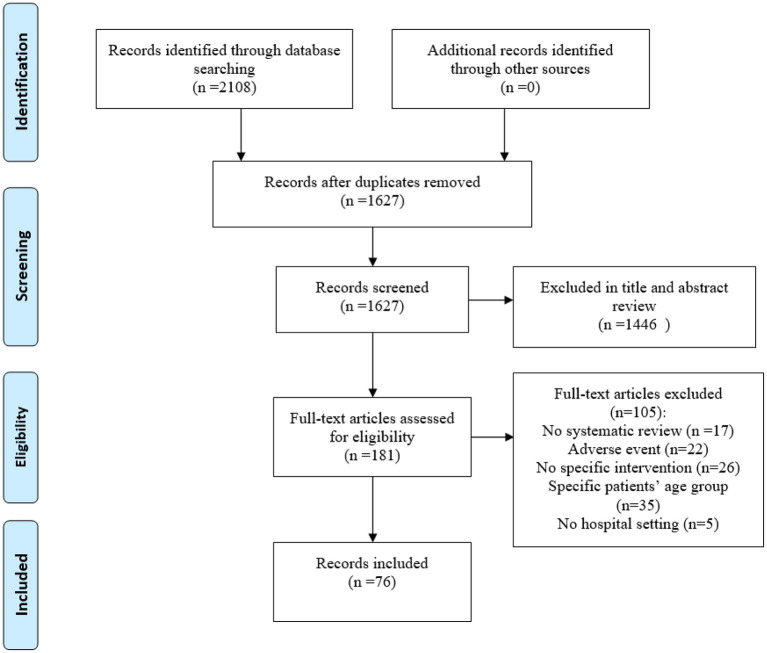
We conducted a systematic review of systematic reviews by searching four databases (PubMed, Scopus, Ovid Medline, and Embase) until January 2021 to elicit interventions that have the potential to decrease medical errors. Two reviewers independently conducted data extraction and analyses.
Seventysix systematic review papers were included in the study. We identified eight types of interventions based on medical error type classification: overall medical error, medication error, diagnostic error, patients fall, healthcare-associated infections, transfusion and testing errors, surgical error, and patient suicide. Most studies focused on medication error (66%) and were conducted in hospital settings (74%).
Despite a plethora of suggested interventions, patient safety has not significantly improved. Therefore, policymakers need to focus more on the implementation considerations of selected interventions.
若不解决对患者预后产生不利影响的医疗差错问题,提高医疗质量和确保患者安全便无从谈起。因此,正确估算发病率并实施最恰当的解决方案以控制和减少医疗差错至关重要。我们确定了此类干预措施。
我们通过检索四个数据库(PubMed、Scopus、Ovid Medline和Embase)对系统评价进行了系统综述,检索截至2021年1月,以找出有可能减少医疗差错的干预措施。两名评审员独立进行数据提取和分析。
该研究纳入了76篇系统评价论文。我们根据医疗差错类型分类确定了八种干预措施:总体医疗差错、用药差错、诊断差错、患者跌倒、医疗相关感染、输血和检验差错、手术差错以及患者自杀。大多数研究聚焦于用药差错(66%),且是在医院环境中开展的(74%)。
尽管有大量建议的干预措施,但患者安全并未得到显著改善。因此,政策制定者需要更多地关注所选干预措施的实施考量。