• 文献检索
  • 文档翻译
  • 深度研究
  • 学术资讯
  • Suppr Zotero 插件Zotero 插件
  • 邀请有礼
  • 套餐&价格
  • 历史记录
应用&插件
Suppr Zotero 插件Zotero 插件浏览器插件Mac 客户端Windows 客户端微信小程序
定价
高级版会员购买积分包购买API积分包
服务
文献检索文档翻译深度研究API 文档MCP 服务
关于我们
关于 Suppr公司介绍联系我们用户协议隐私条款
关注我们

Suppr 超能文献

核心技术专利:CN118964589B侵权必究
粤ICP备2023148730 号-1Suppr @ 2026

文献检索

告别复杂PubMed语法,用中文像聊天一样搜索,搜遍4000万医学文献。AI智能推荐,让科研检索更轻松。

立即免费搜索

文件翻译

保留排版,准确专业,支持PDF/Word/PPT等文件格式,支持 12+语言互译。

免费翻译文档

深度研究

AI帮你快速写综述,25分钟生成高质量综述,智能提取关键信息,辅助科研写作。

立即免费体验

使用随机森林算法进行肾小球和肾小管损伤诊断。

Using random forest algorithm for glomerular and tubular injury diagnosis.

作者信息

Song Wenzhu, Zhou Xiaoshuang, Duan Qi, Wang Qian, Li Yaheng, Li Aizhong, Zhou Wenjing, Sun Lin, Qiu Lixia, Li Rongshan, Li Yafeng

机构信息

School of Public Health, Shanxi Medical University, Taiyuan, China.

Department of Nephrology, Shanxi Provincial People's Hospital (Fifth Hospital) of Shanxi Medical University, Taiyuan, China.

出版信息

Front Med (Lausanne). 2022 Jul 28;9:911737. doi: 10.3389/fmed.2022.911737. eCollection 2022.

DOI:10.3389/fmed.2022.911737
PMID:35966858
原文链接:https://pmc.ncbi.nlm.nih.gov/articles/PMC9366016/
Abstract

OBJECTIVES

Chronic kidney disease (CKD) is a common chronic condition with high incidence and insidious onset. Glomerular injury (GI) and tubular injury (TI) represent early manifestations of CKD and could indicate the risk of its development. In this study, we aimed to classify GI and TI using three machine learning algorithms to promote their early diagnosis and slow the progression of CKD.

METHODS

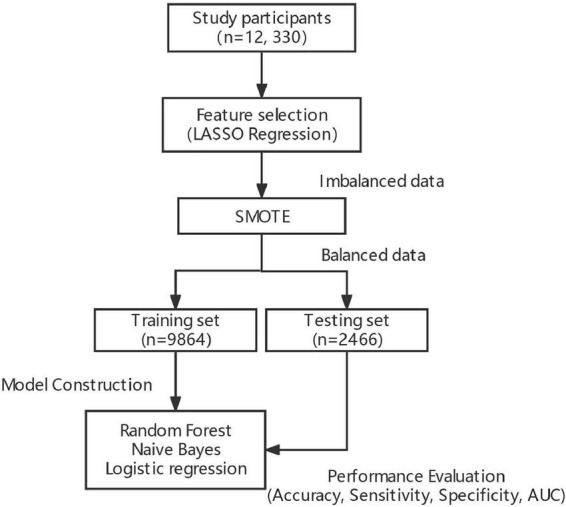
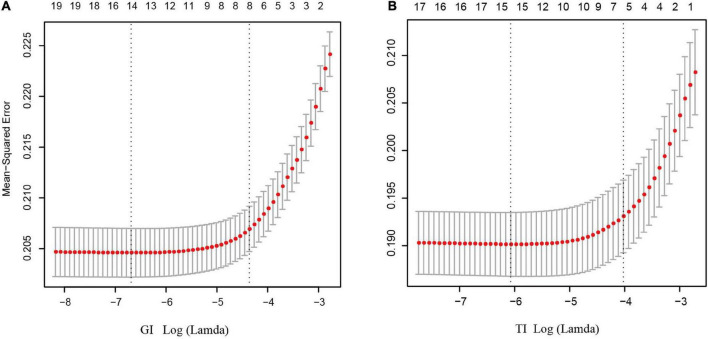
Demographic information, physical examination, blood, and morning urine samples were first collected from 13,550 subjects in 10 counties in Shanxi province for classification of GI and TI. Besides, LASSO regression was employed for feature selection of explanatory variables, and the SMOTE (synthetic minority over-sampling technique) algorithm was used to balance target datasets, i.e., GI and TI. Afterward, Random Forest (RF), Naive Bayes (NB), and logistic regression (LR) were constructed to achieve classification of GI and TI, respectively.

RESULTS

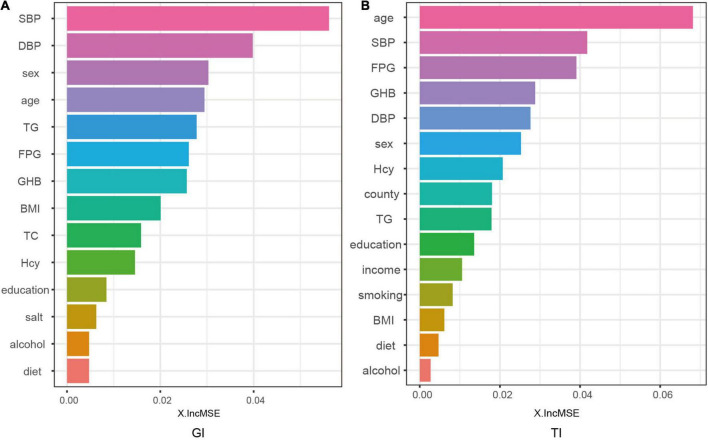
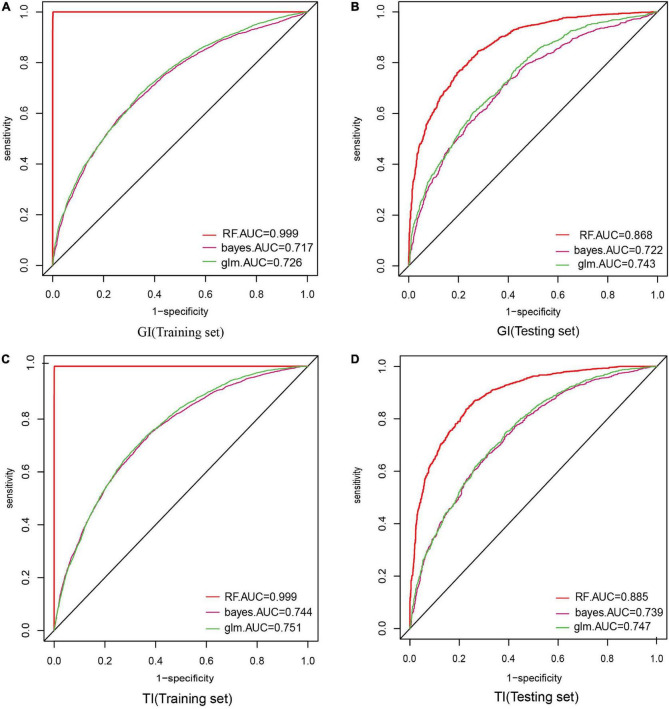
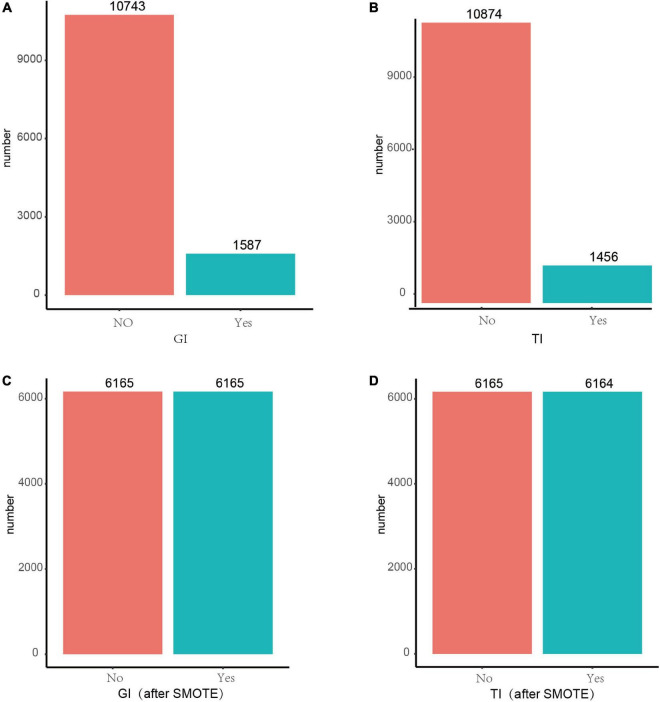
A total of 12,330 participants enrolled in this study, with 20 explanatory variables. The number of patients with GI, and TI were 1,587 (12.8%) and 1,456 (11.8%), respectively. After feature selection by LASSO, 14 and 15 explanatory variables remained in these two datasets. Besides, after SMOTE, the number of patients and normal ones were 6,165, 6,165 for GI, and 6,165, 6,164 for TI, respectively. RF outperformed NB and LR in terms of accuracy (78.14, 80.49%), sensitivity (82.00, 84.60%), specificity (74.29, 76.09%), and AUC (0.868, 0.885) for both GI and TI; the four variables contributing most to the classification of GI and TI represented SBP, DBP, sex, age and age, SBP, FPG, and GHb, respectively.

CONCLUSION

RF boasts good performance in classifying GI and TI, which allows for early auxiliary diagnosis of GI and TI, thus facilitating to help alleviate the progression of CKD, and enjoying great prospects in clinical practice.

摘要

目的

慢性肾脏病(CKD)是一种常见的慢性疾病,发病率高且起病隐匿。肾小球损伤(GI)和肾小管损伤(TI)是CKD的早期表现,可提示其发展风险。在本研究中,我们旨在使用三种机器学习算法对GI和TI进行分类,以促进其早期诊断并减缓CKD的进展。

方法

首先从山西省10个县的13550名受试者中收集人口统计学信息、体格检查、血液和晨尿样本,用于GI和TI的分类。此外,采用LASSO回归进行解释变量的特征选择,并使用SMOTE(合成少数过采样技术)算法平衡目标数据集,即GI和TI。随后,构建随机森林(RF)、朴素贝叶斯(NB)和逻辑回归(LR)分别实现GI和TI的分类。

结果

本研究共纳入12330名参与者,有20个解释变量。GI患者和TI患者的数量分别为1587例(12.8%)和1456例(11.8%)。经LASSO特征选择后,这两个数据集中分别保留了14个和15个解释变量。此外,经SMOTE处理后,GI组患者和正常者的数量分别为6165例、6165例,TI组分别为6165例、6164例。RF在GI和TI的准确率(78.14%、80.49%)、灵敏度(82.00%、84.60%)、特异度(74.29%、76.09%)和AUC(0.868、0.885)方面均优于NB和LR;对GI和TI分类贡献最大的四个变量分别为收缩压、舒张压、性别、年龄以及年龄、收缩压、空腹血糖和糖化血红蛋白。

结论

RF在GI和TI的分类中表现良好,可实现GI和TI的早期辅助诊断,从而有助于减缓CKD的进展,在临床实践中具有广阔前景。
https://cdn.ncbi.nlm.nih.gov/pmc/blobs/f8d4/9366016/e638fc9476f5/fmed-09-911737-g005.jpg
https://cdn.ncbi.nlm.nih.gov/pmc/blobs/f8d4/9366016/82c4d9eed2e1/fmed-09-911737-g001.jpg
https://cdn.ncbi.nlm.nih.gov/pmc/blobs/f8d4/9366016/dfda1229bc09/fmed-09-911737-g002.jpg
https://cdn.ncbi.nlm.nih.gov/pmc/blobs/f8d4/9366016/366a7139a87c/fmed-09-911737-g003.jpg
https://cdn.ncbi.nlm.nih.gov/pmc/blobs/f8d4/9366016/5b25459e940e/fmed-09-911737-g004.jpg
https://cdn.ncbi.nlm.nih.gov/pmc/blobs/f8d4/9366016/e638fc9476f5/fmed-09-911737-g005.jpg
https://cdn.ncbi.nlm.nih.gov/pmc/blobs/f8d4/9366016/82c4d9eed2e1/fmed-09-911737-g001.jpg
https://cdn.ncbi.nlm.nih.gov/pmc/blobs/f8d4/9366016/dfda1229bc09/fmed-09-911737-g002.jpg
https://cdn.ncbi.nlm.nih.gov/pmc/blobs/f8d4/9366016/366a7139a87c/fmed-09-911737-g003.jpg
https://cdn.ncbi.nlm.nih.gov/pmc/blobs/f8d4/9366016/5b25459e940e/fmed-09-911737-g004.jpg
https://cdn.ncbi.nlm.nih.gov/pmc/blobs/f8d4/9366016/e638fc9476f5/fmed-09-911737-g005.jpg

相似文献

1
Using random forest algorithm for glomerular and tubular injury diagnosis.使用随机森林算法进行肾小球和肾小管损伤诊断。
Front Med (Lausanne). 2022 Jul 28;9:911737. doi: 10.3389/fmed.2022.911737. eCollection 2022.
2
Machine learning-based warning model for chronic kidney disease in individuals over 40 years old in underprivileged areas, Shanxi Province.山西省贫困地区40岁以上人群慢性肾脏病的机器学习预警模型
Front Med (Lausanne). 2023 Jan 9;9:930541. doi: 10.3389/fmed.2022.930541. eCollection 2022.
3
[Constructing the Bayesian network models to explore the factors related to glomerular and tubular injury].构建贝叶斯网络模型以探索与肾小球和肾小管损伤相关的因素
Zhonghua Yi Xue Za Zhi. 2023 May 16;103(18):1401-1409. doi: 10.3760/cma.j.cn112137-20221101-02279.
4
Using Sensor Data to Detect Lameness and Mastitis Treatment Events in Dairy Cows: A Comparison of Classification Models.利用传感器数据检测奶牛跛行和乳腺炎治疗事件:分类模型比较。
Sensors (Basel). 2020 Jul 10;20(14):3863. doi: 10.3390/s20143863.
5
Structure-activity relationship-based chemical classification of highly imbalanced Tox21 datasets.基于结构-活性关系的高度不平衡Tox21数据集的化学分类
J Cheminform. 2020 Oct 27;12(1):66. doi: 10.1186/s13321-020-00468-x.
6
Stroke Prediction with Machine Learning Methods among Older Chinese.基于机器学习方法对中国老年人进行中风预测。
Int J Environ Res Public Health. 2020 Mar 12;17(6):1828. doi: 10.3390/ijerph17061828.
7
Optimizing the Predictive Ability of Machine Learning Methods for Landslide Susceptibility Mapping Using SMOTE for Lishui City in Zhejiang Province, China.利用 SMOTE 优化机器学习方法在浙江省丽水市滑坡易发性制图中的预测能力。
Int J Environ Res Public Health. 2019 Jan 28;16(3):368. doi: 10.3390/ijerph16030368.
8
Predicting 1-Year Mortality after Hip Fracture Surgery: An Evaluation of Multiple Machine Learning Approaches.预测髋部骨折手术后1年死亡率:多种机器学习方法的评估
J Pers Med. 2021 Jul 27;11(8):727. doi: 10.3390/jpm11080727.
9
Prediction of fatty liver disease using machine learning algorithms.使用机器学习算法预测脂肪肝疾病。
Comput Methods Programs Biomed. 2019 Mar;170:23-29. doi: 10.1016/j.cmpb.2018.12.032. Epub 2018 Dec 29.
10
Comparison between Statistical Models and Machine Learning Methods on Classification for Highly Imbalanced Multiclass Kidney Data.高度不平衡多类肾脏数据分类中统计模型与机器学习方法的比较
Diagnostics (Basel). 2020 Jun 18;10(6):415. doi: 10.3390/diagnostics10060415.

引用本文的文献

1
Aromadendrin alleviates LPS-induced kidney apoptosis and inflammation by inhibiting phosphorylation of MAPK and NF-κB signaling pathways.香橙素通过抑制丝裂原活化蛋白激酶(MAPK)和核因子κB(NF-κB)信号通路的磷酸化来减轻脂多糖(LPS)诱导的肾脏细胞凋亡和炎症。
Histol Histopathol. 2025 Feb;40(2):249-258. doi: 10.14670/HH-18-770. Epub 2024 May 30.
2
A Random Forest Algorithm for Assessing Risk Factors Associated With Chronic Kidney Disease: Observational Study.一种用于评估慢性肾脏病相关危险因素的随机森林算法:观察性研究。
Asian Pac Isl Nurs J. 2024 Jun 3;8:e48378. doi: 10.2196/48378.
3
Gut microbiota landscape and potential biomarker identification in female patients with systemic lupus erythematosus using machine learning.

本文引用的文献

1
Epidemiology of chronic kidney disease: an update 2022.慢性肾脏病流行病学:2022年最新情况
Kidney Int Suppl (2011). 2022 Apr;12(1):7-11. doi: 10.1016/j.kisu.2021.11.003. Epub 2022 Mar 18.
2
Targeting the Pathobiology of Diabetic Kidney Disease.靶向糖尿病肾病的病理生物学。
Adv Chronic Kidney Dis. 2021 Jul;28(4):282-289. doi: 10.1053/j.ackd.2021.07.001.
3
Using machine learning to predict atrial fibrillation diagnosed after ischemic stroke.使用机器学习预测缺血性卒后诊断的心房颤动。
基于机器学习的系统性红斑狼疮女性患者肠道微生物组特征及潜在生物标志物鉴定。
Front Cell Infect Microbiol. 2023 Dec 19;13:1289124. doi: 10.3389/fcimb.2023.1289124. eCollection 2023.
4
Using elastography-based multilayer perceptron model to evaluate renal fibrosis in chronic kidney disease.利用基于弹性成像的多层感知器模型评估慢性肾脏病中的肾纤维化。
Ren Fail. 2023 Dec;45(1):2202755. doi: 10.1080/0886022X.2023.2202755.
5
Using Bayesian networks with Tabu-search algorithm to explore risk factors for hyperhomocysteinemia.使用贝叶斯网络和禁忌搜索算法探索高同型半胱氨酸血症的危险因素。
Sci Rep. 2023 Jan 28;13(1):1610. doi: 10.1038/s41598-023-28123-z.
6
Machine learning-based warning model for chronic kidney disease in individuals over 40 years old in underprivileged areas, Shanxi Province.山西省贫困地区40岁以上人群慢性肾脏病的机器学习预警模型
Front Med (Lausanne). 2023 Jan 9;9:930541. doi: 10.3389/fmed.2022.930541. eCollection 2022.
Int J Cardiol. 2022 Jan 15;347:21-27. doi: 10.1016/j.ijcard.2021.11.005. Epub 2021 Nov 12.
4
Machine Learning Based Prediction of Squamous Cell Carcinoma in Ex Vivo Confocal Laser Scanning Microscopy.基于机器学习的体外共聚焦激光扫描显微镜下鳞状细胞癌预测
Cancers (Basel). 2021 Nov 3;13(21):5522. doi: 10.3390/cancers13215522.
5
Machine learning to identify immune-related biomarkers of rheumatoid arthritis based on WGCNA network.基于 WGCNA 网络的机器学习识别类风湿关节炎免疫相关生物标志物。
Clin Rheumatol. 2022 Apr;41(4):1057-1068. doi: 10.1007/s10067-021-05960-9. Epub 2021 Nov 12.
6
General deep learning model for detecting diabetic retinopathy.用于检测糖尿病性视网膜病变的通用深度学习模型。
BMC Bioinformatics. 2021 Nov 8;22(Suppl 5):84. doi: 10.1186/s12859-021-04005-x.
7
Integrated space-frequency-time domain feature extraction for MEG-based Alzheimer's disease classification.基于脑磁图的阿尔茨海默病分类的集成空频时域特征提取
Brain Inform. 2021 Nov 2;8(1):24. doi: 10.1186/s40708-021-00145-1.
8
Improving Risk Identification of Adverse Outcomes in Chronic Heart Failure Using SMOTE+ENN and Machine Learning.使用SMOTE+ENN和机器学习改善慢性心力衰竭不良结局的风险识别
Risk Manag Healthc Policy. 2021 Jun 8;14:2453-2463. doi: 10.2147/RMHP.S310295. eCollection 2021.
9
Convolutional Neural Network Model for Intensive Care Unit Acute Kidney Injury Prediction.用于重症监护病房急性肾损伤预测的卷积神经网络模型
Kidney Int Rep. 2021 Feb 26;6(5):1289-1298. doi: 10.1016/j.ekir.2021.02.031. eCollection 2021 May.
10
Diagnostic Classification and Biomarker Identification of Alzheimer's Disease with Random Forest Algorithm.基于随机森林算法的阿尔茨海默病诊断分类与生物标志物识别
Brain Sci. 2021 Apr 2;11(4):453. doi: 10.3390/brainsci11040453.