Smith Troy
Targeted Evidence-Based Research Solutions Ltd, Arouca, Trinidad and Tobago.
Curr Psychol. 2022 Aug 8:1-15. doi: 10.1007/s12144-022-03505-0.
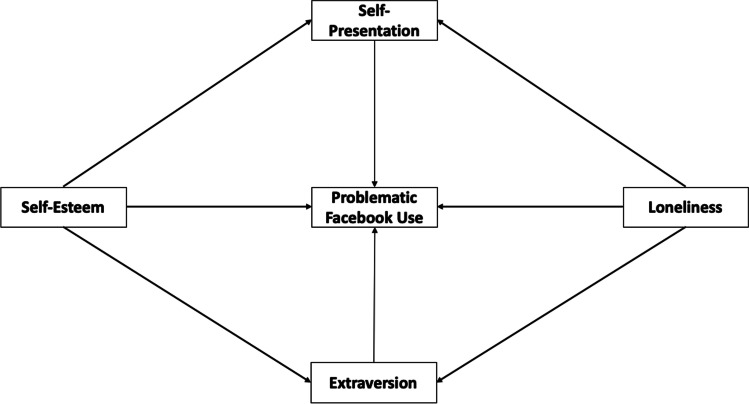
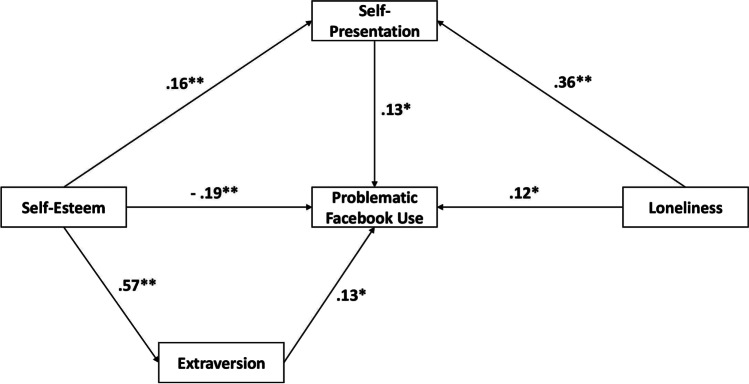
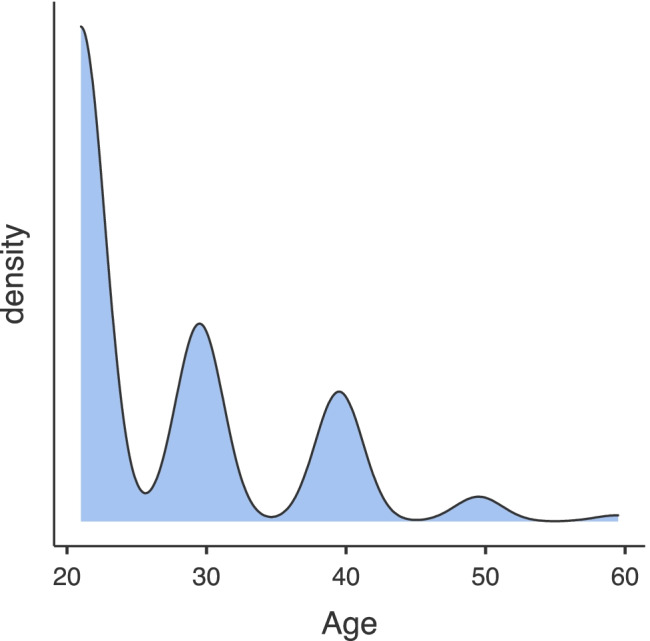
Studies indicate that loneliness and self-esteem are predictive factors of problematic social media use. Further, it is proposed that self-presentation and extraversion may explain individual differences in online activity and problematic social media use. The present study confirms the relationship of loneliness and self-esteem with problematic Facebook use and investigates the hypothesis that these psychological factors may be linked to problematic Facebook use through their association with self-presentation and extraversion. The sample of university students consisted of 477 Facebook users, 64% females, aged 18-64. Social media usage intensity was assessed by collecting passive data on the total time spent and the number of sessions on Facebook per day for the last 6 months. The psychological factors, personality, motives and problematic Facebook use were assessed via self-report measures. Results showed that the relationship of loneliness and self-esteem with problematic Facebook use was significantly positive and negative respectively. The relationship between self-esteem and problematic Facebook use was found to be inconsistently mediated by both self-presentation and extraversion, while loneliness was partially mediated by self-presentation only. The total effect of loneliness and self-esteem remained positive and negative respectively, although extraversion and self-presentation had a suppressing effect on the relationship between self-esteem and problematic Facebook use. Further, the prevalence of 'at-risk' Facebook users was found to be 6.0%. It was also determined that the usage intensity of 'at-risk' users was significantly different from other Facebook users. These results highlight the existence of different patterns of associations linking psychological factors, usage intensity and problematic Facebook use.
The online version contains supplementary material available at 10.1007/s12144-022-03505-0.
研究表明,孤独感和自尊是社交媒体使用问题的预测因素。此外,有人提出自我呈现和外向性可能解释在线活动和社交媒体使用问题中的个体差异。本研究证实了孤独感和自尊与Facebook使用问题之间的关系,并调查了这样一种假设,即这些心理因素可能通过与自我呈现和外向性的关联而与Facebook使用问题相关联。大学生样本包括477名Facebook用户,其中64%为女性,年龄在18至64岁之间。通过收集过去6个月每天在Facebook上花费的总时间和会话次数的被动数据来评估社交媒体使用强度。通过自我报告测量来评估心理因素、个性、动机和Facebook使用问题。结果表明,孤独感和自尊与Facebook使用问题之间的关系分别显著为正和负。发现自尊与Facebook使用问题之间的关系由自我呈现和外向性不一致地介导,而孤独感仅由自我呈现部分介导。尽管外向性和自我呈现对自尊与Facebook使用问题之间的关系有抑制作用,但孤独感和自尊的总效应分别仍为正和负。此外,发现“有风险”的Facebook用户的患病率为6.0%。还确定“有风险”用户的使用强度与其他Facebook用户有显著差异。这些结果突出了将心理因素、使用强度和Facebook使用问题联系起来的不同关联模式的存在。
在线版本包含可在10.1007/s12144-022-03505-0获取的补充材料。