Oliveira Manuel, Koshibu Kyoko, Rytz Andreas, Giuffrida Francesca, Sultan Sebastien, Patin Amaury, Gaudin Mathieu, Tomezyk Aurore, Steiner Pascal, Schneider Nora
Brain Health Department, Nestlé Institute of Health Sciences, Nestlé Research, Société des Produits Nestlé S.A., Lausanne, Switzerland.
Clinical Research Unit, Nestlé Research, Société des Produits Nestlé S.A., Lausanne, Switzerland.
Front Nutr. 2022 Jul 26;9:898655. doi: 10.3389/fnut.2022.898655. eCollection 2022.
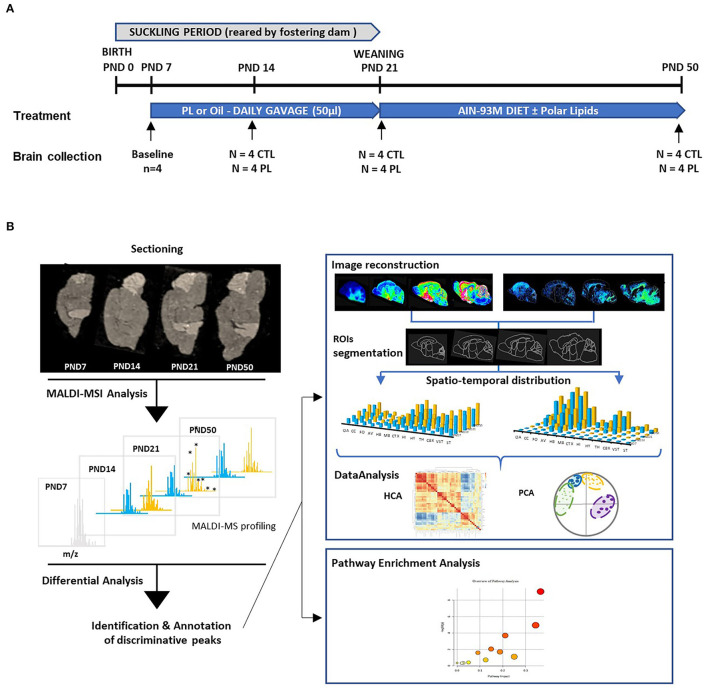
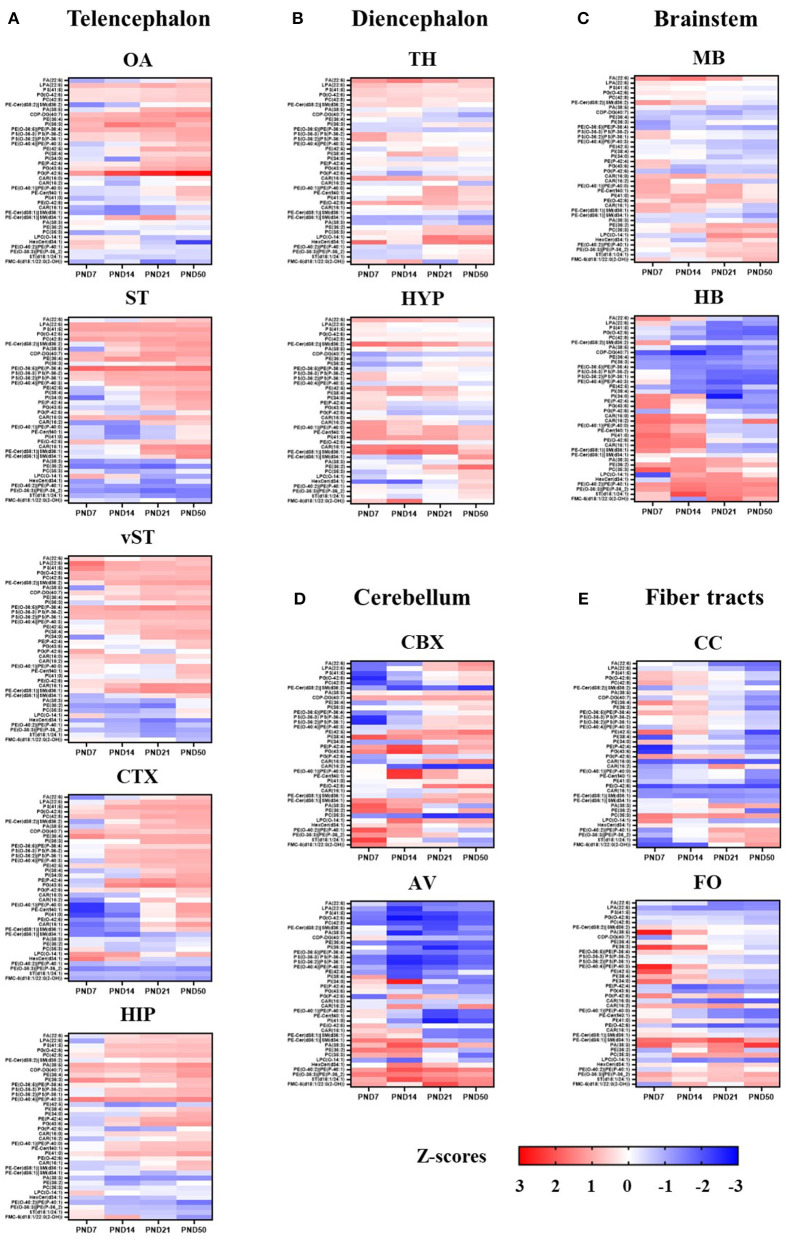
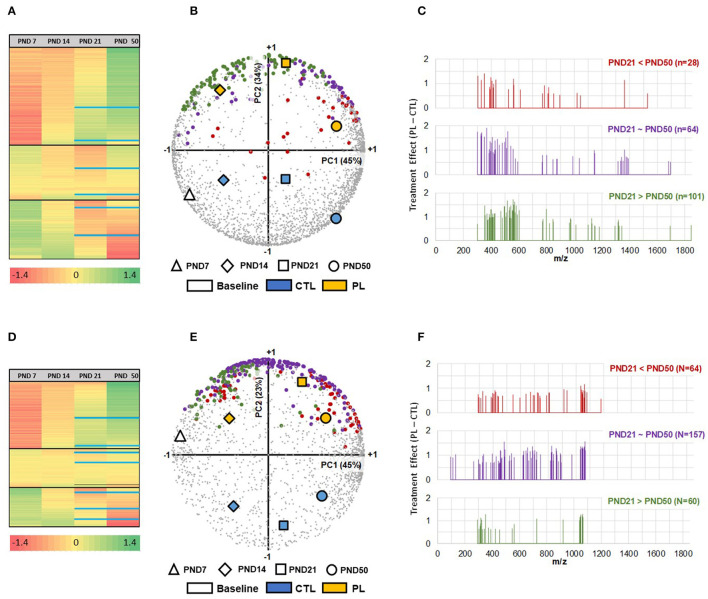
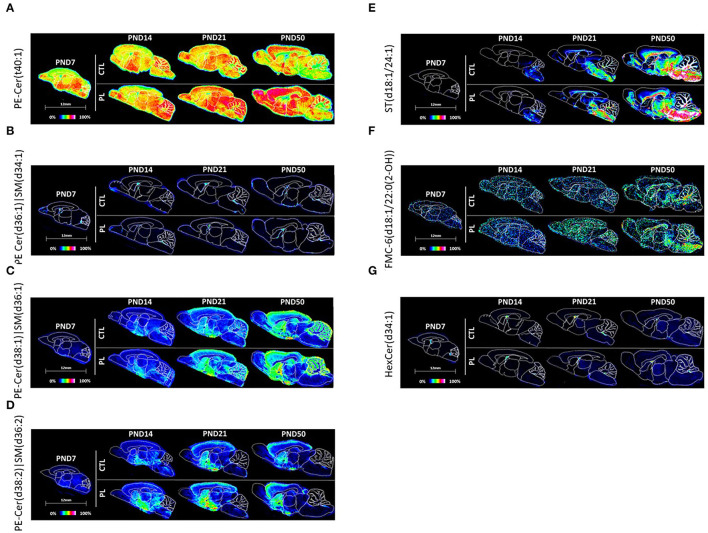
The lipid composition of the brain is well regulated during development, and the specific temporospatial distribution of various lipid species is essential for the development of optimal neural functions. Dietary lipids are the main source of brain lipids and thus contribute to the brain lipidome. Human milk is the only source of a dietary lipids for exclusively breastfed infant. Notably, it contains milk fat globule membrane (MFGM) enriched in polar lipids (PL). While early life is a key for early brain development, the interplay between dietary intake of polar lipids and spatial dynamics of lipid distribution during brain development is poorly understood. Here, we carried out an exploratory study to assess the early postnatal temporal profiling of brain lipidome between postnatal day (PND) 7 and PND 50 using matrix-assisted laser desorption ionization as a mass spectrometry imaging (MALDI-MSI) in an preclinical model. We also assessed the effect of chronic supplementation with PL extracted from alpha-lactalbumin-enriched whey protein concentrate (WPC) containing 10% lipids, including major lipid classes found in the brain (37% phospholipids and 15% sphingomyelin). MALDI-MSI of the spatial and temporal accretion of lipid species during brain development showed that the brain lipidome is changing heterogeneously along time during brain development. In addition, increases in 400+ PL supplement-dependent lipids were observed. PL supplementation had significant spatial and temporal effect on specific fatty esters, glycerophosphocholines, glycerophosphoethanolamines, and phosphosphingolipids. Interestingly, the average levels of these lipids per brain area tended to be constant in various brain structures across the age groups, paralleling the general brain growth. In contrast, other lipids, such as cytidine diphosphate diacylglycerol, diacylglycerophosphates, phosphocholines, specific ether-phosphoethanolamines, phosphosphingolipids, glycerophosphoinositols, and glycerophosphoserines showed clear age-dependent changes uncoupled from the general brain growth. These results suggest that the dietary PL supplementation may preferentially provide the building blocks for the general brain growth during development. Our findings add to the understanding of brain-nutrient relations, their temporospatial dynamics, and potential impact on neurodevelopment.
大脑的脂质组成在发育过程中受到良好调控,各种脂质种类的特定时空分布对于最佳神经功能的发育至关重要。膳食脂质是大脑脂质的主要来源,因此对大脑脂质组有贡献。母乳是纯母乳喂养婴儿唯一的膳食脂质来源。值得注意的是,它含有富含极性脂质(PL)的乳脂肪球膜(MFGM)。虽然生命早期是大脑早期发育的关键时期,但膳食中极性脂质的摄入与大脑发育过程中脂质分布的空间动态之间的相互作用却知之甚少。在此,我们进行了一项探索性研究,在一个临床前模型中,使用基质辅助激光解吸电离作为质谱成像(MALDI-MSI)技术,评估出生后第7天(PND 7)至第50天大脑脂质组的早期产后时间谱。我们还评估了长期补充从富含α-乳白蛋白的乳清蛋白浓缩物(WPC)中提取的PL的效果,该WPC含有10%的脂质,包括大脑中发现的主要脂质类别(37%的磷脂和15%的鞘磷脂)。大脑发育过程中脂质种类的时空积累的MALDI-MSI显示,大脑脂质组在大脑发育过程中随时间呈异质性变化。此外,观察到400多种PL补充剂依赖性脂质增加。PL补充剂对特定脂肪酸酯、甘油磷酸胆碱、甘油磷酸乙醇胺和磷酸鞘脂具有显著的时空效应。有趣的是,这些脂质在每个脑区的平均水平在不同年龄组的各种脑结构中趋于恒定,与大脑的总体生长情况平行。相比之下,其他脂质,如胞苷二磷酸二酰甘油、二酰甘油磷酸、磷酸胆碱、特定的醚-磷酸乙醇胺、磷酸鞘脂、甘油磷酸肌醇和甘油磷酸丝氨酸则显示出与大脑总体生长无关的明显年龄依赖性变化。这些结果表明,膳食PL补充剂可能在发育过程中优先为大脑的总体生长提供构建模块。我们的发现增进了对大脑-营养关系、它们的时空动态以及对神经发育潜在影响的理解。