Wu Haixiao, Li Shu, Lin Yile, Wang Jun, Chekhonin Vladimir P, Peltzer Karl, Baklaushev Vladimir P, Abbas Kirellos Said, Zhang Jin, Li Huiyang, Zhang Chao
Tianjin Medical University Cancer Institute and Hospital, National Clinical Research Center for Cancer, Key Laboratory of Cancer Prevention and Therapy, Tianjin's Clinical Research Center for Cancer, Tianjin, China.
The Sino-Russian Joint Research Center for Bone Metastasis in Malignant Tumor, Tianjin, China.
Front Nutr. 2022 Jul 28;9:899501. doi: 10.3389/fnut.2022.899501. eCollection 2022.
Leucopenia (LP) greatly limits the efficacy of chemotherapy in osteosarcoma patients. This study aimed to evaluate the nutritional status of osteosarcoma patients before chemotherapy, assess the risk of LP during the perichemotherapy period, and explore the association between malnutrition and LP.
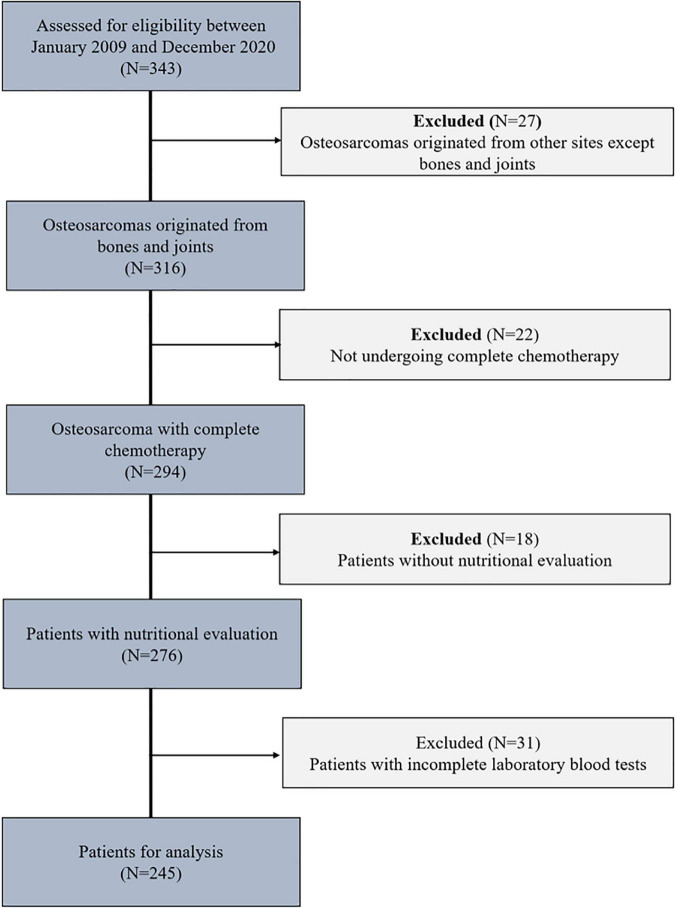
This study retrospectively analyzed osteosarcoma patients treated in the Tianjin Medical University Cancer Institute and Hospital, China, between January 2009 and December 2020 according to the inclusion and exclusion criteria. Malnutrition in adolescents (5 to 19 years old) and adults (≥20 years old) was diagnosed using WHO AnthroPlus software (version 1.0.4) and Global Leadership initiative on Malnutrition (GLIM), respectively. According to the diagnostic criteria of LP in CTCAE 5.0, patients were divided into the LP group and the non-LP group.
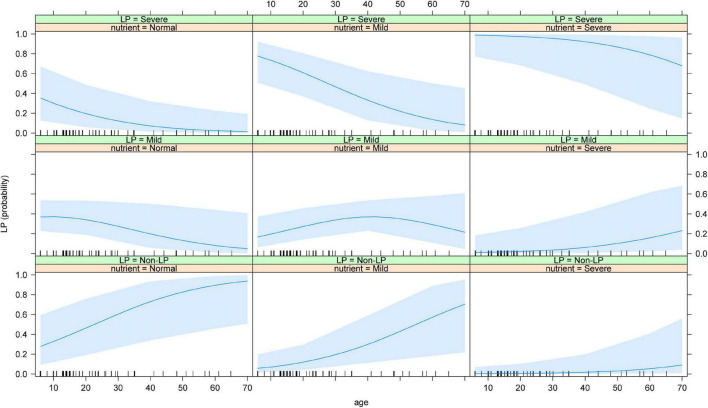
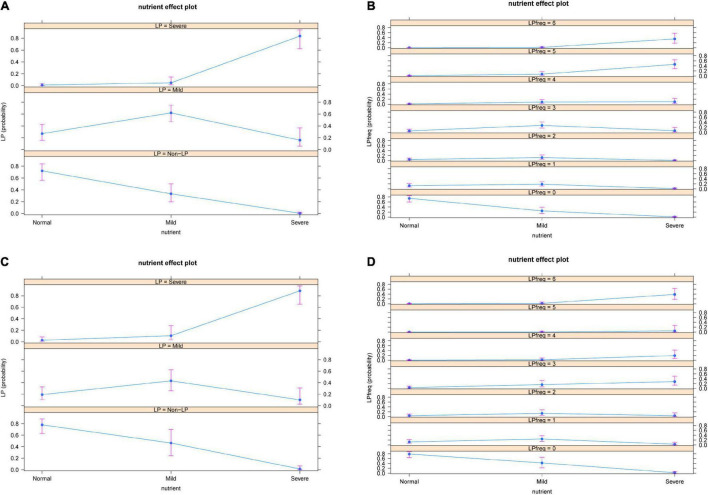
A total of 245 osteosarcoma patients were included. The incidence of malnutrition was 49.0%, and the incidence of LP was 51.8%. The incidence of malnutrition in adolescent patients was 53.1%, and their incidence of LP was 55.2%; the incidence of malnutrition in adult patients was 43.1%, and their incidence of LP was 47.1%. Logistic regression analysis showed that malnutrition before chemotherapy was an independent risk factor for the occurrence of LP after chemotherapy (OR = 6.85, 95% CI = 2.16-25.43; and OR = 35.03, 95% CI = 6.98-238.46 in mildly and severely malnourished young patients; OR = 6.06; 95% CI = 1.43-30.16; and OR = 38.09, 95% CI = 7.23-285.78 in mildly and severely malnourished adult patients, respectively). The results showed that age and nutritional status had a joint effect on the occurrence of LP.
The nutrition status of osteosarcoma patients before chemotherapy is significantly correlated with the occurrence and severity of LP during peri-chemotherapy period. During osteosarcoma chemotherapy, necessary nutritional support should be given to patients of different ages to correct their malnutrition status in a timely manner, ultimately improving the efficacy of chemotherapy and the prognosis of patients.
白细胞减少症(LP)极大地限制了骨肉瘤患者化疗的疗效。本研究旨在评估骨肉瘤患者化疗前的营养状况,评估化疗期间发生LP的风险,并探讨营养不良与LP之间的关联。
本研究根据纳入和排除标准,回顾性分析了2009年1月至2020年12月在中国天津医科大学肿瘤医院接受治疗的骨肉瘤患者。分别使用WHO AnthroPlus软件(1.0.4版)和全球营养不良领导倡议(GLIM)诊断青少年(5至19岁)和成人(≥20岁)的营养不良情况。根据CTCAE 5.0中LP的诊断标准,将患者分为LP组和非LP组。
共纳入245例骨肉瘤患者。营养不良发生率为49.0%,LP发生率为51.8%。青少年患者营养不良发生率为53.1%,LP发生率为55.2%;成人患者营养不良发生率为43.1%,LP发生率为47.1%。Logistic回归分析显示,化疗前营养不良是化疗后发生LP的独立危险因素(轻度和重度营养不良的年轻患者中,OR = 6.85,95%CI = 2.16 - 25.43;OR = 35.03,95%CI = 6.98 - 238.46;轻度和重度营养不良的成年患者中,OR = 6.06;95%CI = 1.43 - 30.16;OR = 38.09,95%CI = 7.23 - 285.78)。结果表明年龄和营养状况对LP的发生有联合影响。
骨肉瘤患者化疗前的营养状况与化疗期间LP的发生及严重程度显著相关。在骨肉瘤化疗期间,应给予不同年龄段患者必要的营养支持,及时纠正其营养不良状况,最终提高化疗疗效及患者预后。