Center of Infectious Diseases, Beijing Ditan Hospital, Capital Medical University, Beijing, China.
Beijing Key Laboratory of Emerging Infectious Disease, Beijing Ditan Hospital, Captital Medical University, Beijing, China.
J Med Virol. 2022 Dec;94(12):5922-5932. doi: 10.1002/jmv.28068. Epub 2022 Aug 29.
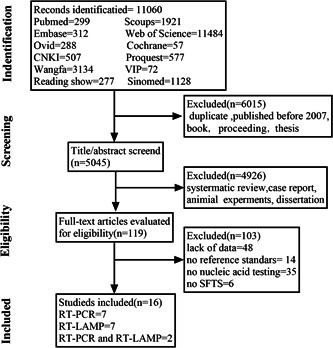
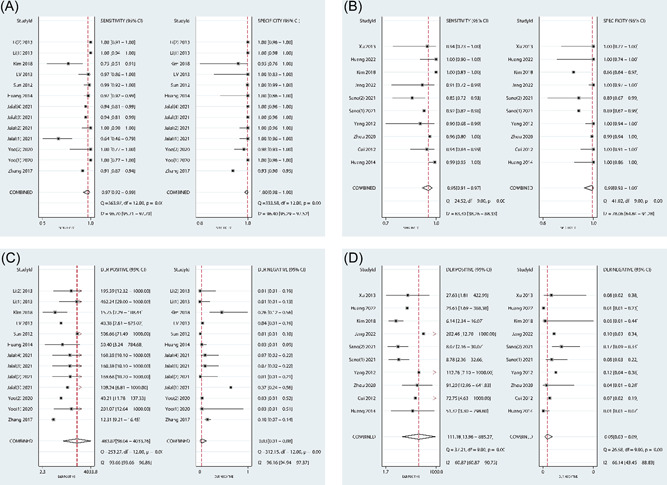
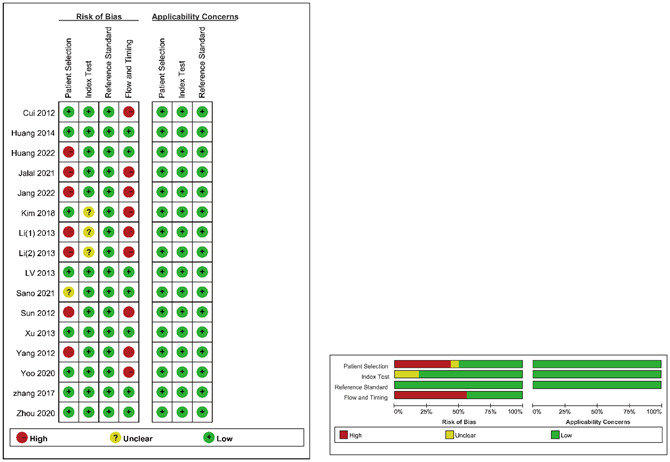
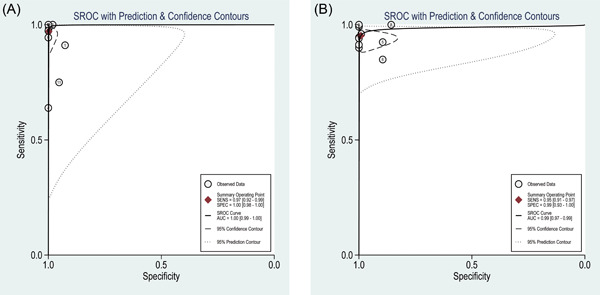
Nucleic acid molecular diagnostic technology plays an important role in the detection of severe fever with thrombocytopenia syndrome (SFTS). However, no relevant reports have been published on the accuracy of reverse-transcription polymerase chain reaction (RT-PCR) and reverse-transcription loop-mediated isothermal amplification (RT-LAMP) in the diagnosis of SFTS. Thus, we conducted a meta-analysis and systematic review to evaluate the accuracy of the two methods. On June 19, 2022, we comprehensively searched the PubMed, Embase, Cochrane Library, Web of Science, Scoups, Ovid, Proquest, China National Knowledge Infrastructure Database, Wan Fang Data, Traditional Chinese Medicine Database (Sinomed), VIP Database, and Reading Showing Database for articles on nucleic acid diagnostic techniques, such as RT-PCR and RT-LAMP, used to diagnose SFTS. Statistical analysis was performed using STATA 14.0 and Meta-Disc 1.4. Sixteen articles involving 2942 clinical blood samples were included in the analysis. RT-PCR and RT-LAMP were used as index tests, whereas RT-PCR or other detection methods were used as reference standards. The pooled values for the sensitivity, specificity, positive and negative likelihood ratios of the RT-PCR test were 0.97 (95% confidence interval [CI]: 0.92-0.99), 1.00 (95% CI: 0.98-1.00), 483.87 (95% CI: 58.04-4033.76), and 0.03 (95% CI:0.01-0.08), respectively. Those for the RT-LAMP test were 0.95 (95% CI: 0.91-0.97), 0.99 (95% CI: 0.93-1.00), 111.18 (95% CI: 13.96-885.27), and 0.05 (95% CI: 0.03-0.09), respectively. Both RT-PCR and RT-LAMP have high diagnostic value in SFTS and can be applied in different scenarios for laboratory confirmation or on-site screening.
核酸分子诊断技术在严重发热伴血小板减少综合征(SFTS)的检测中发挥着重要作用。然而,目前尚无关于逆转录聚合酶链反应(RT-PCR)和逆转录环介导等温扩增(RT-LAMP)在 SFTS 诊断中的准确性的相关报道。因此,我们进行了一项荟萃分析和系统评价,以评估这两种方法的准确性。2022 年 6 月 19 日,我们全面检索了 PubMed、Embase、Cochrane 图书馆、Web of Science、Scoups、Ovid、Proquest、中国知网、万方数据、中国生物医学文献数据库(Sinomed)、维普数据库和读秀知识库,以获取有关核酸诊断技术(如 RT-PCR 和 RT-LAMP)用于诊断 SFTS 的文章。使用 STATA 14.0 和 Meta-Disc 1.4 进行统计分析。共纳入 16 项涉及 2942 例临床血样的研究。将 RT-PCR 和 RT-LAMP 作为指标试验,而将 RT-PCR 或其他检测方法作为参考标准。RT-PCR 试验的敏感性、特异性、阳性和阴性似然比的合并值分别为 0.97(95%置信区间 [CI]:0.92-0.99)、1.00(95% CI:0.98-1.00)、483.87(95% CI:58.04-4033.76)和 0.03(95% CI:0.01-0.08)。RT-LAMP 试验的合并值分别为 0.95(95% CI:0.91-0.97)、0.99(95% CI:0.93-1.00)、111.18(95% CI:13.96-885.27)和 0.05(95% CI:0.03-0.09)。RT-PCR 和 RT-LAMP 对 SFTS 均具有较高的诊断价值,可应用于不同场景的实验室确认或现场筛查。