Department of Veterinary Microbiology, Iowa State Universitygrid.34421.30, Ames, Iowa, USA.
Division of Biology, Kansas State Universitygrid.36567.31, Manhattan Kansas, USA.
mSystems. 2022 Oct 26;7(5):e0029322. doi: 10.1128/msystems.00293-22. Epub 2022 Aug 15.
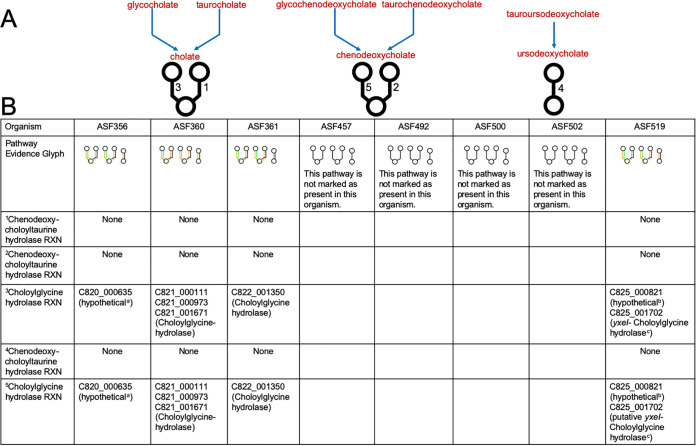
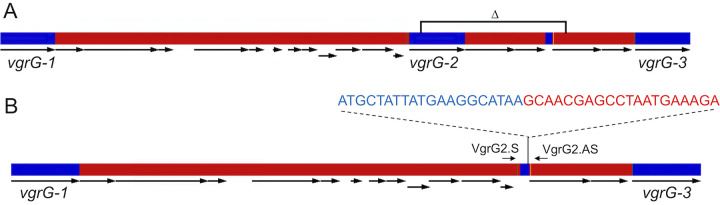
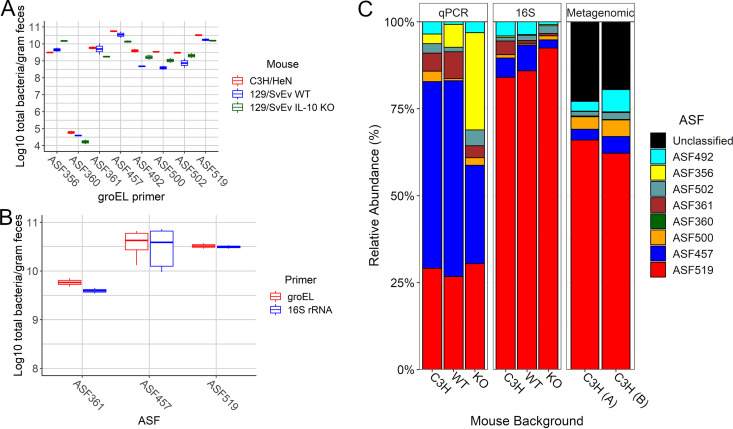
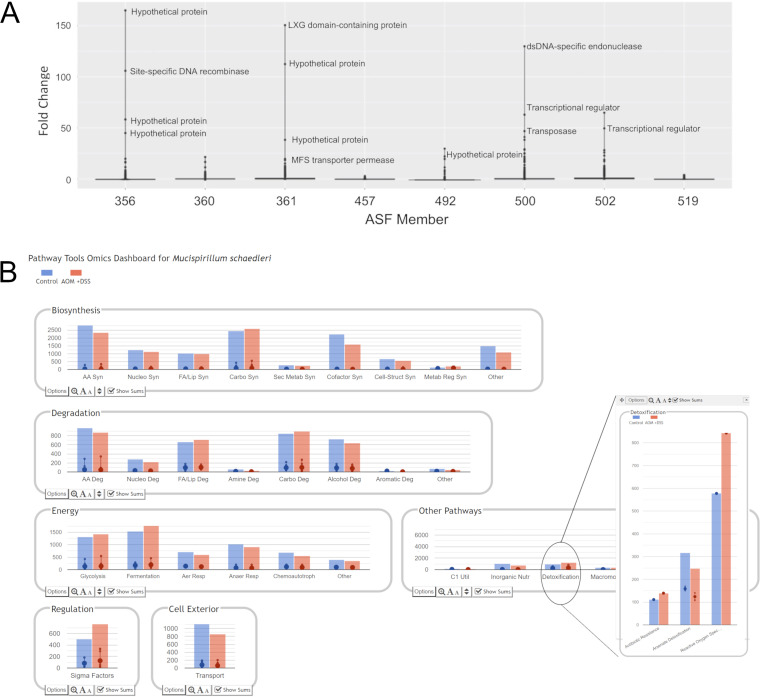
Animals colonized with a defined microbiota represent useful experimental systems to investigate microbiome function. The altered Schaedler flora (ASF) represents a consortium of eight murine bacterial species that have been used for more than 4 decades where the study of mice with a reduced microbiota is desired. In contrast to germ-free mice, or mice colonized with only one or two species, ASF mice show the normal gut structure and immune system development. To further expand the utility of the ASF, we have developed technical and bioinformatic resources to enable a systems-based analysis of microbiome function using this model. Here, we highlighted four distinct applications of these resources that enable and improve (i) measurements of the abundance of each ASF member by quantitative PCR; (ii) exploration and comparative analysis of ASF genomes and the metabolic pathways they encode that comprise the entire gut microbiome; (iii) global transcriptional profiling to identify genes whose expression responds to environmental changes within the gut; and (iv) discovery of genetic changes resulting from the evolutionary adaptation of the microbiota. These resources were designed to be accessible to a broad community of researchers that, in combination with conventionally-reared mice (i.e., with complex microbiome), should contribute to our understanding of microbiome structure and function. Improved experimental systems are needed to advance our understanding of how the gut microbiome influences processes of the mammalian host as well as microbial community structure and function. An approach that is receiving considerable attention is the use of animal models that harbor a stable microbiota of known composition, i.e., defined microbiota, which enables control over an otherwise highly complex and variable feature of mammalian biology. The altered Schaedler flora (ASF) consortium is a well-established defined microbiota model, where mice are stably colonized with 8 distinct murine bacterial species. To take better advantage of the ASF, we established new experimental and bioinformatics resources for researchers to make better use of this model as an experimental system to study microbiome function.
动物的定植菌群代表了有用的实验系统,可以用于研究微生物组的功能。改变的 Schaedler 菌群(ASF)代表了一组 8 种鼠源细菌的共生体,已经被使用了 40 多年,用于研究微生物组减少的小鼠。与无菌小鼠或定植了一种或两种细菌的小鼠相比,ASF 小鼠表现出正常的肠道结构和免疫系统发育。为了进一步扩展 ASF 的用途,我们开发了技术和生物信息学资源,以实现使用该模型对微生物组功能进行系统分析。在这里,我们强调了这些资源的四个不同应用,这些应用使并改进了以下方面:(i)通过定量 PCR 测量每个 ASF 成员的丰度;(ii)探索和比较 ASF 基因组及其编码的代谢途径的分析,这些途径构成了整个肠道微生物组;(iii)进行全局转录谱分析,以确定对肠道内环境变化做出响应的基因;以及(iv)发现由于微生物组的进化适应而导致的遗传变化。这些资源旨在供广泛的研究人员使用,与传统饲养的小鼠(即具有复杂定植菌群的小鼠)相结合,应有助于我们理解微生物组的结构和功能。为了提高我们对肠道微生物组如何影响哺乳动物宿主的过程以及微生物群落结构和功能的理解,需要改进实验系统。一种受到广泛关注的方法是使用具有已知组成的稳定定植菌群的动物模型,即定义好的定植菌群,从而可以控制哺乳动物生物学中原本非常复杂和多变的特征。改变的 Schaedler 菌群(ASF)共生体是一种成熟的定义好的定植菌群模型,其中小鼠稳定定植了 8 种不同的鼠源细菌。为了更好地利用 ASF,我们为研究人员建立了新的实验和生物信息学资源,以更好地利用这种模型作为研究微生物组功能的实验系统。