Department of Thoracic/Head and Neck Medical Oncology, University of Texas MD Anderson Cancer Center, Houston, Texas.
Edwin L. Steele Laboratories, Department of Radiation Oncology, Massachusetts General Hospital, Harvard Medical School, Boston, Massachusetts.
Clin Cancer Res. 2023 Jan 4;29(1):30-39. doi: 10.1158/1078-0432.CCR-22-1366.
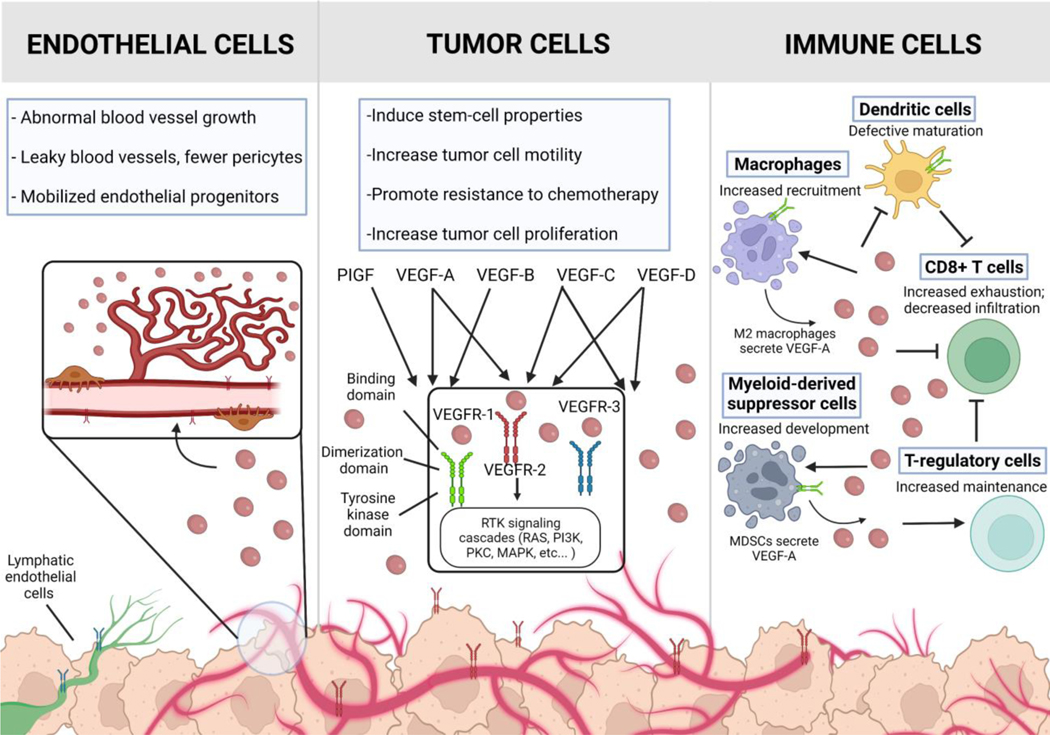
Angiogenesis, the sprouting of new blood vessels from existing vessels, is one of six known mechanisms employed by solid tumors to recruit blood vessels necessary for their initiation, growth, and metastatic spread. The vascular network within the tumor facilitates the transport of nutrients, oxygen, and immune cells and is regulated by pro- and anti-angiogenic factors. Nearly four decades ago, VEGF was identified as a critical factor promoting vascular permeability and angiogenesis, followed by identification of VEGF family ligands and their receptors (VEGFR). Since then, over a dozen drugs targeting the VEGF/VEGFR pathway have been approved for approximately 20 solid tumor types, usually in combination with other therapies. Initially designed to starve tumors, these agents transiently "normalize" tumor vessels in preclinical and clinical studies, and in the clinic, increased tumor blood perfusion or oxygenation in response to these agents is associated with improved outcomes. Nevertheless, the survival benefit has been modest in most tumor types, and there are currently no biomarkers in routine clinical use for identifying which patients are most likely to benefit from treatment. However, the ability of these agents to reprogram the immunosuppressive tumor microenvironment into an immunostimulatory milieu has rekindled interest and has led to the FDA approval of seven different combinations of VEGF/VEGFR pathway inhibitors with immune checkpoint blockers for many solid tumors in the past 3 years. In this review, we discuss our understanding of the mechanisms of response and resistance to blocking VEGF/VEGFR, and potential strategies to develop more effective therapeutic approaches.
血管生成,即新血管从现有血管中萌发,是实体瘤用于招募启动、生长和转移所需血管的六种已知机制之一。肿瘤内的血管网络促进了营养物质、氧气和免疫细胞的运输,并受到促血管生成和抗血管生成因子的调节。大约四十年前,VEGF 被确定为促进血管通透性和血管生成的关键因素,随后确定了 VEGF 家族配体及其受体 (VEGFR)。此后,已有十几种针对 VEGF/VEGFR 途径的药物被批准用于大约 20 种实体瘤类型,通常与其他疗法联合使用。这些药物最初旨在使肿瘤饥饿,在临床前和临床研究中,它们会短暂地“使肿瘤血管正常化”,并且在临床上,这些药物增加肿瘤血液灌注或氧合作用与改善预后相关。然而,在大多数肿瘤类型中,生存获益是适度的,目前尚无常规临床使用的生物标志物来识别哪些患者最有可能从治疗中受益。然而,这些药物能够将免疫抑制性肿瘤微环境重新编程为免疫刺激环境,重新引起了人们的兴趣,并导致在过去 3 年中,FDA 批准了七种不同的 VEGF/VEGFR 途径抑制剂与免疫检查点抑制剂联合用于许多实体瘤的治疗。在这篇综述中,我们讨论了我们对阻断 VEGF/VEGFR 反应和耐药机制的理解,以及开发更有效治疗方法的潜在策略。