Department of Biological Sciences, University of Calgary, Calgary, Alberta T2N 1N4, Canada.
Dipartimento di Chimica "Giacomo Ciamician", Università di Bologna, Via Selmi 2, 40126 Bologna, Italy.
ACS Appl Bio Mater. 2022 Sep 19;5(9):4203-4212. doi: 10.1021/acsabm.2c00404. Epub 2022 Aug 15.
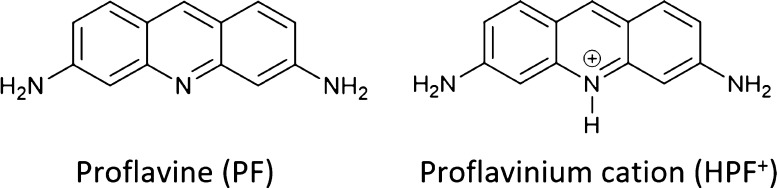
Here, we exploit our mechanochemical synthesis for co-crystallization of an organic antiseptic, proflavine, with metal-based antimicrobials (silver, copper, zinc, and gallium). Our previous studies have looked for general antimicrobial activity for the co-crystals: proflavine·AgNO, proflavine·CuCl, ZnCl[Proflavinium], [Proflavinium][ZnCl]·HO, and [Proflavinium][Ga(oxalate)]·4HO. Here, we explore and compare more precisely the bacteriostatic (minimal inhibitory concentrations) and antibiofilm (prevention of cell attachment and propagation) activities of the co-crystals. For this, we choose three prominent "ESKAPE" bacterial pathogens of , , and . The antimicrobial behavior of the co-crystals was compared to that of the separate components of the polycrystalline samples to ascertain whether the proflavine-metal complex association in the solid state provided effective antimicrobial performance. We were particularly interested to see if the co-crystals were effective in preventing bacteria from initiating and propagating the biofilm mode of growth, as this growth form provides high antimicrobial resistance properties. We found that for the planktonic lifestyle of growth of the three bacterial strains, different co-crystal formulations gave selectivity for best performance For the biofilm state of growth, we see that the silver proflavine co-crystal has the best overall antibiofilm activity against all three organisms. However, other proflavine-metal co-crystals also show practical antimicrobial efficacy against and . While not all proflavine-metal co-crystals demonstrated enhanced antimicrobial efficacy over their constituents alone, all possessed acceptable antimicrobial properties while trapped in the co-crystal form. We also demonstrate that the metal-proflavine crystals retain antimicrobial activity in storage. This work defines that co-crystallization of metal compounds and organic antimicrobials has a potential role in the quest for antimicrobials/antiseptics in the defense against bacteria in our antimicrobial resistance era.
在这里,我们利用机械化学合成方法将一种有机防腐剂普罗凡与金属基抗菌剂(银、铜、锌和镓)共结晶。我们之前的研究已经寻找了共晶的一般抗菌活性:普罗凡·硝酸银、普罗凡·氯化铜、ZnCl[普罗凡鎓]、[普罗凡鎓][ZnCl]·H2O 和 [普罗凡鎓][草酸镓]·4H2O。在这里,我们更精确地探索和比较了共晶的抑菌(最小抑菌浓度)和抗生物膜(防止细胞附着和繁殖)活性。为此,我们选择了三个突出的“ESKAPE”细菌病原体、和。我们将共晶的抗菌行为与多晶样品的单独成分进行了比较,以确定固体状态下普罗凡-金属配合物的结合是否提供了有效的抗菌性能。我们特别感兴趣的是,共晶是否能有效防止细菌启动和繁殖生物膜生长模式,因为这种生长形式提供了高度的抗微生物抗性。我们发现,对于三种细菌菌株的浮游生物生长方式,不同的共晶配方对最佳性能具有选择性。对于生物膜生长状态,我们看到银普罗凡共晶对所有三种生物都具有最佳的整体抗生物膜活性。然而,其他普罗凡-金属共晶也显示出对和的实际抗菌功效。虽然并非所有普罗凡-金属共晶都表现出比其成分单独使用时增强的抗菌功效,但所有共晶形式都具有可接受的抗菌性能。我们还证明了金属-普罗凡晶体在储存过程中保持抗菌活性。这项工作定义了金属化合物和有机抗菌剂的共结晶在寻求对抗我们抗微生物耐药时代细菌的抗菌剂/防腐剂方面具有潜在作用。