Mukhtar Noha, Bakhsh Abdulmohsen, Alreshidi Nahlah, Aljomaiah Abeer, Aljamei Hadeel, Alsudani Nada, Elsayed Tarek, Fadel Roqayh, Alqahtani Eman, Alzahrani Ali S
Department of Medicine, King Faisal Specialist Hospital & Research Centre, Riyadh 11211, Saudi Arabia.
Endocr Metab Sci. 2022 Jun 30;7:100122. doi: 10.1016/j.endmts.2022.100122. Epub 2022 Aug 11.
COVID-19 is a new viral infection affecting mainly the respiratory system with involvement of many other organs. Thyroid dysfunction has been described in COVID-19 but data are still unclear and conflicting on its frequency, severity and relationship with the outcome.
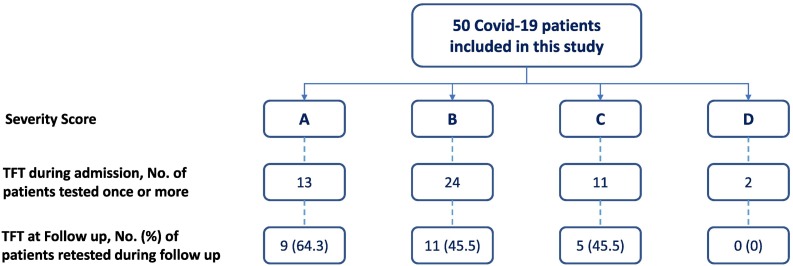
We assessed thyroid function tests (TFT) in 50 patients admitted to our institution with confirmed COVID-19 infection. We excluded patients known to have thyroid diseases or taking drugs that may affect thyroid function. Serum free thyroxine (FT4), thyrotropin (TSH) and triiodothyronine (T3) were measured once or more during the first 10 days after admission. In about 50 % of the cases, a follow up TFT was obtained during the first year after discharge (at a median follow up of 6 months).
We included 50 patients, 29 males (58 %) and 21 females (42 %). The median age was 47 years (range 25-89). Overall, TFTs were completely normal in all patients except for minor transient abnormalities in 5 patients (10 %) as follows: three patients had a mild transient elevated TSH, one had a mild transient suppressed TSH and one patient had a mildly low FT4 with normal TSH. There were no differences between the follow up TFTs obtained after discharge and TFTs obtained during admission in the acute phase.
In this study, thyroid dysfunction during acute COVID-19 infection was rare, mild and transient. However, the study might not be powered enough to detect an association between thyroid dysfunction and the severity of illness and further studies are needed to assess this issue. Late-onset thyroid dysfunction does not seem to occur in COVID-19 infection during the next year after discharge.
新型冠状病毒肺炎(COVID-19)是一种主要影响呼吸系统的新型病毒感染,可累及许多其他器官。COVID-19患者中已出现甲状腺功能障碍,但关于其发生率、严重程度及其与预后的关系的数据仍不明确且相互矛盾。
我们对本院收治的50例确诊COVID-19感染患者的甲状腺功能进行了评估。我们排除了已知患有甲状腺疾病或正在服用可能影响甲状腺功能药物的患者。在入院后的前10天内,对血清游离甲状腺素(FT4)、促甲状腺激素(TSH)和三碘甲状腺原氨酸(T3)进行了一次或多次测量。在约50%的病例中,出院后第一年(中位随访时间为6个月)进行了甲状腺功能的随访检测。
我们纳入了50例患者,其中男性29例(58%),女性21例(42%)。中位年龄为47岁(范围25 - 89岁)。总体而言,除5例(10%)患者有轻微短暂异常外,所有患者的甲状腺功能检测均完全正常,具体情况如下:3例患者促甲状腺激素轻度短暂升高,1例患者促甲状腺激素轻度短暂降低,1例患者游离甲状腺素轻度降低但促甲状腺激素正常。出院后获得的随访甲状腺功能检测结果与急性期入院时的检测结果之间无差异。
在本研究中,急性COVID-19感染期间甲状腺功能障碍罕见、轻微且短暂。然而,该研究可能没有足够的能力检测甲状腺功能障碍与疾病严重程度之间的关联,需要进一步研究来评估这一问题。出院后次年,COVID-19感染似乎不会出现迟发性甲状腺功能障碍。