Department of Surgical Oncology, The First Affiliated Hospital, Zhejiang University School of Medicine, Hangzhou, China.
Department of Medical Oncology, The First Affiliated Hospital, Zhejiang University School of Medicine, Hangzhou, China.
Front Endocrinol (Lausanne). 2021 Feb 19;11:623792. doi: 10.3389/fendo.2020.623792. eCollection 2020.
The novel coronavirus COVID-19, has caused a worldwide pandemic, impairing several human organs and systems. Whether COVID-19 affects human thyroid function remains unknown.
Eighty-four hospitalized COVID-19 patients in the First Affiliated Hospital, Zhejiang University School of Medicine (Hangzhou, China) were retrospectively enrolled in this study, among which 22 cases had complete records of thyroid hormones. In addition, 91 other patients with pneumonia and 807 healthy subjects were included as controls.
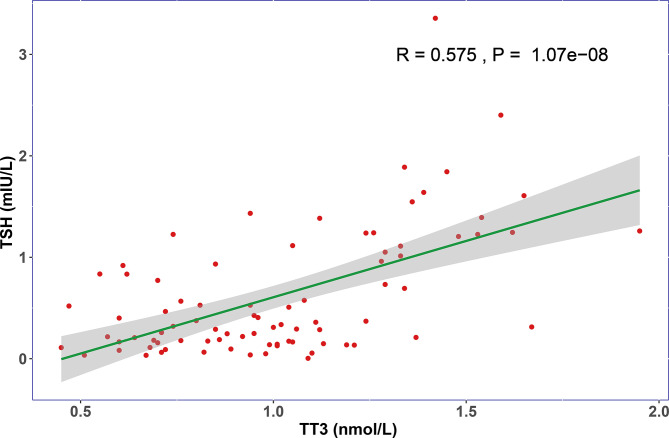
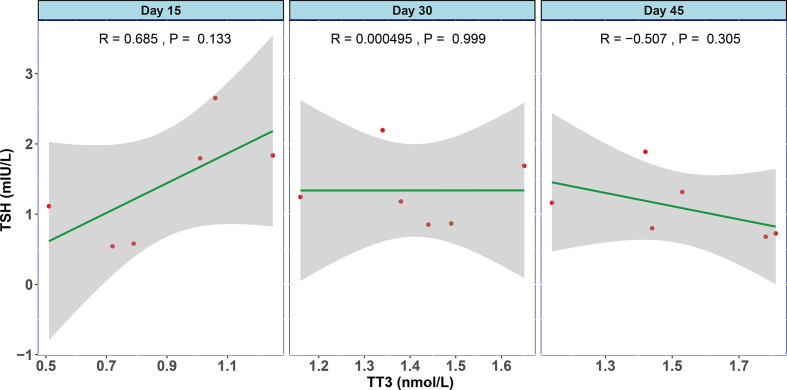
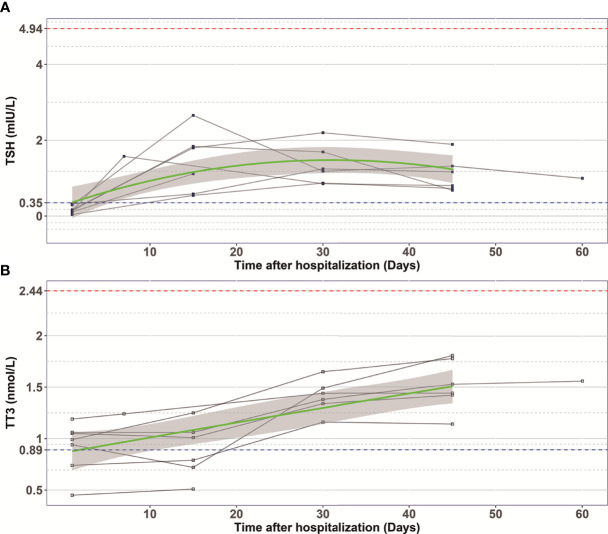
We found that levels of total triiodothyronine (TT3) and thyroid stimulating hormone (TSH) were lower in COVID-19 patients than healthy group (p < 0.001). Besides, TSH level in COVID-19 patients was obviously lower than non-COVID-19 patients (p < 0.001). Within the group of COVID-19, 61.9% (52/84) patients presented with thyroid function abnormalities and the proportion of thyroid dysfunction was higher in severe cases than mild/moderate cases (74.6 vs. 23.8%, p < 0.001). Patients with thyroid dysfunction tended to have longer viral nucleic acid cleaning time (14.1 ± 9.4 vs. 10.6 ± 8.3 days, p = 0.088). To note, thyroid dysfunction was also associated with decreased lymphocytes (p < 0.001) and increased CRP (p = 0.002). The correlation between TT3 and TSH level seemed to be positive rather than negative in the early stage, and gradually turned to be negatively related over time.
Thyroid function abnormalities are common in COVID-19 patients, especially in severe cases. This might be partially explained by nonthyroidal illness syndrome.
新型冠状病毒(COVID-19)引发了全球性大流行,损害了多个人体器官和系统。COVID-19 是否影响人类甲状腺功能尚不清楚。
本研究回顾性纳入浙江大学医学院附属第一医院(中国杭州)的 84 例住院 COVID-19 患者,其中 22 例有完整的甲状腺激素记录。此外,纳入 91 例肺炎患者和 807 例健康对照者作为对照。
我们发现 COVID-19 患者的总三碘甲状腺原氨酸(TT3)和促甲状腺激素(TSH)水平低于健康组(p<0.001)。此外,COVID-19 患者的 TSH 水平明显低于非 COVID-19 患者(p<0.001)。在 COVID-19 组中,61.9%(52/84)的患者存在甲状腺功能异常,且重症患者的甲状腺功能障碍发生率高于轻症/中度患者(74.6%比 23.8%,p<0.001)。甲状腺功能障碍患者的病毒核酸转阴时间较长(14.1±9.4 比 10.6±8.3 天,p=0.088)。需要注意的是,甲状腺功能障碍与淋巴细胞减少(p<0.001)和 C 反应蛋白(CRP)升高(p=0.002)有关。TT3 和 TSH 水平的相关性在早期似乎呈正相关而非负相关,随着时间的推移逐渐转为负相关。
COVID-19 患者中甲状腺功能异常很常见,尤其是重症患者。这部分可由非甲状腺疾病综合征解释。