He Suihua, Bouzy Pascaline, Stone Nicholas, Ward Carwyn, Hamerton Ian
Bristol Composites Institute, Department of Aerospace Engineering, School of Civil, Aerospace, and Mechanical, Engineering, University of Bristol, Queen's Building, University Walk, Bristol BS8 1TR, U.K.
Physics and Astronomy, College of Engineering, Mathematics and Physical Sciences, University of Exeter, Exeter EX4 4QL, U.K.
Anal Chem. 2022 Aug 30;94(34):11848-11855. doi: 10.1021/acs.analchem.2c02306. Epub 2022 Aug 16.
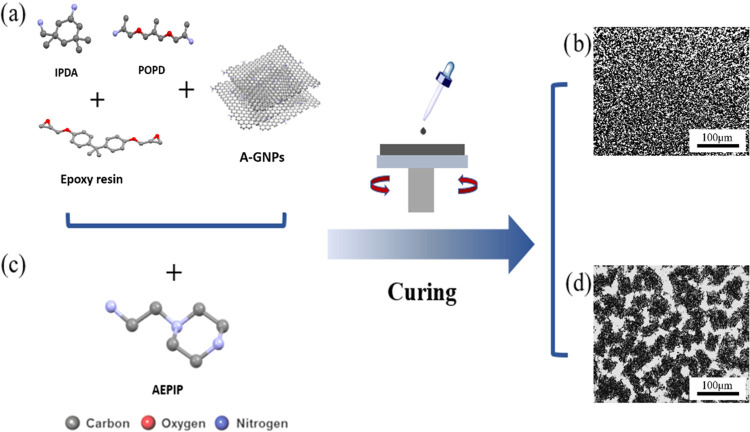
By incorporating 1-(2-aminoethyl)piperazine (AEPIP) into a commercial epoxy blend, a bicontinuous microstructure is produced with the selective localization of amine-functionalized graphene nanoplatelets (A-GNPs). This cured blend underwent self-assembly, and the morphology and topology were observed spectral imaging techniques. As the selective localization of nanofillers in thermoset blends is rarely achieved, and the mechanism remains largely unknown, the optical photothermal infrared (O-PTIR) spectroscopy technique was employed to identify the compositions of microdomains. The A-GNP tends to be located in the region containing higher concentrations of both secondary amine and secondary alcohol; additionally, the phase morphology was found to be influenced by the amine concentration. With the addition of AEPIP, the size of the graphene domains becomes smaller and secondary phase separation is detected within the graphene domain evidenced by the chemical contrast shown in the high-resolution chemical map. The corresponding chemical mapping clearly shows that this phenomenon was mainly induced by the chemical contrast in related regions. The findings reported here provide new insight into a complicated, self-assembled nanofiller domain formed in a multicomponent epoxy blend, demonstrating the potential of O-PTIR as a powerful and useful approach for assessing the mechanism of selectively locating nanofillers in the phase structure of complex thermoset systems.
通过将1-(2-氨基乙基)哌嗪(AEPIP)加入到一种商用环氧共混物中,利用胺官能化石墨烯纳米片(A-GNPs)的选择性定位制备出一种双连续微观结构。这种固化后的共混物进行了自组装,并采用光谱成像技术观察了其形态和拓扑结构。由于在热固性共混物中很少能实现纳米填料的选择性定位,且其机制在很大程度上仍不为人所知,因此采用光热红外(O-PTIR)光谱技术来识别微区的组成。A-GNP倾向于位于仲胺和仲醇浓度较高的区域;此外,发现相形态受胺浓度的影响。随着AEPIP的加入,石墨烯域的尺寸变小,并且在石墨烯域内检测到二次相分离,这在高分辨率化学图中显示的化学对比度中得到了证明。相应的化学图谱清楚地表明,这种现象主要是由相关区域的化学对比度引起的。本文报道的研究结果为多组分环氧共混物中形成的复杂自组装纳米填料域提供了新的见解,证明了O-PTIR作为一种强大而有用的方法来评估纳米填料在复杂热固性体系相结构中选择性定位机制的潜力。