Jiang Xiaodan, Yuan Hao, Zhang Mingzhou, Lv Huibin, Chou Yilin, Yang Jiarui, Li Xuemin
Department of Ophthalmology, Peking University Third Hospital, No. 49 Huayuan North Road, Haidian District, Beijing, 100191, People's Republic of China.
Beijing Key Laboratory of Restoration of Damaged Ocular Nerve, No. 49 Huayuan North Road, Haidian District, Beijing, 100191, People's Republic of China.
Ophthalmol Ther. 2022 Oct;11(5):1895-1912. doi: 10.1007/s40123-022-00556-1. Epub 2022 Aug 16.
This study aimed to evaluate the efficacy and safety of a new-generation intense pulsed light (IPL) device in improving the symptoms and signs of meibomian gland dysfunction (MGD)-related dry eye, and compare it with a traditional IPL device.
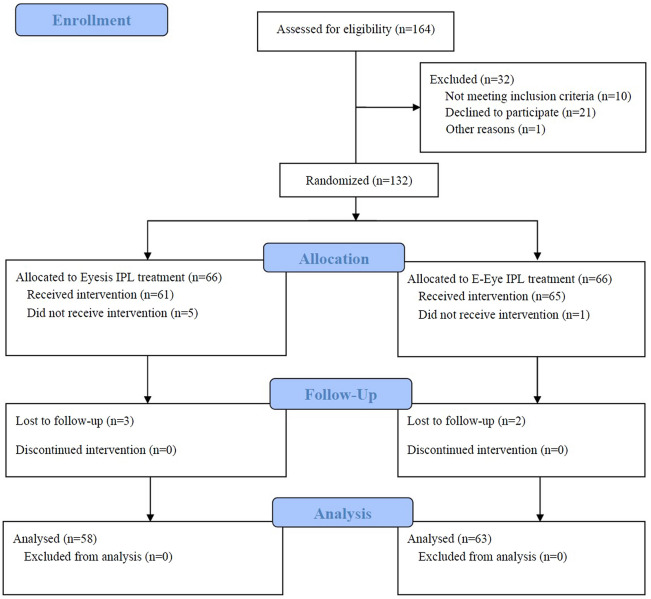
This multicenter randomized controlled trial enrolled 132 patients with MGD-related dry eye from two centers. Patients were randomly assigned into the new-generation IPL (Eyesis) group or traditional IPL (E-Eye) group, and then blinded to receive treatment on days 0 and 7. Ocular Surface Disease Index (OSDI), tear meniscus height (TMH), tear breakup time (TBUT), corneal fluorescein staining (CFS), Schirmer test, and meibomian gland signs were evaluated on days 0, 7, and 14. The primary outcome was defined as the effective rate of treating MGD at day 14. Any adverse events were recorded for safety assessment. Intergroup comparisons and non-inferiority analysis were performed. p values less than 0.05 were considered statistically significant.
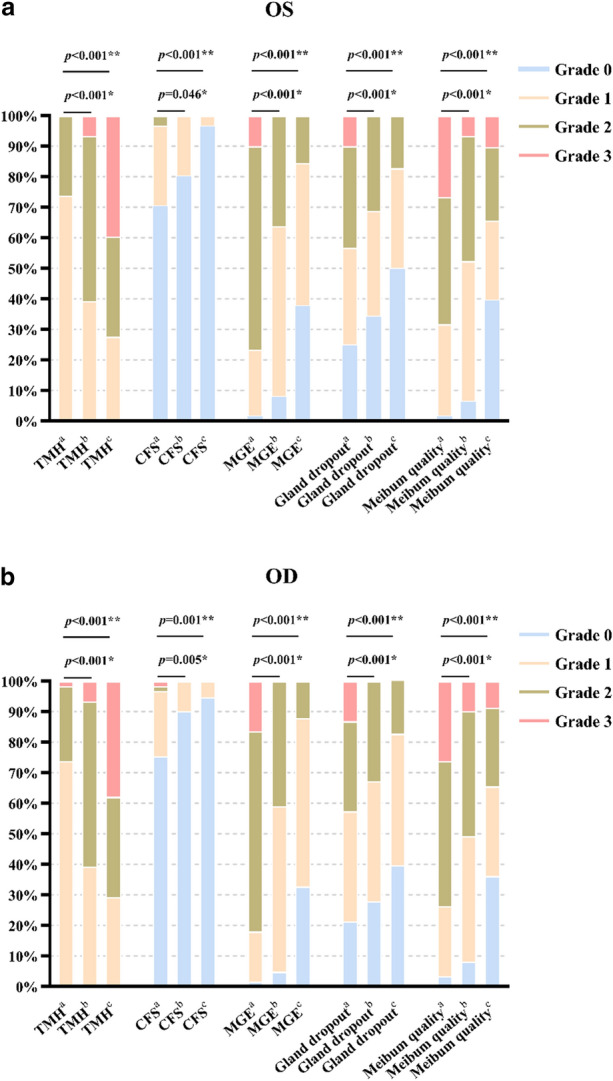
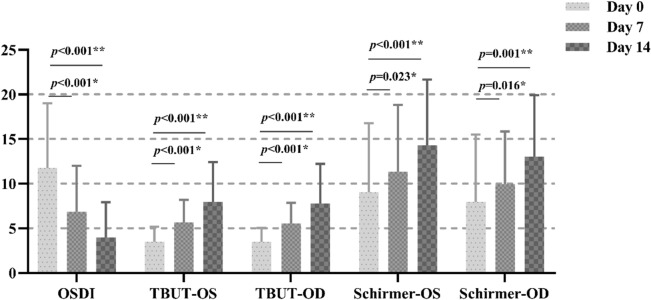
Basic information showed no significant difference between treatment groups. The intergroup difference of the effective rate was - 1.7% in the left eye and 1.6% in right eye, verifying the non-inferiority of the Eyesis device (p = 0.927). Significant improvements in OSDI, TBUT, Schirmer test, TMH, CFS, and meibomian gland signs were observed in Eyesis group on days 7 and 14 (all p < 0.05). Compared to the E-Eye group, the Eyesis group achieved more significant improvements in OSDI, TBUT, Schirmer test, TMH, and meibum quality (all p < 0.05). There was no significant difference in the incidences of adverse events between groups (p = 1.000).
The new-generation IPL was effective and safe in relieving the symptoms and signs of MGD-related dry eye, exhibiting a non-inferior effective rate compared to the traditional IPL. Additionally, Eyesis showed more clinical benefits over E-Eye in alleviating symptoms, increasing tear film stability and improving meibomian gland function.
本研究旨在评估新一代强脉冲光(IPL)设备改善睑板腺功能障碍(MGD)相关干眼症状和体征的疗效及安全性,并与传统IPL设备进行比较。
这项多中心随机对照试验从两个中心招募了132例MGD相关干眼患者。患者被随机分为新一代IPL(Eyesis)组或传统IPL(E-Eye)组,然后在第0天和第7天接受盲法治疗。在第0天、第7天和第14天评估眼表疾病指数(OSDI)、泪河高度(TMH)、泪膜破裂时间(TBUT)、角膜荧光素染色(CFS)、泪液分泌试验以及睑板腺体征。主要结局定义为第14天治疗MGD的有效率。记录所有不良事件以进行安全性评估。进行组间比较和非劣效性分析。p值小于0.05被认为具有统计学意义。
基本信息显示治疗组之间无显著差异。有效率的组间差异在左眼为-1.7%,右眼为1.6%,证实了Eyesis设备的非劣效性(p = 0.927)。在第7天和第14天,Eyesis组的OSDI、TBUT、泪液分泌试验、TMH、CFS和睑板腺体征均有显著改善(所有p < 0.05)。与E-Eye组相比,Eyesis组在OSDI、TBUT、泪液分泌试验、TMH和睑脂质量方面有更显著的改善(所有p < 0.05)。两组不良事件发生率无显著差异(p = 1.000)。
新一代IPL在缓解MGD相关干眼的症状和体征方面有效且安全,与传统IPL相比有效率非劣效。此外,在缓解症状、增加泪膜稳定性和改善睑板腺功能方面,Eyesis比E-Eye显示出更多的临床益处。