Department of Epidemiology and Public Health, Swiss Tropical and Public Health Institute, Allschwil, Switzerland.
University of Basel, Basel, Switzerland.
Parasit Vectors. 2022 Aug 16;15(1):292. doi: 10.1186/s13071-022-05404-6.
Schistosomiasis elimination has gained renewed priority in the WHO guidance documents published in 2020 and 2022. The SchistoBreak project, implemented in Pemba, Tanzania between 2020 and 2024, aims to assess new tools and strategies for shifting from elimination as a public health problem towards interruption of transmission. Here we report our baseline findings and discuss implications for future interventions.
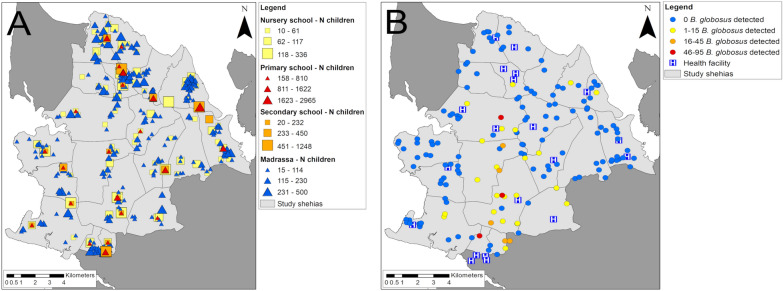
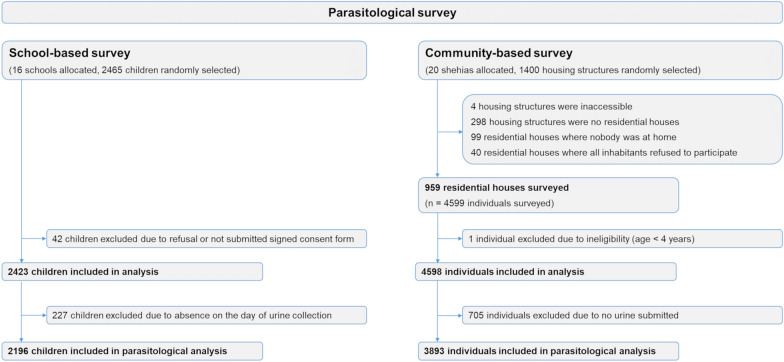
In 2020, human water contact sites (HWCSs) in the study area were geolocated and snail surveys were conducted. A parasitological and questionnaire cross-sectional baseline survey was implemented in 20 communities and their 16 primary schools between November 2020 and February 2021. Urine samples were collected at the school and household levels from individuals aged ≥ 4 years. Schistosoma haematobium infection was detected by urine filtration microscopy. Snail, parasitological and questionnaire-derived data were analyzed descriptively, spatially and with generalized estimated equation models.
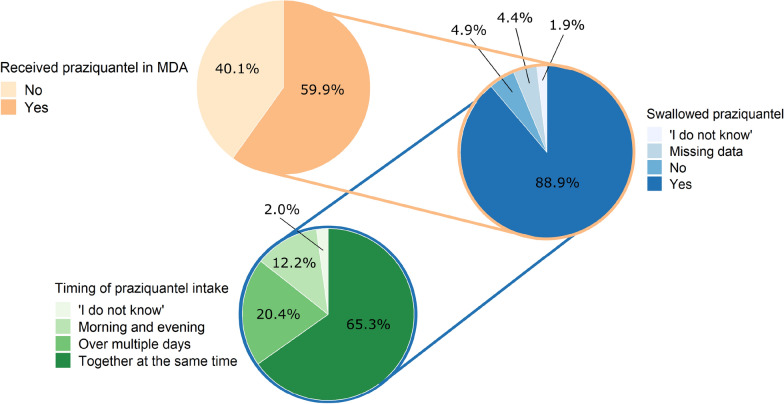
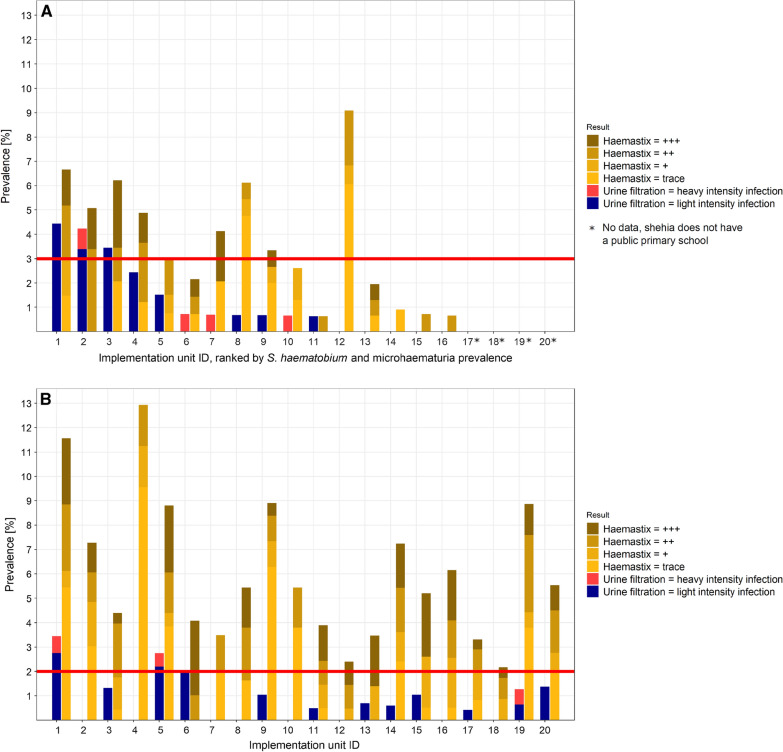
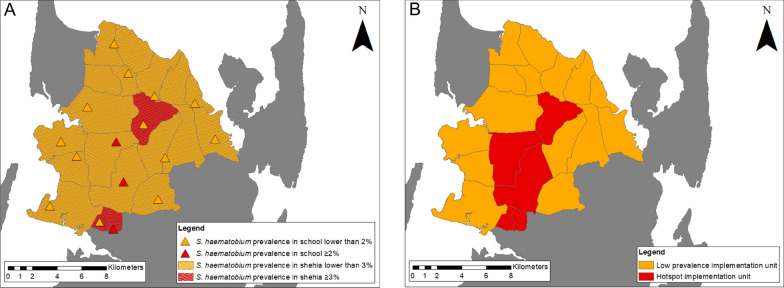
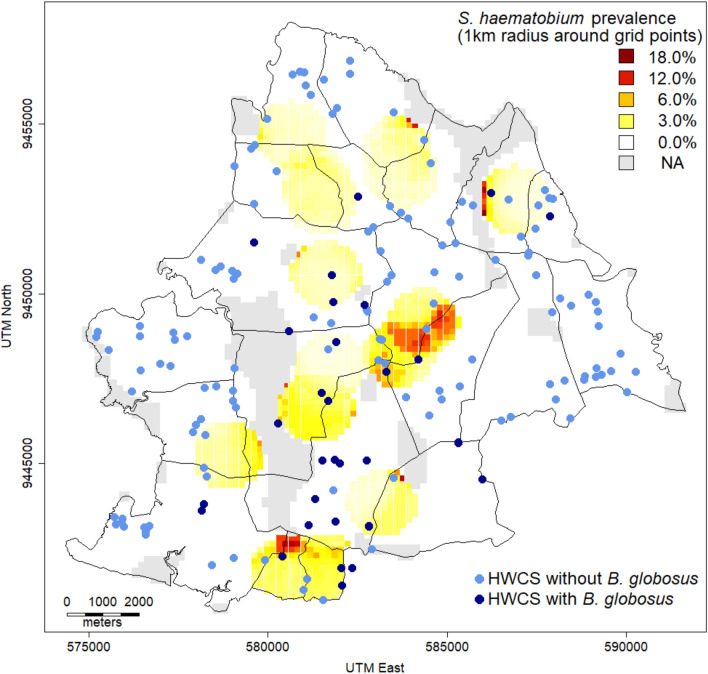
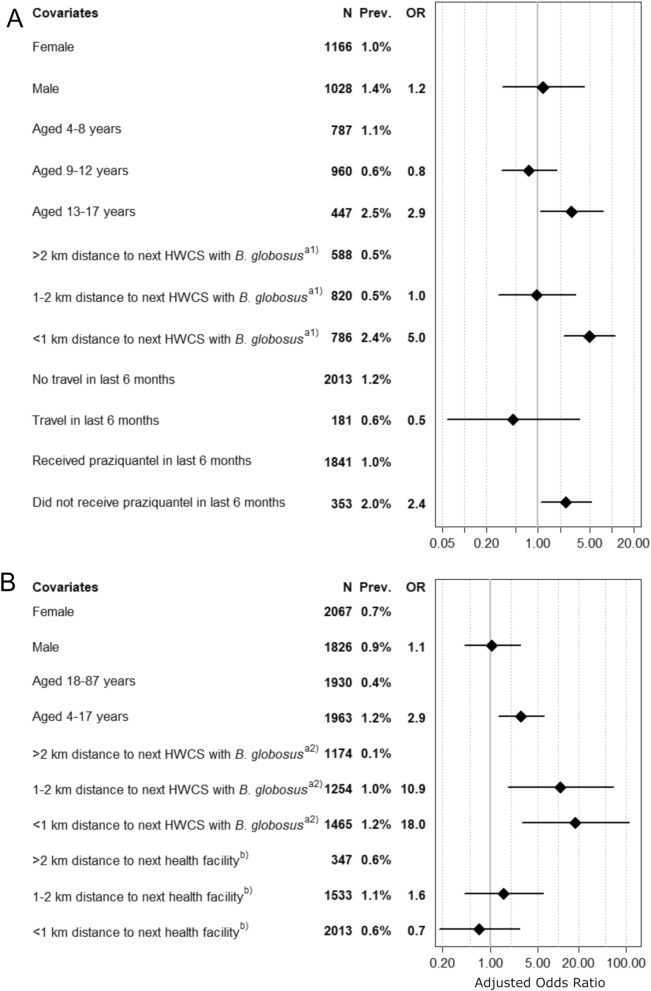
The intermediate host snail Bulinus globosus was detected in 19.8% (33/167) of HWCSs. The overall S. haematobium prevalence was 1.2% (26/2196) in school-aged children and 0.8% (31/3893) in community members, with 0.2% (4/2196) and 0.1% (3/3893) heavy-intensity infections, respectively. Children who studied < 1 km away from HWCSs with B. globosus had significantly higher odds for a S. haematobium infection than those attending a school located > 2 km away (odds ratio [OR]: 5.0; 95% confidence interval [CI]: 2.3-11.1). Individuals living in a house located < 1 km away from HWCSs with B. globosus had higher odds than those residing in > 2 km distance (OR: 18.0; 95% CI: 2.9-111.0). Self-reported praziquantel treatment coverage was 83.2% (2015/2423) in schoolchildren in the mass drug administration (MDA) conducted in August 2020. Coverage among adult community members was 59.9% (574/958), but only 34.8% (333/958) took praziquantel correctly.
While the S. haematobium prevalence is very low in Pemba, there are many HWCSs with B. globosus situated close to schools or houses that pose a considerable risk of recrudescence. To maintain and accelerate the progress towards interruption of transmission, targeted and cost-effective interventions that are accepted by the community are needed; for example, snail control plus focal MDA, or test-and-treat in schools and households near infested waterbodies.
2020 年和 2022 年发布的世界卫生组织指导文件重新强调了消除血吸虫病的重要性。2020 年至 2024 年在坦桑尼亚奔巴岛实施的 SchistoBreak 项目旨在评估将消除作为公共卫生问题转变为阻断传播的新工具和策略。在此,我们报告了本底研究结果,并讨论了对未来干预措施的影响。
2020 年,对研究区域内的人类水源接触点(HWCS)进行了地理位置定位,并开展了螺类调查。2020 年 11 月至 2021 年 2 月,在 20 个社区及其 16 所小学实施了寄生虫学和问卷调查基线横断面研究。从 4 岁及以上个体的学校和家庭水平采集尿液样本。采用尿液过滤显微镜法检测埃及血吸虫感染。对螺类、寄生虫学和问卷调查数据进行了描述性分析、空间分析和广义估计方程模型分析。
在 167 个 HWCS 中,检测到中间宿主圆田螺 19.8%(33/167)。在学龄儿童中,埃及血吸虫总体感染率为 1.2%(26/2196),社区成员中为 0.8%(31/3893),分别有 0.2%(4/2196)和 0.1%(3/3893)为重度感染。与就读距离 HWCS 超过 2 公里的学校的儿童相比,就读距离 HWCS 小于 1 公里的儿童感染埃及血吸虫的几率显著更高(比值比 [OR]:5.0;95%置信区间 [CI]:2.3-11.1)。与居住在距离 HWCS 超过 2 公里的家庭相比,居住在距离 HWCS 小于 1 公里的家庭的个体感染埃及血吸虫的几率更高(OR:18.0;95%CI:2.9-111.0)。2020 年 8 月进行的大规模药物治疗(MDA)中,2423 名学龄儿童中有 83.2%(2015/2423)报告接受了驱虫治疗。成年社区成员的覆盖率为 59.9%(574/958),但只有 34.8%(333/958)正确服用了驱虫药。
尽管奔巴岛埃及血吸虫感染率非常低,但仍有许多 HWCS 靠近学校或房屋,存在复发的巨大风险。为了维持和加速阻断传播的进展,需要采取社区接受的有针对性且具有成本效益的干预措施,例如,螺类控制加局部 MDA,或在受污染水体附近的学校和家庭进行检测和治疗。