Swiss Tropical and Public Health Institute, Basel, Switzerland.
University of Basel, Basel, Switzerland.
PLoS Negl Trop Dis. 2019 May 6;13(5):e0007268. doi: 10.1371/journal.pntd.0007268. eCollection 2019 May.
The Zanzibar Elimination of Schistosomiasis Transmission (ZEST) project aimed to eliminate urogenital schistosomiasis as a public health problem from Pemba and to interrupt Schistosoma haematobium transmission from Unguja in 5 years.
A repeated cross-sectional cluster-randomized trial was implemented from 2011/12 till 2017. On each island, 45 shehias were randomly assigned to receive one of three interventions: biannual mass drug administration (MDA) with praziquantel alone, or in combination with snail control or behavior change measures. In cross-sectional surveys, a single urine sample was collected from ~9,000 students aged 9- to 12-years and from ~4,500 adults aged 20- to 55-years annually, and from ~9,000 1st year students at baseline and the final survey. Each sample was examined for S. haematobium eggs by a single urine filtration. Prevalence and infection intensity were determined. Odds of infection were compared between the intervention arms.
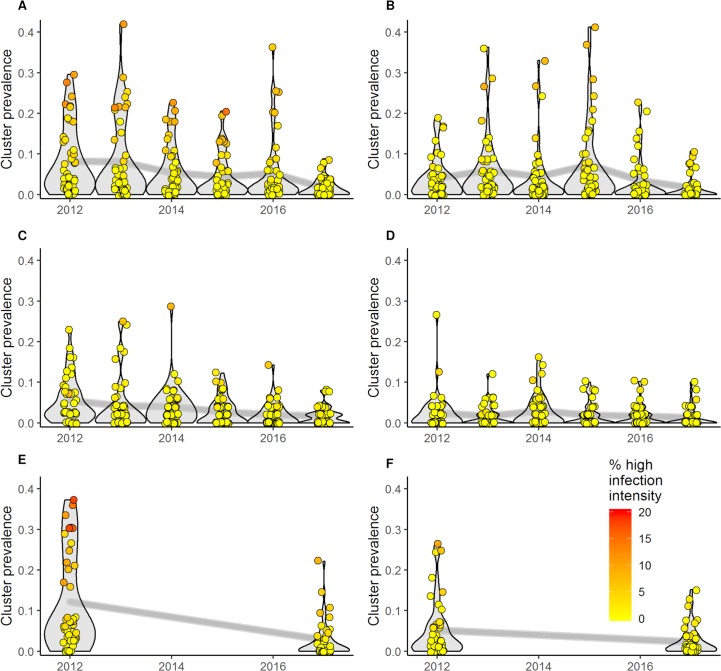
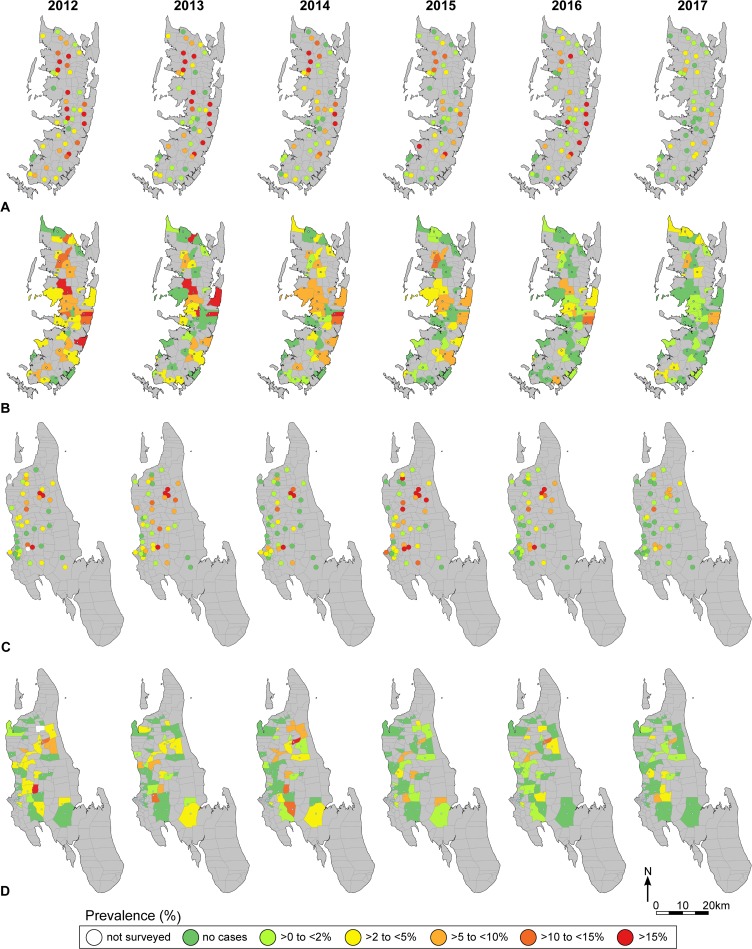
Prevalence was reduced from 6.1% (95% confidence interval (CI): 4.5%-7.6%) to 1.7% (95% CI: 1.2%-2.2%) in 9- to 12-year old students, from 3.9% (95% CI: 2.8%-5.0%) to 1.5% (95% CI: 1.0%-2.0%) in adults, and from 8.8% (95% CI: 6.5%-11.2%) to 2.6% (95% CI: 1.7%-3.5%) in 1st year students from 2011/12 to 2017. In 2017, heavy infection intensities occurred in 0.4% of 9- to 12-year old students, 0.1% of adults, and 0.8% of 1st year students. Considering 1st year students in 2017, 13/45 schools in Pemba and 4/45 schools in Unguja had heavy infection intensities >1%. There was no significant difference in prevalence between the intervention arms in any study group and year.
CONCLUSIONS/SIGNIFICANCE: Urogenital schistosomiasis was eliminated as public health problem from most sites in Pemba and Unguja. Prevalence was significantly reduced, but transmission was not interrupted. Continued interventions that are adaptive and tailored to the micro-epidemiology of S. haematobium in Zanzibar are needed to sustain and advance the gains made by ZEST.
桑给巴尔消除血吸虫病传播(ZEST)项目旨在消除奔巴岛和温古贾岛的泌尿生殖道血吸虫病,目标是在 5 年内阻断曼氏血吸虫的传播。
该研究采用重复的横断面整群随机试验,于 2011/12 年至 2017 年实施。在每个岛屿上,将 45 个谢希亚随机分配到以下三个干预组之一:每六个月进行一次吡喹酮单独或联合钉螺控制或行为改变措施的大规模药物治疗(MDA)。在横断面调查中,每年从 9 至 12 岁的约 9000 名学生和约 4500 名 20 至 55 岁的成年人中收集单次尿液样本,并在基线和最后一次调查中从约 9000 名一年级学生中收集单次尿液样本。每个样本均通过单次尿液过滤检查曼氏血吸虫卵。确定患病率和感染强度。比较干预组之间的感染几率。
9 至 12 岁学生的患病率从 6.1%(95%置信区间(CI):4.5%-7.6%)降至 1.7%(95% CI:1.2%-2.2%),成年人的患病率从 3.9%(95% CI:2.8%-5.0%)降至 1.5%(95% CI:1.0%-2.0%),一年级学生的患病率从 8.8%(95% CI:6.5%-11.2%)降至 2.6%(95% CI:1.7%-3.5%),从 2011/12 年到 2017 年。2017 年,9 至 12 岁学生中重度感染强度为 0.4%,成年人中为 0.1%,一年级学生中为 0.8%。考虑到 2017 年的一年级学生,奔巴岛的 45 所学校中有 13 所和温古贾岛的 45 所学校中有 4 所学校的重度感染强度>1%。在任何研究组和年份,干预组之间的患病率均无显著差异。
结论/意义:泌尿生殖道血吸虫病已从奔巴岛和温古贾岛的大多数地区消除了公共卫生问题。患病率显著降低,但传播未被阻断。需要持续开展适应性和针对桑给巴尔曼氏血吸虫微流行病学的干预措施,以维持和推进 ZEST 取得的成果。