School of Life Sciences, University of Science and Technology of China, Hefei, 230027, Anhui, China.
BGI-Shenzhen, Shenzhen, 518083, China.
Microbiome. 2022 Aug 17;10(1):128. doi: 10.1186/s40168-022-01324-w.
As important producers using photosynthesis on Earth, cyanobacteria contribute to the oxygenation of atmosphere and the primary production of biosphere. However, due to the eutrophication of urban waterbodies and global warming, uncontrollable growth of cyanobacteria usually leads to the seasonal outbreak of cyanobacterial blooms. Cyanophages, a group of viruses that specifically infect and lyse cyanobacteria, are considered as potential environment-friendly agents to control the harmful blooms. Compared to the marine counterparts, only a few freshwater cyanophages have been isolated and genome sequenced to date, largely limiting their characterizations and applications.
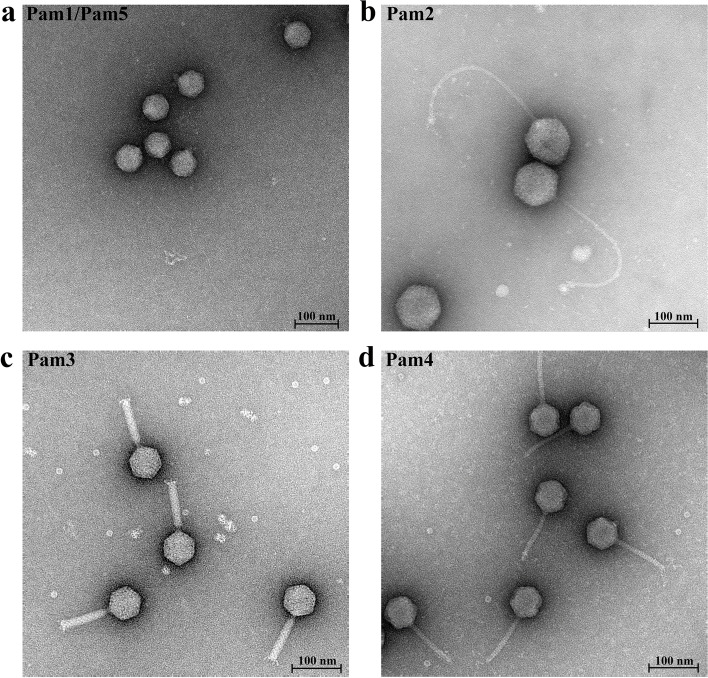
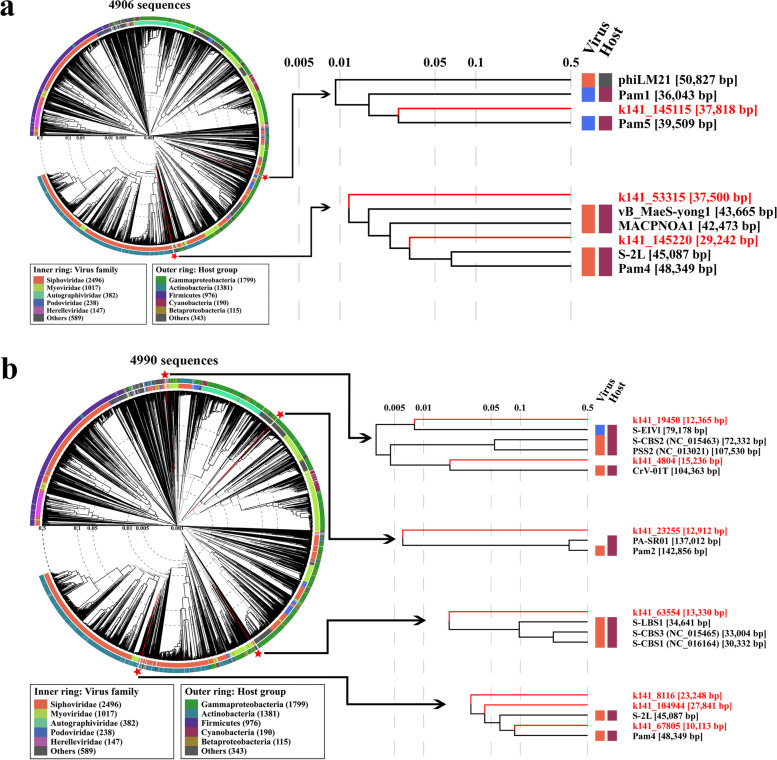
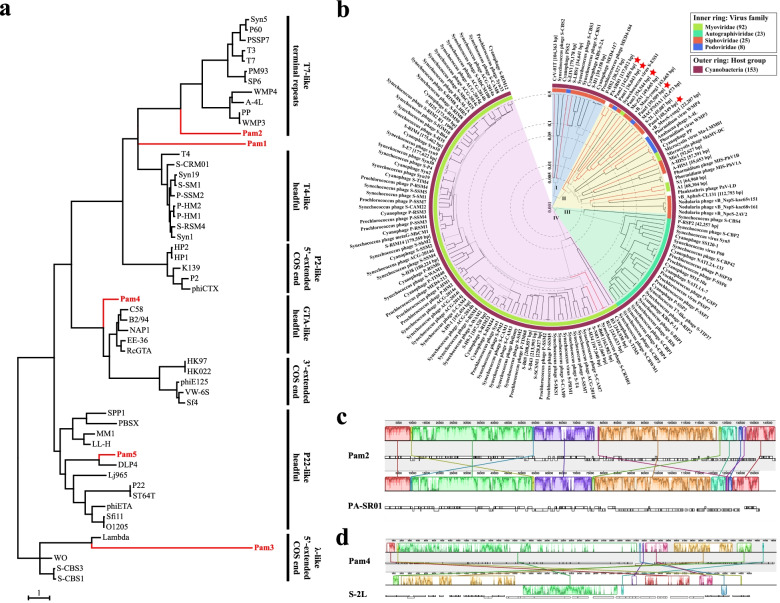
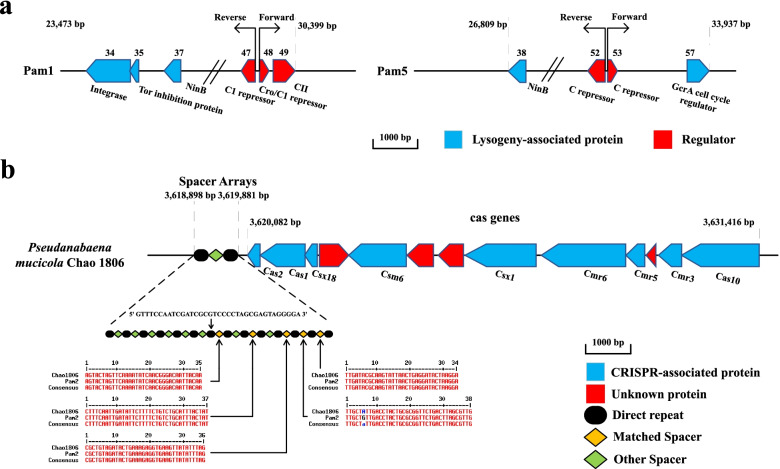
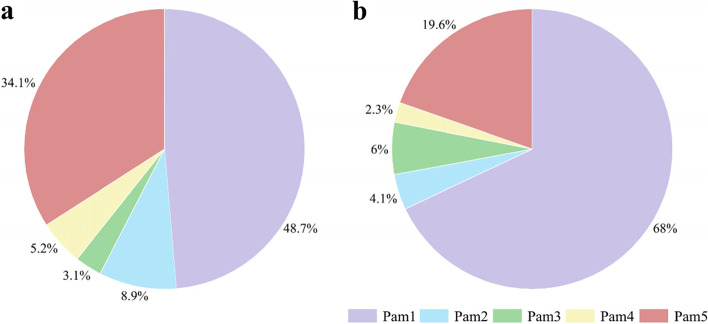
Here, we isolated five freshwater cyanophages varying in tail morphology, termed Pam1Pam5, all of which infect the cyanobacterium Pseudanabaena mucicola Chao 1806 that was isolated from the bloom-suffering Lake Chaohu in Anhui, China. The whole-genome sequencing showed that cyanophages Pam1Pam5 all contain a dsDNA genome, varying in size from 36 to 142 Kb. Phylogenetic analyses suggested that Pam1Pam5 possess different DNA packaging mechanisms and are evolutionarily distinct from each other. Notably, Pam1 and Pam5 have lysogeny-associated gene clusters, whereas Pam2 possesses 9 punctuated DNA segments identical to the CRISPR spacers in the host genome. Metagenomic data-based calculation of the relative abundance of Pam1Pam5 at the Nanfei estuary towards the Lake Chaohu revealed that the short-tailed Pam1 and Pam5 account for the majority of the five cyanophages. Moreover, comparative analyses of the reference genomes of Pam1~Pam5 and previously reported cyanophages enabled us to identify three circular and seven linear contigs of virtual freshwater cyanophages from the metagenomic data of the Lake Chaohu.
We propose a high-throughput strategy to systematically identify cyanophages based on the currently available metagenomic data and the very limited reference genomes of experimentally isolated cyanophages. This strategy could be applied to mine the complete or partial genomes of unculturable bacteriophages and viruses. Transformation of the synthesized whole genomes of these virtual phages/viruses to proper hosts will enable the rescue of bona fide viral particles and eventually enrich the library of microorganisms that exist on Earth. Video abstract.
作为地球上重要的光合作用生物,蓝藻为大气的氧化和生物圈的初级生产做出了贡献。然而,由于城市水体的富营养化和全球变暖,蓝藻的不受控制的生长通常会导致蓝藻水华的季节性爆发。噬藻体,一类专门感染和裂解蓝藻的病毒,被认为是控制有害水华的潜在环保剂。与海洋对应物相比,到目前为止,只有少数淡水噬藻体被分离和基因组测序,这在很大程度上限制了它们的特性和应用。
在这里,我们分离了五种形态各异的淡水噬藻体,分别命名为 Pam1Pam5,它们都感染了从中国安徽巢湖水华爆发的蓝藻 Pseudanabaena mucicola Chao 1806。全基因组测序表明,噬藻体 Pam1Pam5 均含有大小从 36 到 142 Kb 的双链 DNA 基因组。系统发育分析表明,Pam1Pam5 具有不同的 DNA 包装机制,彼此之间进化上是不同的。值得注意的是,Pam1 和 Pam5 具有溶原相关基因簇,而 Pam2 则具有 9 个与宿主基因组中的 CRISPR 间隔物相同的点断 DNA 片段。基于 Nanfei 河口向巢湖的宏基因组数据计算的 Pam1Pam5 的相对丰度表明,短尾的 Pam1 和 Pam5 占这五种噬藻体的大部分。此外,对 Pam1~Pam5 的参考基因组和以前报道的噬藻体的比较分析,使我们能够从巢湖的宏基因组数据中鉴定出三种环状和七种线状的虚拟淡水噬藻体的 contigs。
我们提出了一种基于现有宏基因组数据和有限的实验分离噬藻体的参考基因组来系统鉴定噬藻体的高通量策略。这种策略可以应用于挖掘不可培养的噬菌体和病毒的完整或部分基因组。将这些虚拟噬菌体/病毒的合成全基因组转化为合适的宿主,将能够拯救真正的病毒颗粒,并最终丰富地球上存在的微生物文库。