Laboratory of Algology and Microbial Ecology, Nature Research Centre, Vilnius, Lithuania
Center for Ecology and Evolution in Microbial Model Systems, Department of Biology and Environmental Science, Linnaeus University, Kalmar, Sweden.
Appl Environ Microbiol. 2018 Dec 13;85(1). doi: 10.1128/AEM.01311-18. Print 2019 Jan 1.
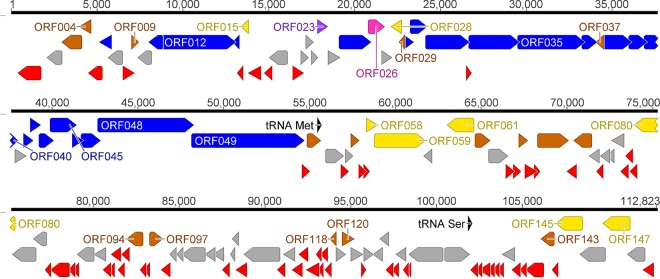
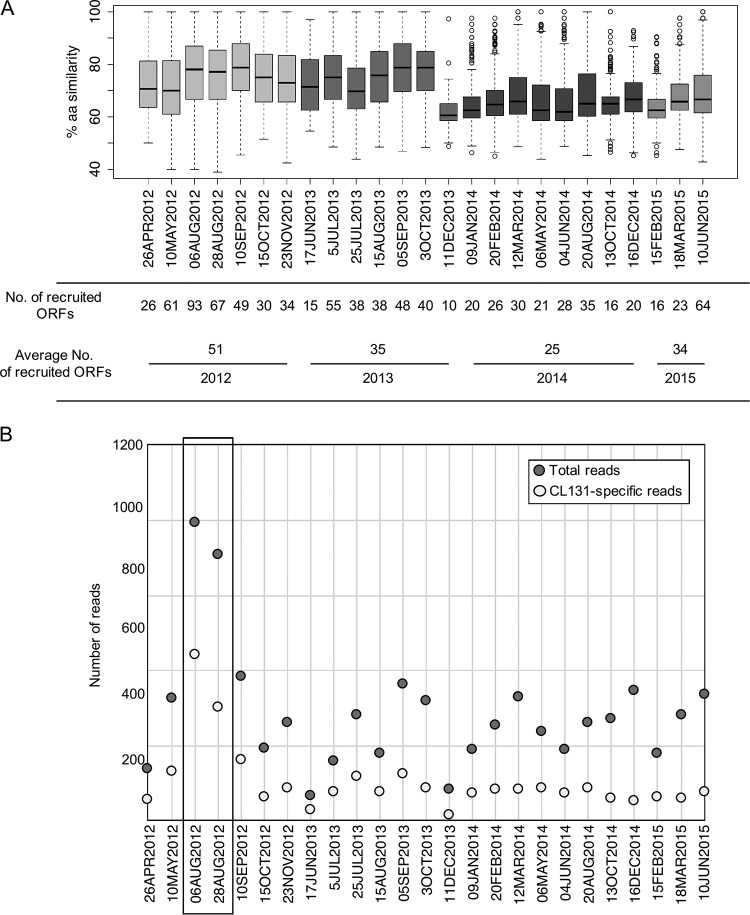
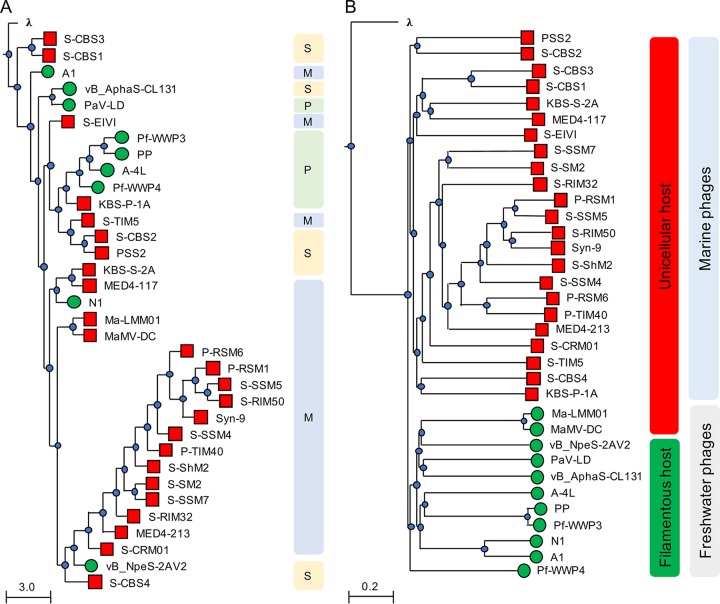
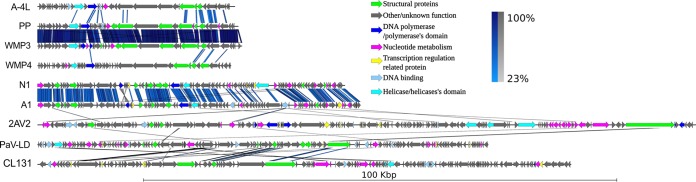
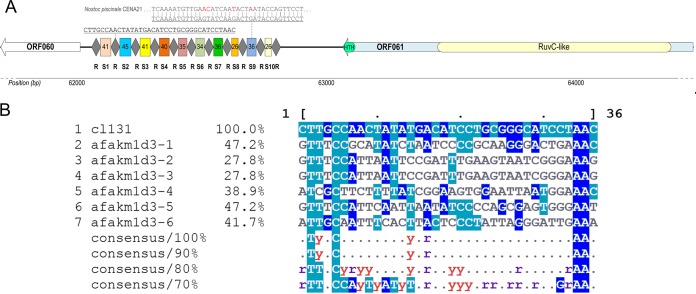
While filamentous cyanobacteria play a crucial role in food web dynamics and biogeochemical cycling of many aquatic ecosystems around the globe, the knowledge regarding the phages infecting them is limited. Here, we describe the complete genome of the virulent cyanophage vB_AphaS-CL131 (here, CL 131), a phage that infects the filamentous diazotrophic bloom-forming cyanobacterium in the brackish Baltic Sea. CL 131 features a 112,793-bp double-stranded DNA (dsDNA) genome encompassing 149 putative open reading frames (ORFs), of which the majority (86%) lack sequence homology to genes with known functions in other bacteriophages or bacteria. Phylogenetic analysis revealed that CL 131 possibly represents a new evolutionary lineage within the group of cyanophages infecting filamentous cyanobacteria, which form a separate cluster from phages infecting unicellular cyanobacteria. CL 131 encodes a putative type V-U2 CRISPR-Cas system with one spacer (out of 10) targeting a DNA primase pseudogene in a cyanobacterium and a putative type II toxin-antitoxin system, consisting of a GNAT family N-acetyltransferase and a protein of unknown function containing the PRK09726 domain (characteristic of HipB antitoxins). Comparison of CL 131 proteins to reads from Baltic Sea and other available fresh- and brackish-water metagenomes and analysis of CRISPR-Cas arrays in publicly available genomes demonstrated that phages similar to CL 131 are present and dynamic in the Baltic Sea and share a common history with their hosts dating back at least several decades. In addition, different CRISPR-Cas systems within individual genomes targeted several sequences in the CL 131 genome, including genes related to virion structure and morphogenesis. Altogether, these findings revealed new genomic information for exploring viral diversity and provide a model system for investigation of virus-host interactions in filamentous cyanobacteria. The genomic characterization of novel cyanophage vB_AphaS-CL131 and the analysis of its genomic features in the context of other viruses, metagenomic data, and host CRISPR-Cas systems contribute toward a better understanding of aquatic viral diversity and distribution in general and of brackish-water cyanophages infecting filamentous diazotrophic cyanobacteria in the Baltic Sea in particular. The results of this study revealed previously undescribed features of cyanophage genomes (e.g., self-excising intein-containing putative dCTP deaminase and putative cyanophage-encoded CRISPR-Cas and toxin-antitoxin systems) and can therefore be used to predict potential interactions between bloom-forming cyanobacteria and their cyanophages.
虽然丝状蓝藻在全球许多水生生态系统的食物网动态和生物地球化学循环中起着至关重要的作用,但关于感染它们的噬菌体的知识却很有限。在这里,我们描述了一种烈性的丝状噬藻体 vB_AphaS-CL131(以下简称 CL131)的完整基因组,该噬藻体感染了波罗的海半咸水海域中形成丝状固氮水华的蓝藻。CL131 是一个 112793bp 的双链 DNA(dsDNA)基因组,包含 149 个推定的开放阅读框(ORFs),其中大多数(86%)与其他噬菌体或细菌中具有已知功能的基因没有序列同源性。系统发育分析表明,CL131 可能代表了感染丝状蓝藻的噬菌体群中的一个新进化谱系,该谱系与感染单细胞蓝藻的噬菌体形成一个单独的聚类。CL131 编码了一个推定的 V-U2 CRISPR-Cas 系统,其中一个间隔序列(10 个中的 1 个)靶向蓝藻中的一个 DNA 引物假基因,以及一个推定的 II 型毒素-抗毒素系统,由一个 GNAT 家族的 N-乙酰转移酶和一个含有 PRK09726 结构域(特征 HipB 抗毒素)的未知功能蛋白组成。将 CL131 蛋白与波罗的海及其他可用的淡水和半咸水宏基因组中的reads 进行比较,并分析公共基因组中的 CRISPR-Cas 阵列,结果表明与 CL131 类似的噬菌体在波罗的海存在且具有动态性,并与宿主至少几十年来的共同历史。此外,单个基因组中的不同 CRISPR-Cas 系统靶向 CL131 基因组中的多个序列,包括与病毒粒子结构和形态发生相关的基因。总的来说,这些发现为探索病毒多样性提供了新的基因组信息,并为丝状蓝藻中病毒-宿主相互作用的研究提供了一个模型系统。新型噬藻体 vB_AphaS-CL131 的基因组特征分析及其在其他病毒、宏基因组数据和宿主 CRISPR-Cas 系统背景下的基因组特征分析,有助于更好地了解水生病毒的多样性和分布,特别是了解感染波罗的海丝状固氮蓝藻的半咸水噬藻体。本研究的结果揭示了噬藻体基因组的一些以前未描述的特征(例如,自我切除的内含肽包含的推定 dCTP 脱氨酶和推定的噬藻体编码的 CRISPR-Cas 和毒素-抗毒素系统),因此可用于预测形成水华的蓝藻与其噬藻体之间的潜在相互作用。