Meduňa Mojmír, Isa Fabio, Bressan Franco, von Känel Hans
Department of Condensed Matter Physics, Masaryk University, Kotlářská 2, CZ-61137 Brno, Czech Republic.
Laboratory for Solid State Physics, ETH Zurich, Otto-Stern Weg 1, CH-8093 Zurich, Switzerland.
J Appl Crystallogr. 2022 Jul 5;55(Pt 4):823-836. doi: 10.1107/S1600576722004885. eCollection 2022 Aug 1.
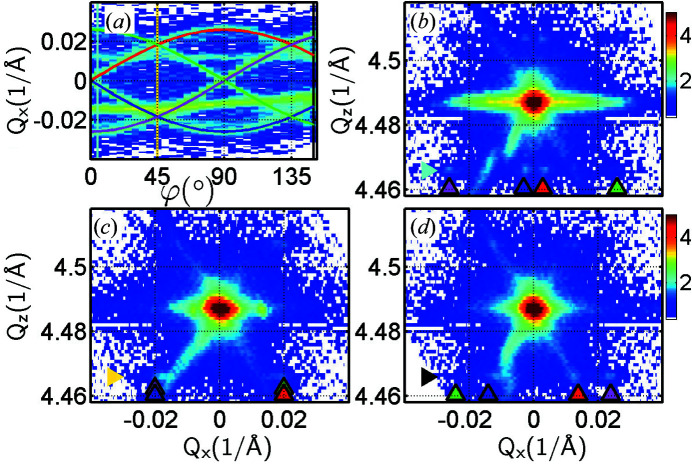
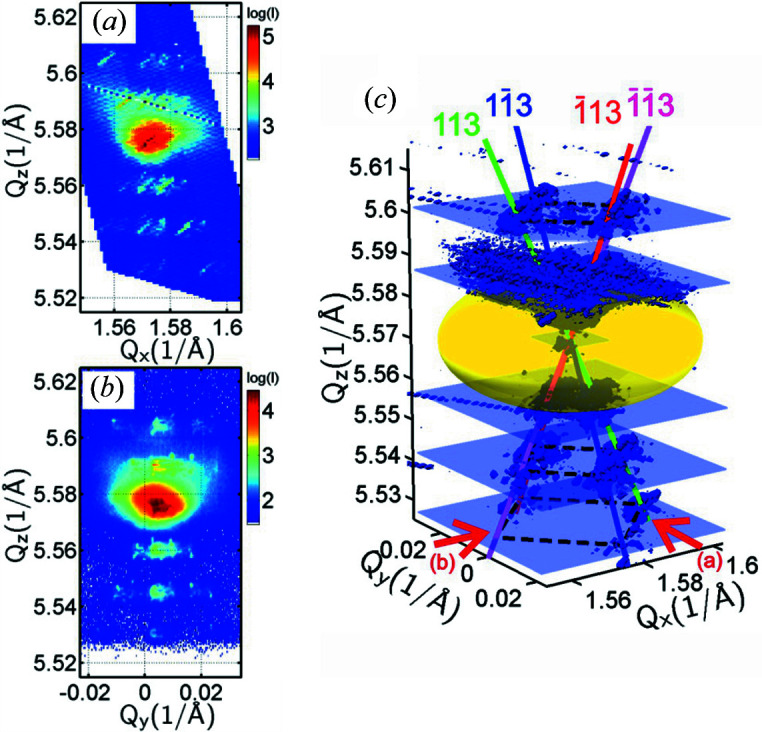
This work presents a new approach suitable for mapping reciprocal space in three dimensions with standard laboratory equipment and a typical X-ray diffraction setup. The method is based on symmetric and coplanar high-resolution X-ray diffraction, ideally realized using 2D X-ray pixel detectors. The processing of experimental data exploits the Radon transform commonly used in medical and materials science. It is shown that this technique can also be used for diffraction mapping in reciprocal space even if a highly collimated beam is not available. The application of the method is demonstrated for various types of epitaxial microcrystals on Si substrates. These comprise partially fused SiGe microcrystals that are tens of micrometres high, multiple-quantum-well structures grown on SiGe microcrystals and pyramid-shaped GaAs/Ge microcrystals on top of Si micropillars.
这项工作提出了一种新方法,适用于使用标准实验室设备和典型的X射线衍射装置在三维空间中映射倒易空间。该方法基于对称共面高分辨率X射线衍射,理想情况下使用二维X射线像素探测器来实现。实验数据的处理利用了医学和材料科学中常用的拉东变换。结果表明,即使没有高度准直的光束,该技术也可用于倒易空间中的衍射映射。该方法在硅衬底上的各种外延微晶上的应用得到了证明。这些包括几十微米高的部分熔融硅锗微晶、生长在硅锗微晶上的多量子阱结构以及硅微柱顶部的金字塔形砷化镓/锗微晶。