Davey Theresa, Suzuki Ken, Miura Hideo, Chen Ying
School of Engineering, Tohoku University Sendai 980-8579 Japan
RSC Adv. 2021 Oct 4;11(52):32573-32589. doi: 10.1039/d1ra06362f.
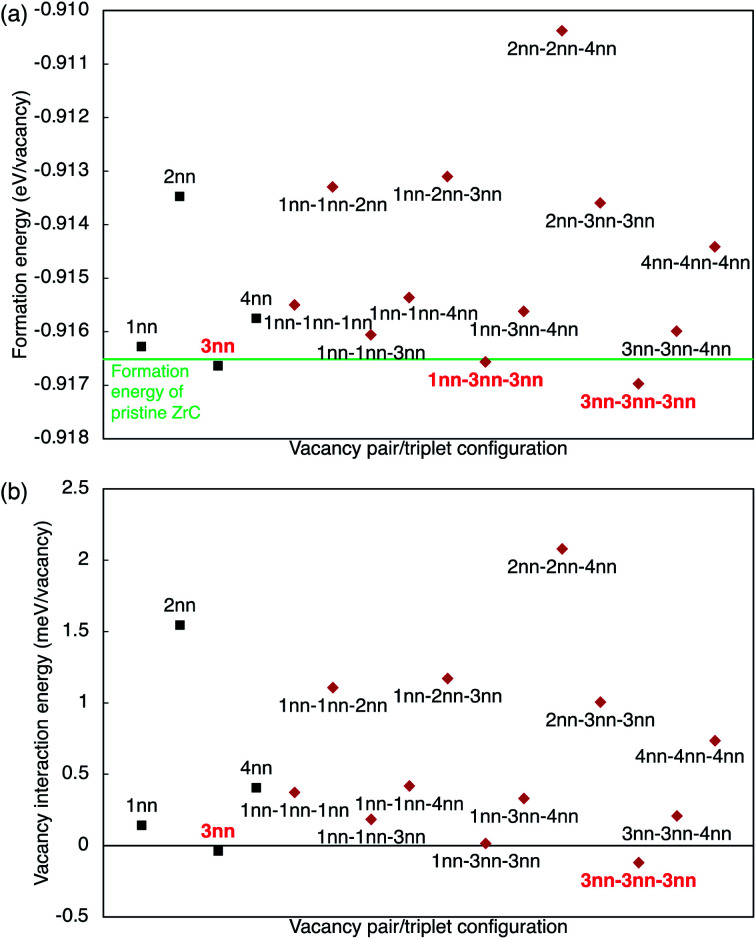
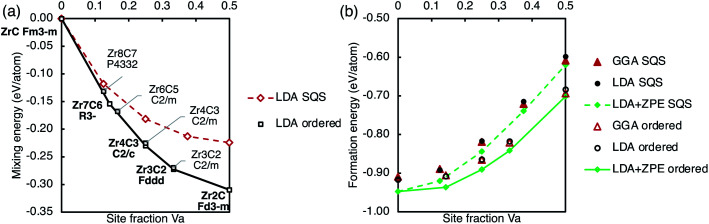
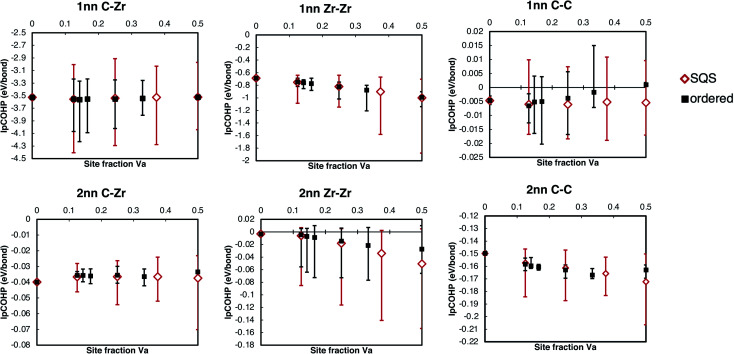
Vacancy-ordered superstructural phases of zirconium carbide have been intermittently observed at low temperatures for over 50 years. However, little is known about these ordered phases as they have proven to be challenging to fabricate experimentally, although theoretical predictions suggest that they should be significantly more stable than the more-observed vacancy-disordered solid solution ZrC ( ≤ 1) phase at low temperatures. The stability and structural properties of the vacancy-ordered and vacancy-disordered phases are investigated using first-principles calculations. The stability of the ordered superstructural phases is related to the driving force from the relative instability of certain vacancy configurations, which are preferred or avoided in ordered structures. The trend of the vacancy ordering and the underlying mechanisms of the relative instability are explained in terms of the geometry of the crystal structures and the electronic charge distribution and atomic bonding features.
碳化锆的空位有序超结构相在低温下已被间歇性观测到50多年了。然而,人们对这些有序相了解甚少,因为事实证明它们在实验制备方面具有挑战性,尽管理论预测表明,在低温下,它们应该比更常见的空位无序固溶体ZrC(≤1)相稳定得多。利用第一性原理计算研究了空位有序相和空位无序相的稳定性及结构性质。有序超结构相的稳定性与某些空位构型的相对不稳定性所产生的驱动力有关,这些空位构型在有序结构中是优先或避免出现的。根据晶体结构的几何形状、电子电荷分布和原子键合特征,解释了空位有序的趋势以及相对不稳定性的潜在机制。