Drolet Marie-Josée, Rose-Derouin Eugénie, Leblanc Julie-Claude, Ruest Mélanie, Williams-Jones Bryn
Trois-Rivières (Québec), Canada Department of Occupational Therapy (OT), Université du Québec à Trois-Rivières (UQTR).
Trois-Rivières (Québec), Canada Bachelor OT program, Université du Québec à Trois-Rivières (UQTR).
J Acad Ethics. 2023;21(2):269-292. doi: 10.1007/s10805-022-09455-3. Epub 2022 Aug 12.
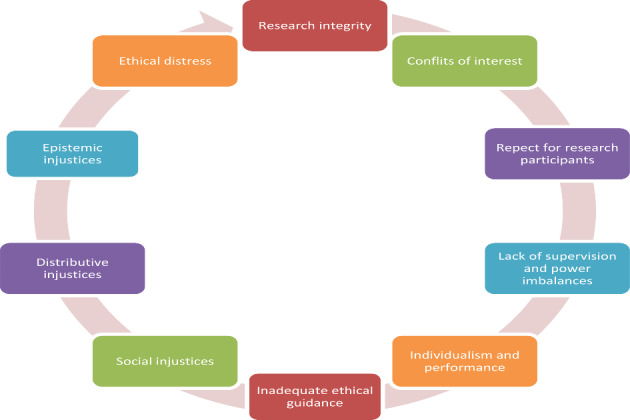
In the context of academic research, a diversity of ethical issues, conditioned by the different roles of members within these institutions, arise. Previous studies on this topic addressed mainly the perceptions of researchers. However, to our knowledge, no studies have explored the transversal ethical issues from a wider spectrum, including other members of academic institutions as the research ethics board (REB) members, and the research ethics experts. The present study used a descriptive phenomenological approach to document the ethical issues experienced by a heterogeneous group of Canadian researchers, REB members, and research ethics experts. Data collection involved socio-demographic questionnaires and individual semi-structured interviews. Following the triangulation of different perspectives (researchers, REB members and ethics experts), emerging ethical issues were synthesized in ten units of meaning: (1) research integrity, (2) conflicts of interest, (3) respect for research participants, (4) lack of supervision and power imbalances, (5) individualism and performance, (6) inadequate ethical guidance, (7) social injustices, (8) distributive injustices, (9) epistemic injustices, and (10) ethical distress. This study highlighted several problematic elements that can support the identification of future solutions to resolve transversal ethical issues in research that affect the heterogeneous members of the academic community.
在学术研究背景下,由于这些机构内成员角色不同,出现了各种各样的伦理问题。以往关于该主题的研究主要关注研究人员的看法。然而,据我们所知,尚无研究从更广泛的范围探讨横向伦理问题,包括学术机构的其他成员,如研究伦理委员会(REB)成员和研究伦理专家。本研究采用描述性现象学方法,记录了加拿大研究人员、REB成员和研究伦理专家这一异质群体所经历的伦理问题。数据收集包括社会人口学问卷调查和个人半结构化访谈。在对不同视角(研究人员、REB成员和伦理专家)进行三角互证后,将新出现的伦理问题归纳为十个意义单元:(1)研究诚信,(2)利益冲突,(3)对研究参与者的尊重,(4)缺乏监督和权力失衡,(5)个人主义与绩效,(6)伦理指导不足,(7)社会不公,(8)分配不公,(9)认知不公,以及(10)伦理困扰。本研究突出了几个有问题的因素,这些因素有助于确定未来的解决方案,以解决影响学术界异质成员的研究中的横向伦理问题。