Matthes Anni, Wolf Florian, Bleidorn Jutta, Markwart Robby
Institute of General Practice and Family Medicine, Jena University Hospital, Friedrich Schiller University, Jena, Thuringia, Germany.
InfectoGnostics Research Campus Jena, Jena, Thuringia, Germany.
Patient Prefer Adherence. 2022 Aug 10;16:2031-2039. doi: 10.2147/PPA.S372366. eCollection 2022.
The use of point-of-care tests (POCTs) has been a central strategy to cope with the COVID-19 pandemic. Yet, evidence on the application and consequences of POCTs within medical settings is rare.
To assess and understand patient perspectives on molecular point-of-care SARS-CoV-2 testing conducted in primary care.
We conducted a cross-sectional survey study among patients who were tested with a molecular SARS-CoV-2 rapid test (ID NOW COVID-19 rapid test, Abbott) in 13 primary care practices in the state of Thuringia (Germany) from February to April 2021. The following aspects were covered in the questionnaire through rating scales and open text formats: test characteristics, trust in test result, consequences of immediate result, cost amount willing to pay and expectations in the future. Open text answers were categorized; quantitative data were analyzed using descriptive statistics and a Mann-Whitney -test to reveal differences in cost contribution depending on the test result.
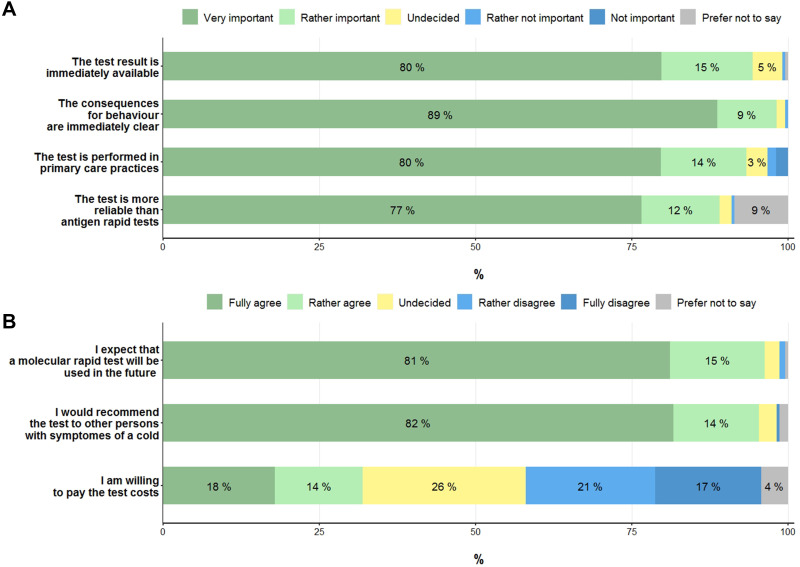
A total of 215 patients from nine family practices and one pediatric practice participated. The immediate availability of the test result was important to the majority of patients (94.3%). 95.7% of patients trusted in their test result. Personal consequences of the immediate test result referred to pandemic measures, certainty of action and reassurance. For further tests, patients were willing to pay between 0€ and 100€ (interquartile range = 10-25€) for the molecular SARS-CoV-2 POCT, regardless of the test result. Expectations of being offered the test again in case of renewed cold symptoms were reported by 96.2%.
Patients highly appreciated molecular SARS-CoV-2 rapid testing conducted in primary care practices. The immediate availability of the test result led to adjustments in patients' behavior and emotional wellbeing. However, potentially challenging for the implementation of POCTs in primary care practices may be the reimbursement of test costs and patients' expectations in future situation.
即时检验(POCT)的使用一直是应对新冠疫情的核心策略。然而,关于POCT在医疗环境中的应用及影响的证据却很少。
评估并了解患者对基层医疗中进行的SARS-CoV-2分子即时检验的看法。
2021年2月至4月,我们在德国图林根州的13家基层医疗机构中,对使用SARS-CoV-2分子快速检测(ID NOW COVID-19快速检测,雅培公司)进行检测的患者开展了一项横断面调查研究。问卷通过评分量表和开放式文本格式涵盖了以下方面:检测特征、对检测结果的信任度、即时结果的影响、愿意支付的费用金额以及对未来的期望。对开放式文本答案进行分类;使用描述性统计和曼-惠特尼检验分析定量数据,以揭示根据检测结果在费用贡献方面的差异。
来自9家家庭诊所和1家儿科诊所的215名患者参与了研究。检测结果的即时可得性对大多数患者(94.3%)来说很重要。95.7%的患者信任他们的检测结果。即时检测结果对个人的影响涉及疫情防控措施、行动的确定性和安心程度。对于进一步检测,无论检测结果如何,患者愿意为SARS-CoV-2分子POCT支付0欧元至100欧元(四分位间距 = 10 - 25欧元)。96.2%的患者表示,如果再次出现感冒症状,希望能再次接受该检测。
患者高度认可在基层医疗诊所进行的SARS-CoV-2分子快速检测。检测结果的即时可得性导致了患者行为和情绪健康的调整。然而,基层医疗诊所中POCT实施可能面临的潜在挑战可能是检测费用的报销以及患者对未来情况的期望。