Institute of Developmental Neurophysiology, Center for Molecular Neurobiology, University Medical Center Hamburg-Eppendorf, Hamburg, Germany.
Center for Brain and Cognition, Computational Neuroscience Group, Universitat Pompeu Fabra, Barcelona, Spain.
Elife. 2022 Aug 17;11:e78811. doi: 10.7554/eLife.78811.
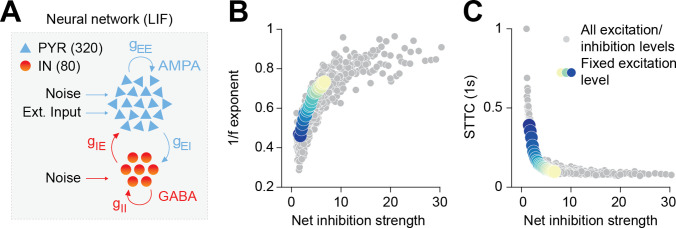
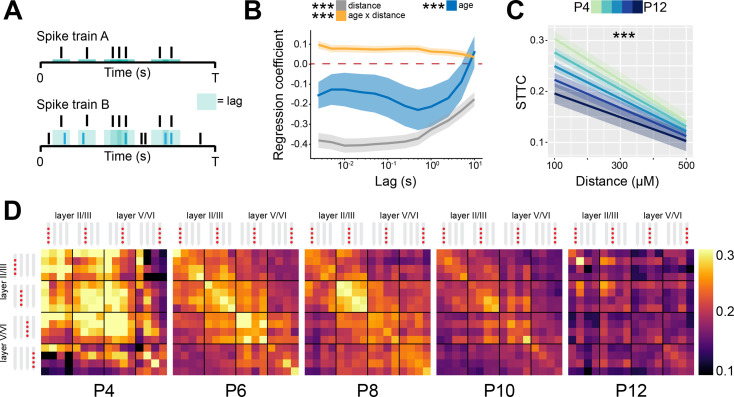
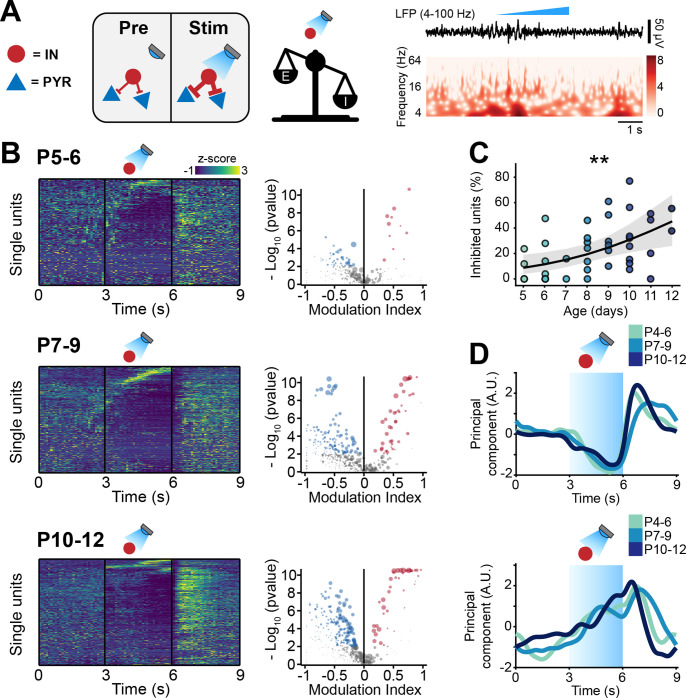
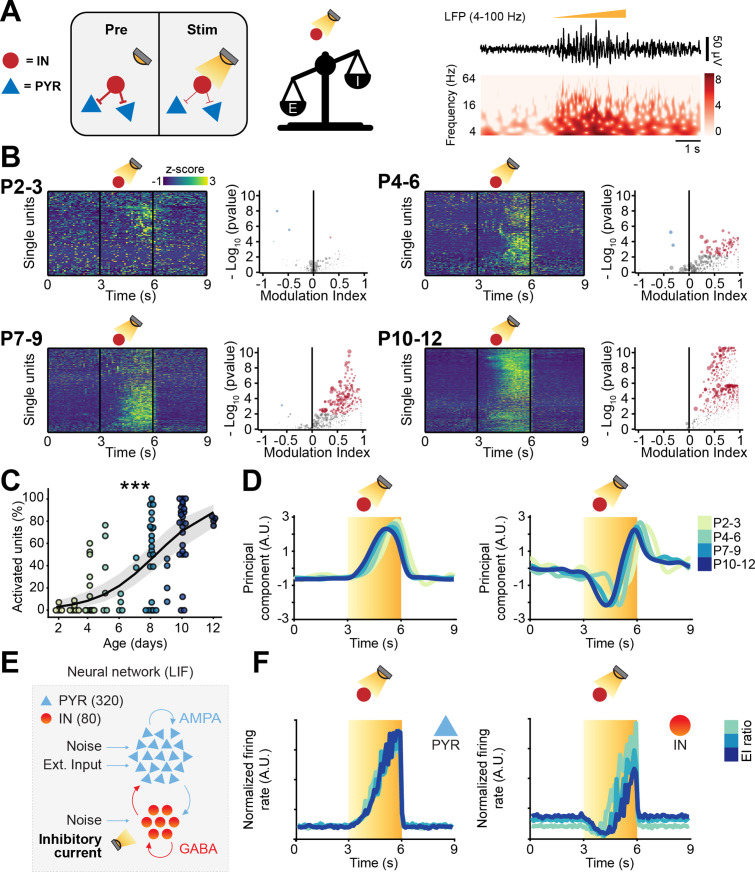
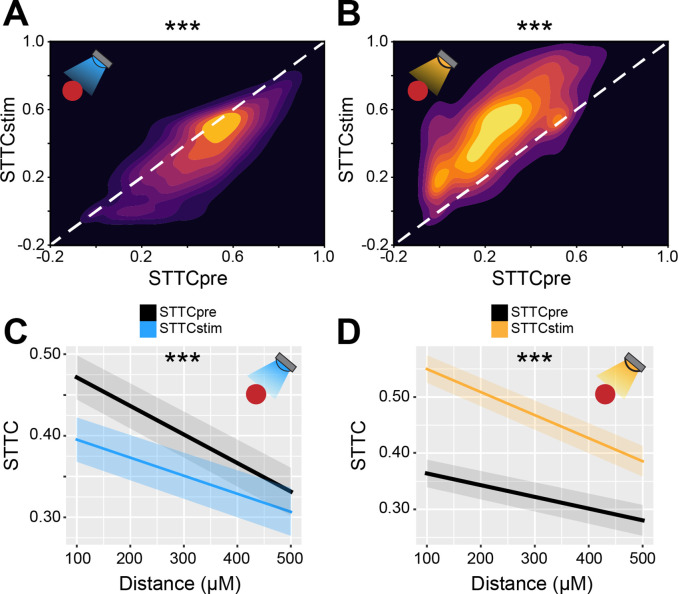
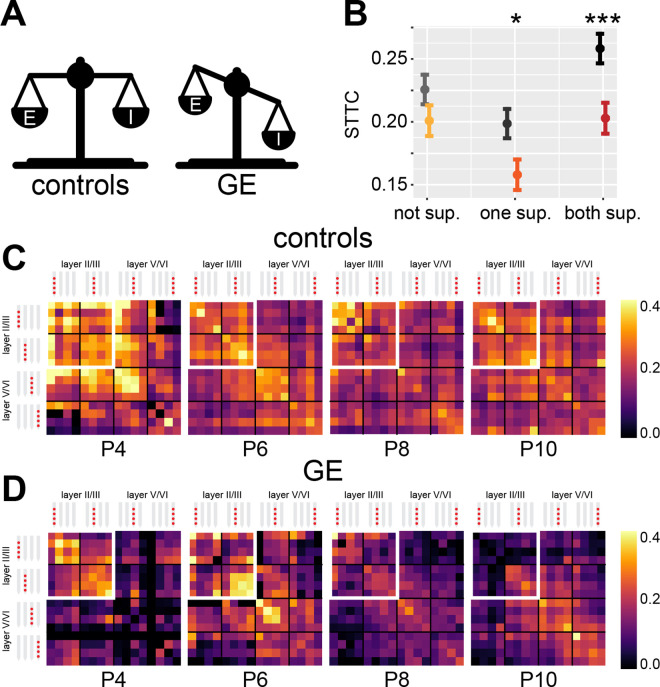
Throughout development, the brain transits from early highly synchronous activity patterns to a mature state with sparse and decorrelated neural activity, yet the mechanisms underlying this process are poorly understood. The developmental transition has important functional consequences, as the latter state is thought to allow for more efficient storage, retrieval, and processing of information. Here, we show that, in the mouse medial prefrontal cortex (mPFC), neural activity during the first two postnatal weeks decorrelates following specific spatial patterns. This process is accompanied by a concomitant tilting of excitation-inhibition (E-I) ratio toward inhibition. Using optogenetic manipulations and neural network modeling, we show that the two phenomena are mechanistically linked, and that a relative increase of inhibition drives the decorrelation of neural activity. Accordingly, in mice mimicking the etiology of neurodevelopmental disorders, subtle alterations in E-I ratio are associated with specific impairments in the correlational structure of spike trains. Finally, capitalizing on EEG data from newborn babies, we show that an analogous developmental transition takes place also in the human brain. Thus, changes in E-I ratio control the (de)correlation of neural activity and, by these means, its developmental imbalance might contribute to the pathogenesis of neurodevelopmental disorders.
在整个发育过程中,大脑从早期高度同步的活动模式转变为稀疏和去相关的神经活动的成熟状态,但这一过程的机制尚不清楚。这种发育转变具有重要的功能后果,因为后一种状态被认为可以更有效地存储、检索和处理信息。在这里,我们发现在小鼠内侧前额叶皮层(mPFC)中,在出生后的头两周内,神经活动会按照特定的空间模式去相关。这一过程伴随着兴奋-抑制(E-I)比朝着抑制方向的协同倾斜。我们利用光遗传学操作和神经网络模型表明,这两个现象在机制上是相关的,抑制的相对增加驱动了神经活动的去相关。因此,在模拟神经发育障碍病因的小鼠中,E-I 比的细微改变与尖峰列车相关性结构的特定损伤有关。最后,利用新生儿大脑的 EEG 数据,我们表明类似的发育转变也发生在人类大脑中。因此,E-I 比的变化控制着神经活动的(去)相关性,并且通过这种方式,其发育失衡可能有助于神经发育障碍的发病机制。