Department of Emergency and Disaster Medicine, Tokushima University Hospital, Tokushima, Japan.
Department of Emergency and Critical Care Medicine, Tokushima University Hospital, Tokushima, Japan.
PLoS One. 2022 Aug 17;17(8):e0273173. doi: 10.1371/journal.pone.0273173. eCollection 2022.
Increased and decreased diaphragm thickness during mechanical ventilation is associated with poor outcomes. Some types of patient-ventilator asynchrony theoretically cause myotrauma of the diaphragm. However, the effects of double cycling on structural changes in the diaphragm have not been previously evaluated. Hence, this study aimed to investigate the relationship between double cycling during the early phase of mechanical ventilation and changes in diaphragm thickness, and the involvement of inspiratory effort in the occurrence of double cycling.
We evaluated adult patients receiving invasive mechanical ventilation for more than 48 h. The end-expiratory diaphragm thickness (Tdiee) was assessed via ultrasonography on days 1, 2, 3, 5 and 7 after the initiation of mechanical ventilation. Then, the maximum rate of change from day 1 (ΔTdiee%) was evaluated. Concurrently, we recorded esophageal pressure and airway pressure on days 1, 2 and 3 for 1 h during spontaneous breathing. Then, the waveforms were retrospectively analyzed to calculate the incidence of double cycling (double cycling index) and inspiratory esophageal pressure swing (ΔPes). Finally, the correlation between double cycling index as well as ΔPes and ΔTdiee% was investigated using linear regression models.
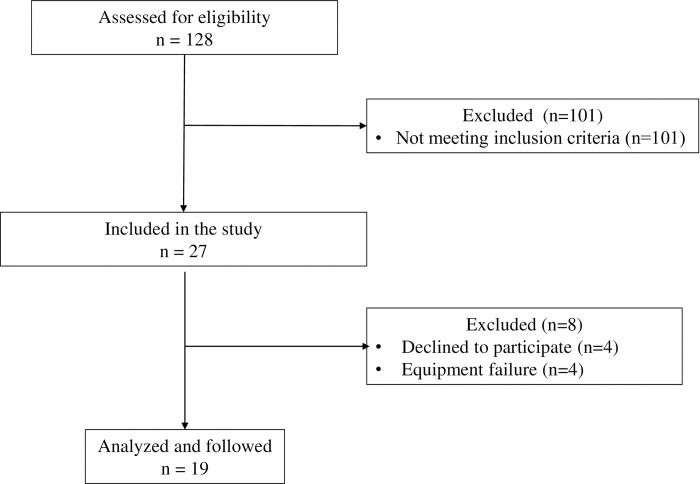
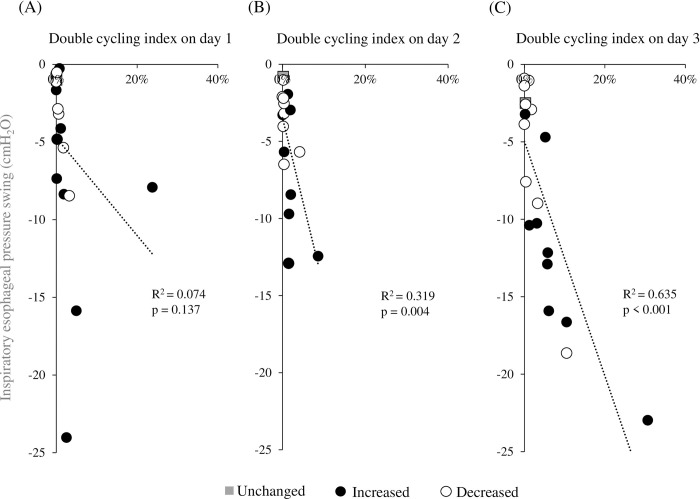
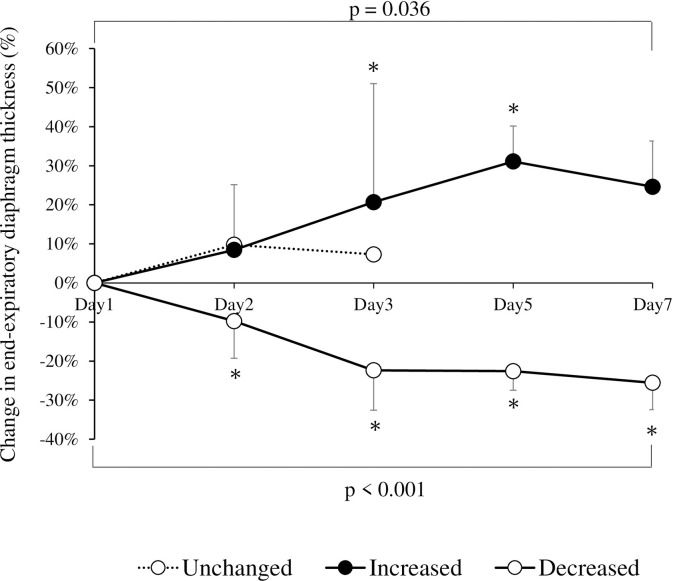
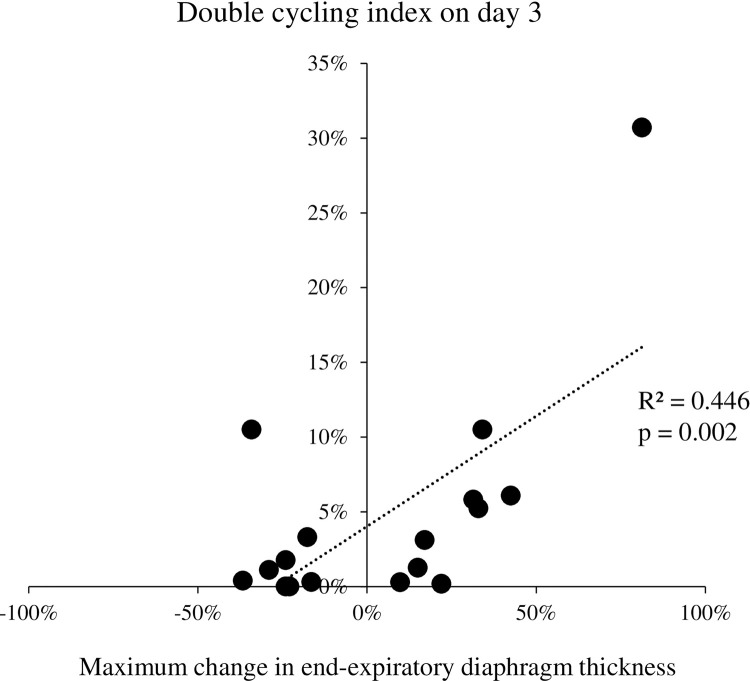
In total, 19 patients with a median age of 69 (interquartile range: 65-78) years were enrolled in this study, and all received pressure assist-control ventilation. The Tdiee increased by more than 10% from baseline in nine patients, decreased by more than 10% in nine and remained unchanged in one. The double cycling indexes on days 1, 2 and 3 were 2.2%, 1.3% and 4.5%, respectively. There was a linear correlation between the double cycling index on day 3 and ΔTdiee% (R2 = 0.446, p = 0.002). The double cycling index was correlated with the ΔPes on days 2 (R2 = 0.319, p = 0.004) and 3 (R2 = 0.635, p < 0.001).
Double cycling on the third day of mechanical ventilation was associated with strong inspiratory efforts and, possibly, changes in diaphragm thickness.
机械通气过程中膈肌厚度的增加和减少与不良预后有关。某些类型的人机不同步理论上会导致膈肌的肌损伤。然而,双触发对膈肌结构变化的影响以前尚未得到评估。因此,本研究旨在探讨机械通气早期双触发与膈肌厚度变化的关系,以及吸气努力在双触发发生中的作用。
我们评估了接受超过 48 小时有创机械通气的成年患者。在机械通气开始后第 1、2、3、5 和 7 天,通过超声评估呼气末膈肌厚度(Tdiee)。然后,评估第 1 天的最大变化率(ΔTdiee%)。同时,在自主呼吸期间,在第 1、2 和 3 天的 1 小时内记录食管压和气道压。然后,对波形进行回顾性分析,以计算双触发(双触发指数)和吸气食管压摆动(ΔPes)的发生率。最后,使用线性回归模型研究双触发指数和ΔPes与ΔTdiee%之间的相关性。
本研究共纳入了 19 名中位年龄为 69 岁(四分位间距:65-78 岁)的患者,均接受压力辅助控制通气。9 名患者的 Tdiee 较基线增加超过 10%,9 名患者的 Tdiee 较基线减少超过 10%,1 名患者的 Tdiee 不变。第 1、2 和 3 天的双触发指数分别为 2.2%、1.3%和 4.5%。第 3 天的双触发指数与ΔTdiee%之间存在线性相关(R2=0.446,p=0.002)。双触发指数与第 2 天(R2=0.319,p=0.004)和第 3 天(R2=0.635,p<0.001)的ΔPes 相关。
机械通气第 3 天的双触发与强烈的吸气努力有关,可能与膈肌厚度的变化有关。