Institute for Electrical Engineering in Medicine, Universität zu Lübeck, Moislinger Allee 53-55, 23558, Lübeck, Germany.
Fraunhofer Research Institution for Individualized and Cell-Based Medical Engineering, Mönkhofer Weg 239 a, 23562, Lübeck, Germany.
Crit Care. 2021 Dec 20;25(1):441. doi: 10.1186/s13054-021-03833-w.
Inspiratory patient effort under assisted mechanical ventilation is an important quantity for assessing patient-ventilator interaction and recognizing over and under assistance. An established clinical standard is respiratory muscle pressure [Formula: see text], derived from esophageal pressure ([Formula: see text]), which requires the correct placement and calibration of an esophageal balloon catheter. Surface electromyography (sEMG) of the respiratory muscles represents a promising and straightforward alternative technique, enabling non-invasive monitoring of patient activity.
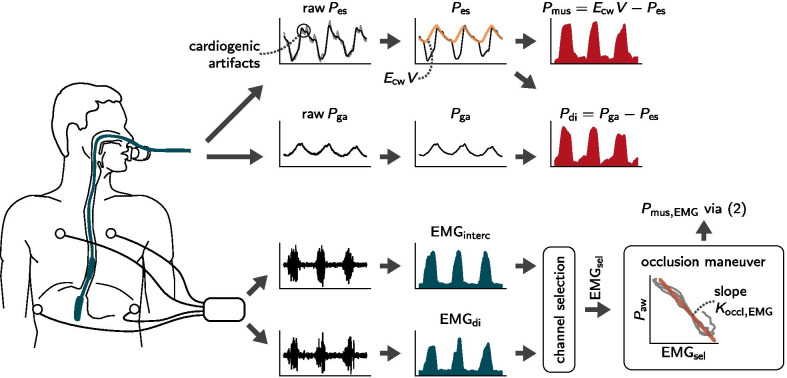
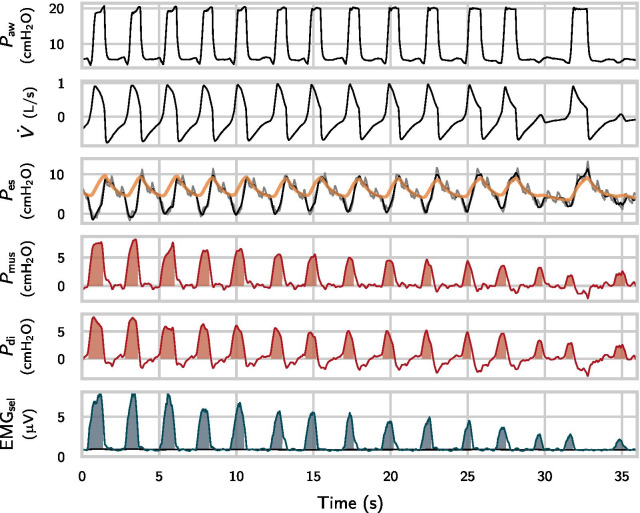
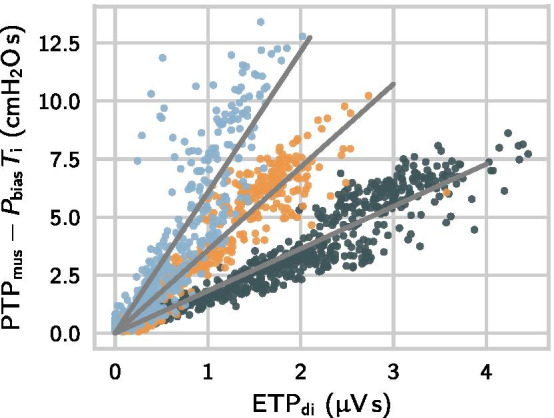
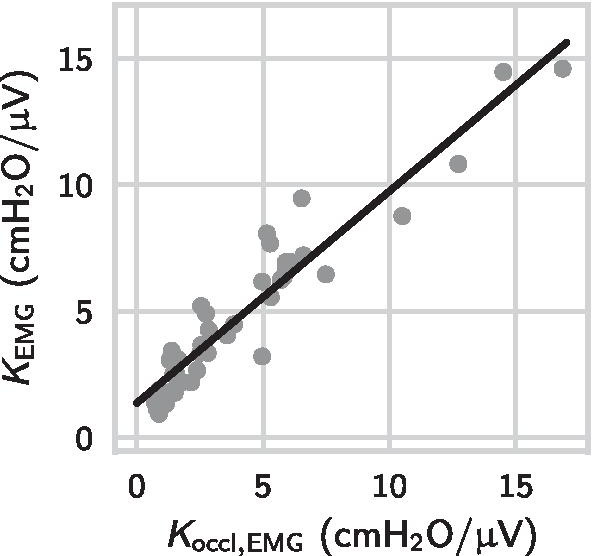
A prospective observational study was conducted with patients under assisted mechanical ventilation, who were scheduled for elective bronchoscopy. Airway flow and pressure, esophageal/gastric pressures and sEMG of the diaphragm and intercostal muscles were recorded at four levels of pressure support ventilation. Patient efforts were quantified via the [Formula: see text]-time product ([Formula: see text]), the transdiaphragmatic pressure-time product ([Formula: see text]) and the EMG-time products (ETP) of the two sEMG channels. To improve the signal-to-noise ratio, a method for automatically selecting the more informative of the sEMG channels was investigated. Correlation between ETP and [Formula: see text] was assessed by determining a neuromechanical conversion factor [Formula: see text] between the two quantities. Moreover, it was investigated whether this scalar can be reliably determined from airway pressure during occlusion maneuvers, thus allowing to quantify inspiratory effort based solely on sEMG measurements.
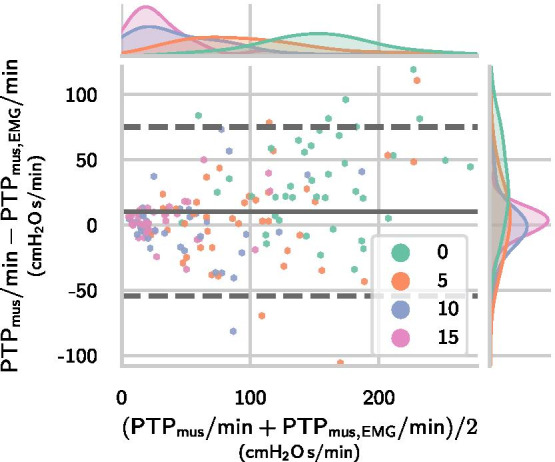
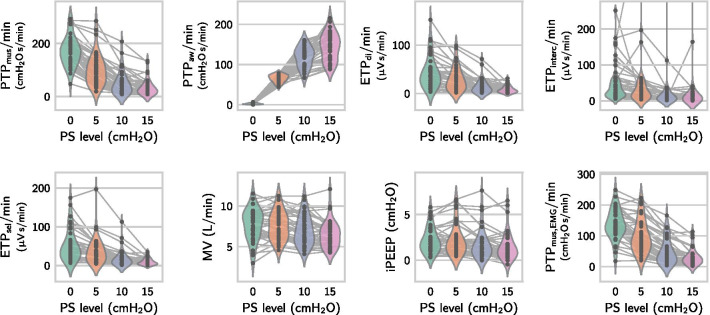
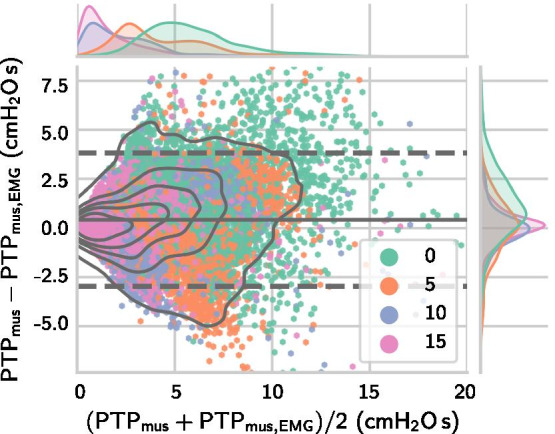
In total, 62 patients with heterogeneous pulmonary diseases were enrolled in the study, 43 of which were included in the data analysis. The ETP of the two sEMG channels was well correlated with [Formula: see text] ([Formula: see text] and [Formula: see text] for diaphragm and intercostal recordings, respectively). The proposed automatic channel selection method improved correlation with [Formula: see text] ([Formula: see text]). The neuromechanical conversion factor obtained by fitting ETP to [Formula: see text] varied widely between patients ([Formula: see text]) and was highly correlated with the scalar determined during occlusions ([Formula: see text], [Formula: see text]). The occlusion-based method for deriving [Formula: see text] from ETP showed a breath-wise deviation to [Formula: see text] of [Formula: see text] across all datasets.
These results support the use of surface electromyography as a non-invasive alternative for monitoring breath-by-breath inspiratory effort of patients under assisted mechanical ventilation.
辅助机械通气下吸气患者的努力是评估患者-通气机相互作用和识别过度辅助和不足辅助的重要指标。一种既定的临床标准是呼吸肌压力[公式:见文本],它源自食管压力[公式:见文本],这需要正确放置和校准食管球囊导管。呼吸肌的表面肌电图(sEMG)代表了一种有前途且直接的替代技术,能够实现对患者活动的非侵入性监测。
对接受辅助机械通气并计划行择期支气管镜检查的患者进行了一项前瞻性观察性研究。在四级压力支持通气下记录气道流量和压力、食管/胃压力以及膈肌和肋间肌的 sEMG。通过[公式:见文本]-时间乘积([公式:见文本])、膈肌跨膈压时间乘积([公式:见文本])和两个 sEMG 通道的肌电图时间乘积(ETP)来量化患者的努力。为了提高信噪比,研究了一种自动选择更有信息量的 sEMG 通道的方法。通过确定两个数量之间的神经机械转换因子[公式:见文本],评估了 ETP 与[公式:见文本]之间的相关性。此外,还研究了是否可以从闭塞操作期间的气道压力可靠地确定此标量,从而仅基于 sEMG 测量来量化吸气努力。
共有 62 名患有不同肺部疾病的患者参加了这项研究,其中 43 名患者纳入数据分析。两个 sEMG 通道的 ETP 与[公式:见文本]高度相关([公式:见文本]和[公式:见文本]分别为膈肌和肋间肌记录)。通过将 ETP 拟合到[公式:见文本]来提出的自动通道选择方法改善了与[公式:见文本]的相关性([公式:见文本])。通过拟合 ETP 获得的神经机械转换因子在患者之间差异很大([公式:见文本]),并且与在闭塞期间确定的标量高度相关([公式:见文本],[公式:见文本])。从 ETP 中基于闭塞的推导[公式:见文本]的方法显示了所有数据集的呼吸偏差为[公式:见文本]。
这些结果支持使用表面肌电图作为监测辅助机械通气下患者逐次吸气努力的非侵入性替代方法。