Lady Davis Institute, Segal Cancer Centre, Jewish General Hospital, McGill University, Montréal, Québec, Canada.
Rosalind and Morris Goodman Cancer Institute, McGill University, Montréal, Québec, Canada.
JCO Precis Oncol. 2022 Aug;6:e2200107. doi: 10.1200/PO.22.00107.
Non-V600 mutations comprise approximately 35% of all BRAF mutations in cancer. Many of these mutations have been identified as oncogenic drivers and can be classified into three classes according to molecular characteristics. Consensus treatment strategies for class 2 and 3 BRAF mutations have not yet been established.
We performed a systematic review and meta-analysis with published reports of individual patients with cancer harboring class 2 or 3 BRAF mutations from 2010 to 2021, to assess treatment outcomes with US Food and Drug Administration-approved mitogen-activated protein kinase (MAPK) pathway targeted therapy (MAPK TT) according to BRAF class, cancer type, and MAPK TT type. Coprimary outcomes were response rate and progression-free survival.
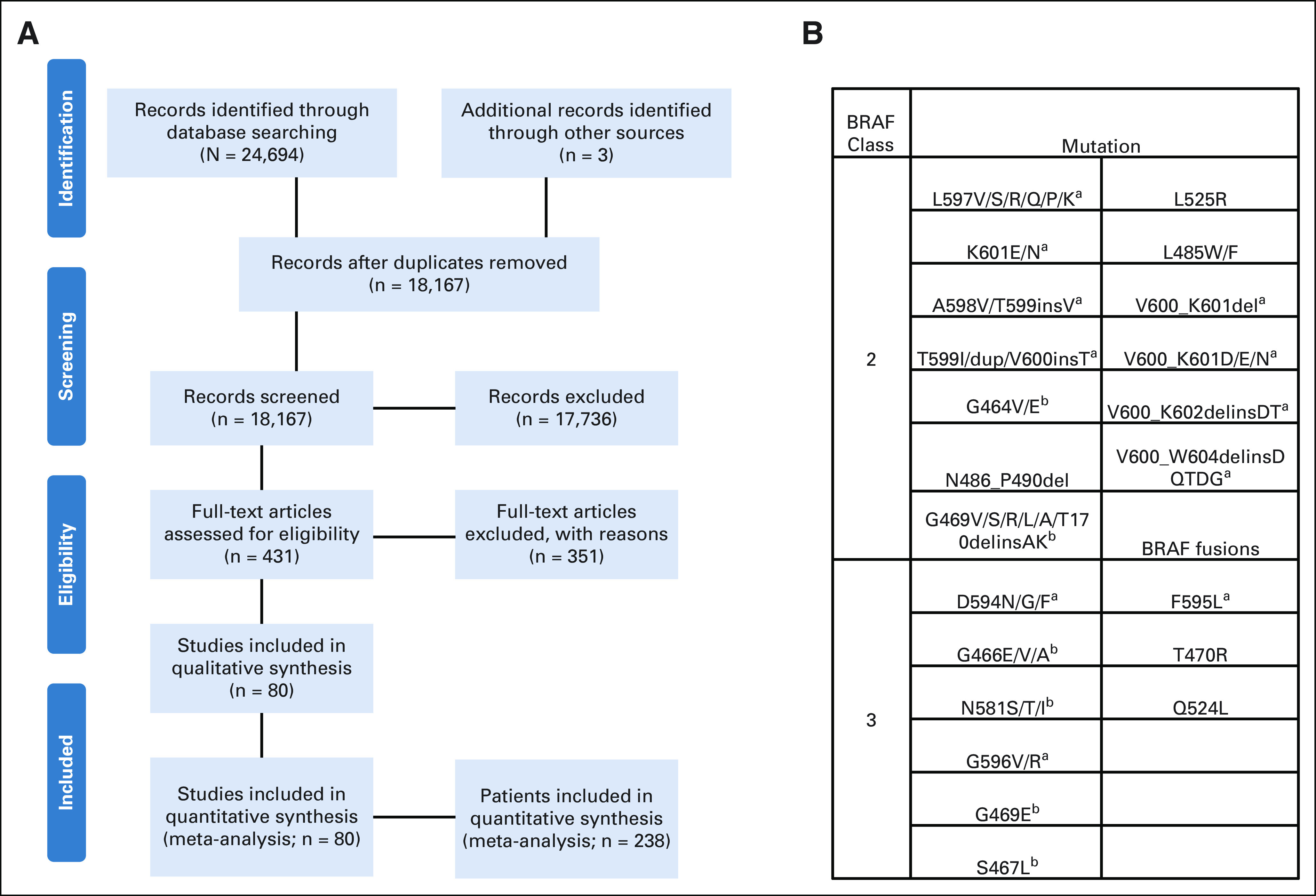
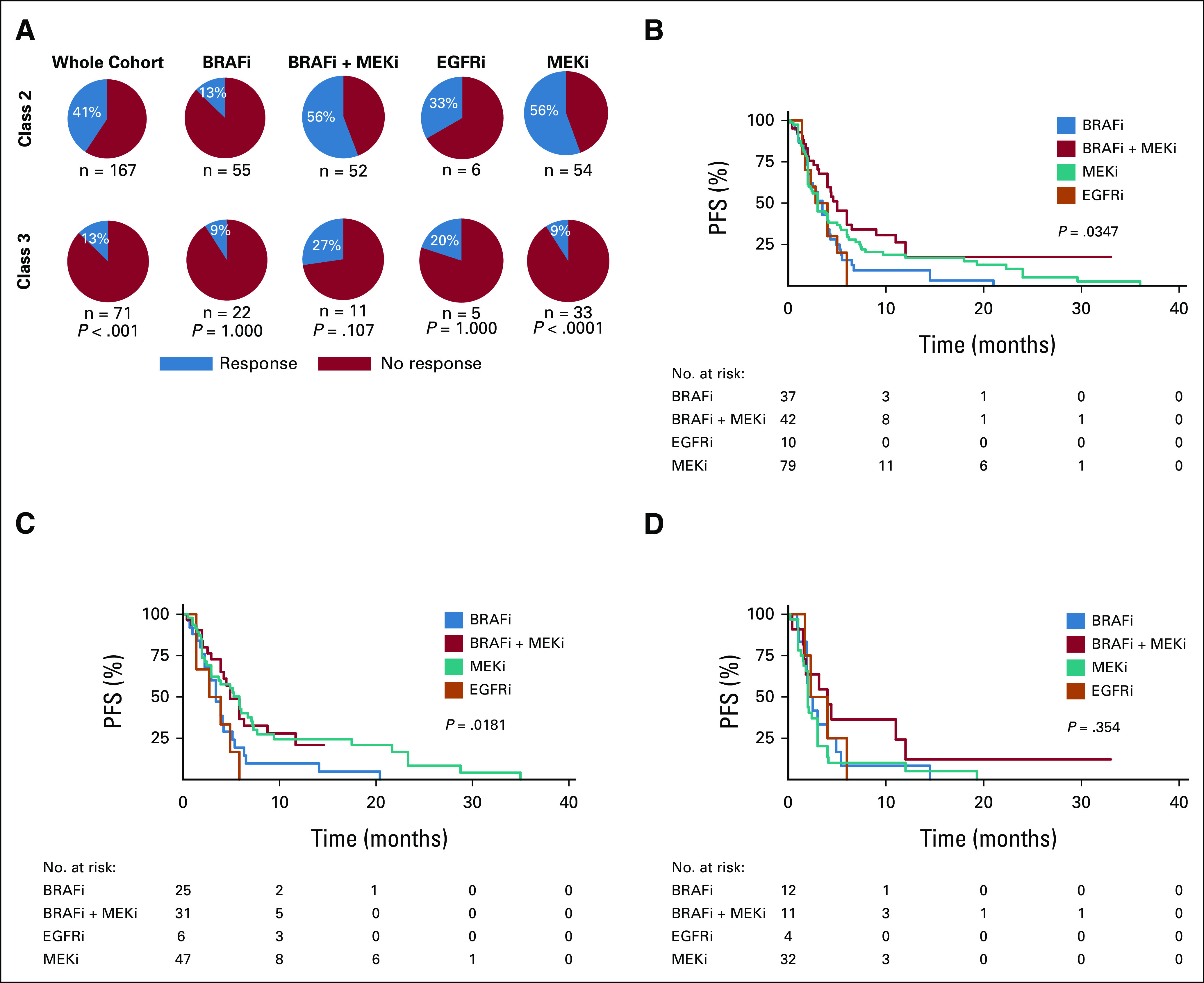
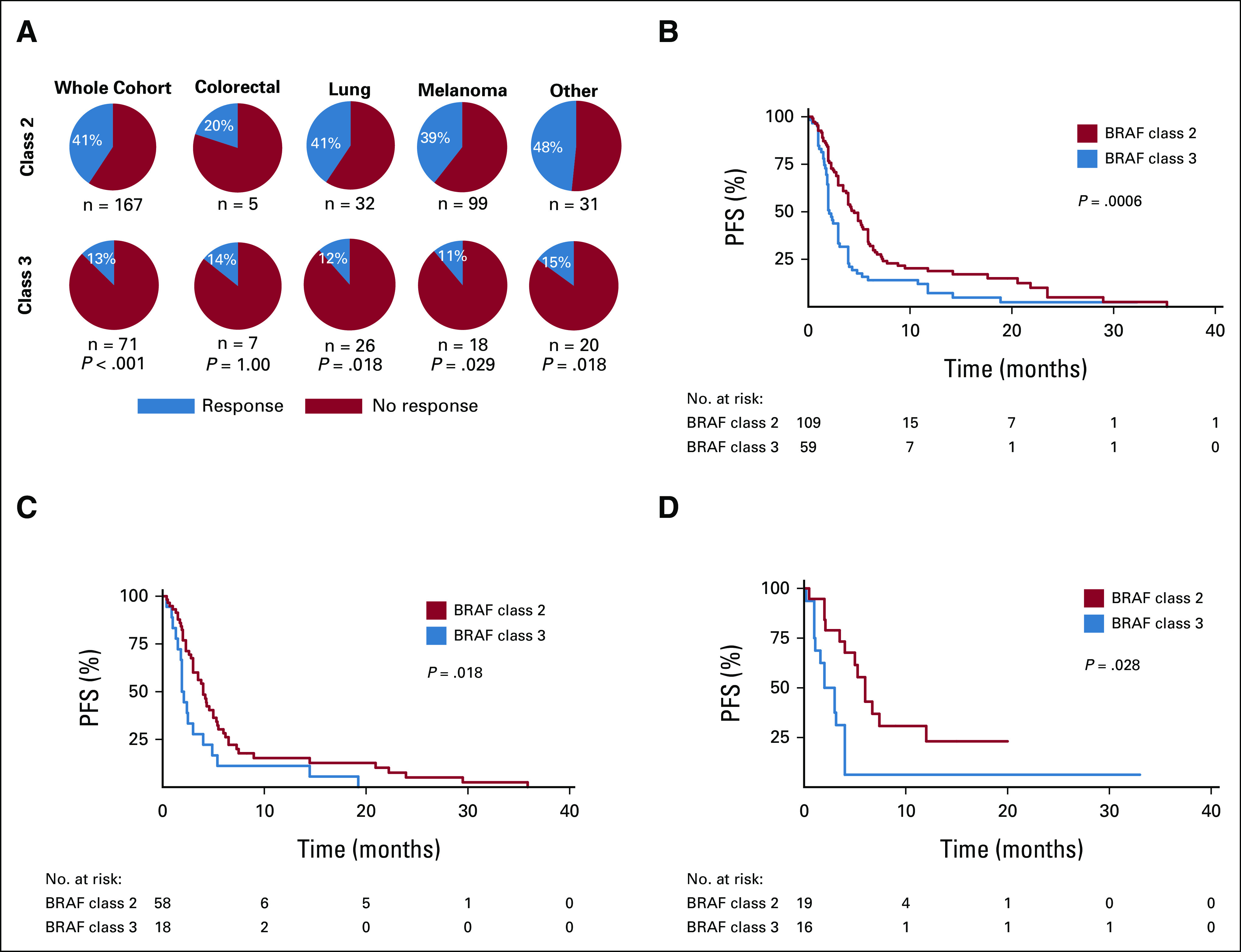
A total of 18,167 studies were screened, identifying 80 studies with 238 patients who met inclusion criteria. This included 167 patients with class 2 and 71 patients with class 3 BRAF mutations. Overall, 77 patients achieved a treatment response. In both univariate and multivariable analyses, response rate and progression-free survival were higher among patients with class 2 compared with class 3 mutations, findings that remain when analyses are restricted to patients with melanoma or lung primary cancers. MEK ± BRAF inhibitors demonstrated greater clinical activity in class 2 compared with class 3 BRAF-mutant tumors than BRAF or EGFR inhibitors.
This meta-analysis suggests that MAPK TTs have clinical activity in some class 2 and 3 BRAF-mutant cancers. BRAF class may dictate responsiveness to current and emerging treatment strategies, particularly in melanoma and lung cancers. Together, this analysis provides clinical validation of predictions made on the basis of a mutation classification system established in the preclinical literature. Further evaluation with prospective clinical trials is needed for this population.
非 V600 突变约占癌症中所有 BRAF 突变的 35%。其中许多突变已被确定为致癌驱动因素,根据分子特征可分为三类。尚未制定针对 2 类和 3 类 BRAF 突变的共识治疗策略。
我们对 2010 年至 2021 年间发表的具有 2 类或 3 类 BRAF 突变的癌症患者的个体患者报告进行了系统评价和荟萃分析,以评估根据 BRAF 类别、癌症类型和 MAPK TT 类型,美国食品和药物管理局批准的丝裂原活化蛋白激酶 (MAPK) 通路靶向治疗 (MAPK TT) 的治疗结果。主要结果是反应率和无进展生存期。
共筛选出 18,167 项研究,确定了 80 项符合纳入标准的研究,共纳入了 238 名患者。这包括 167 名 2 类和 71 名 3 类 BRAF 突变患者。总体而言,77 名患者达到了治疗反应。在单变量和多变量分析中,2 类突变患者的反应率和无进展生存期均高于 3 类突变患者,当分析仅限于黑色素瘤或肺癌患者时,这一发现仍然存在。MEK ± BRAF 抑制剂在 2 类 BRAF 突变肿瘤中的临床活性大于 3 类 BRAF 突变肿瘤,而 BRAF 或 EGFR 抑制剂则不然。
这项荟萃分析表明,MAPK TT 对一些 2 类和 3 类 BRAF 突变癌症具有临床活性。BRAF 类别可能决定对当前和新兴治疗策略的反应性,尤其是在黑色素瘤和肺癌中。总的来说,这项分析为基于临床前文献中建立的突变分类系统做出的预测提供了临床验证。需要对该人群进行前瞻性临床试验进一步评估。