Xia Dongdong, Bai Wei, Wang Enxin, Li Jiaping, Chen Xiaoming, Wang Zhexuan, Huang Mingsheng, Huang Ming, Sun Junhui, Yang Weizhu, Lin Zhengyu, Wu Jianbing, Li Zixiang, Yang Shufa, Zhu Xu, Chen Zaizhong, Zhang Yanfang, Fan Wenzhe, Mai Qicong, Ding Rong, Nie Chunhui, Feng Long, Li Xueda, Huang Wukui, Sun Jun, Wang Qiuhe, Lv Yong, Li Xiaomei, Luo Bohan, Wang Zhengyu, Yuan Jie, Guo Wengang, Li Kai, Li Bing, Li Ruijun, Yin Zhanxin, Xia Jielai, Han Guohong
Department of Liver Diseases and Interventional Radiology, Digestive Diseases Hospital, Xi'an International Medical Center Hospital, Northwest University, Xi'an, China.
Department of Liver Disease and Digestive Interventional Radiology, National Clinical Research Center for Digestive Disease and Xijing Hospital of Digestive Diseases, Fourth Military Medical University, Xi'an, China.
Liver Cancer. 2022 Mar 9;11(4):368-382. doi: 10.1159/000523849. eCollection 2022 Jul.
Lenvatinib is the first-line treatment for advanced hepatocellular carcinoma (HCC). We aimed to compare the clinical outcomes of lenvatinib plus drug-eluting beads transarterial chemoembolization (DEB-TACE) versus lenvatinib alone in real-world practice.
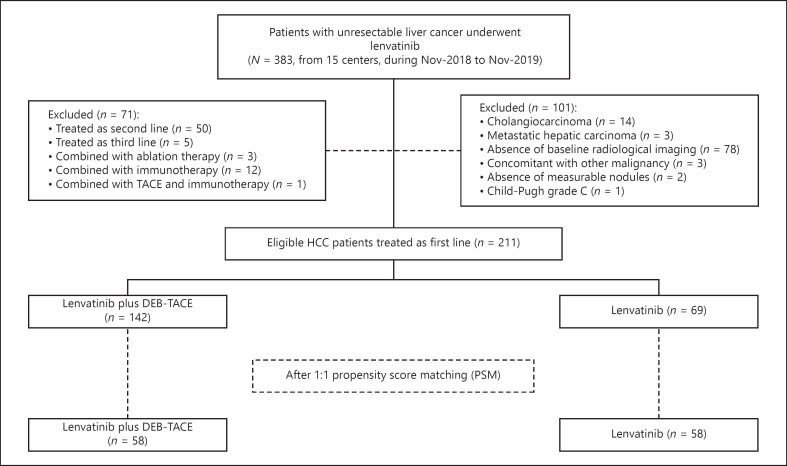
This retrospective analysis included 142 consecutive patients who received lenvatinib plus DEB-TACE and 69 patients who received lenvatinib alone as first-line treatment from 15 Chinese academic centers from November 2018 to November 2019. Overall survival (OS), progression-free survival (PFS), objective response rate (ORR) were evaluated by modified Response Evaluation Criteria in Solid Tumors criteria, and safety profiles were compared between the two groups.
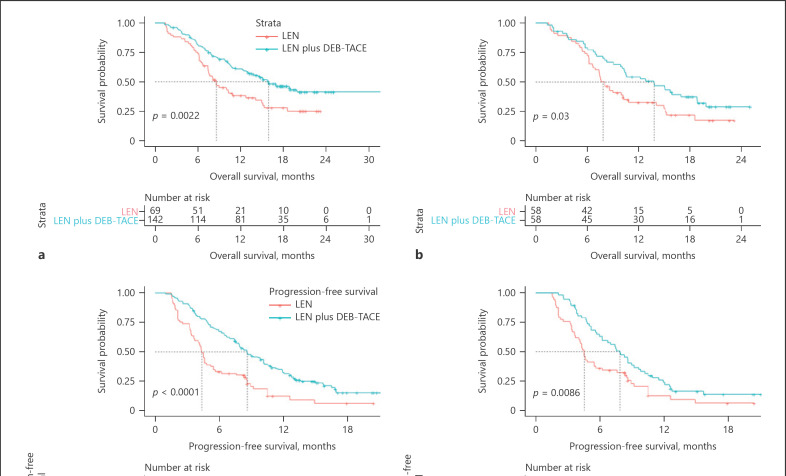
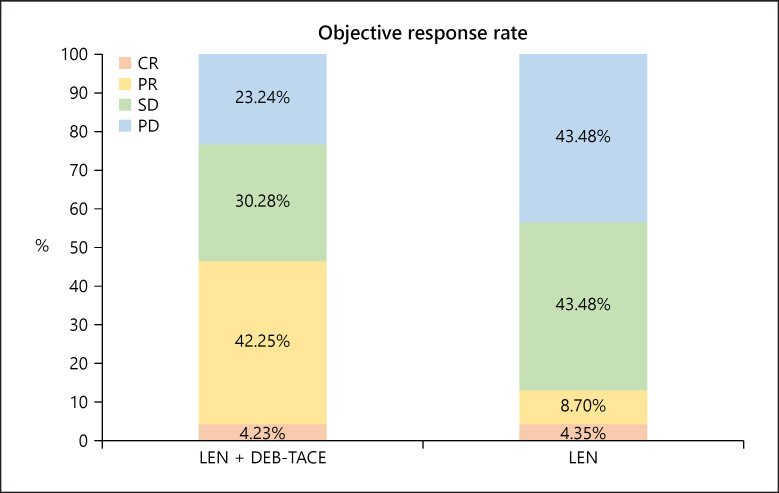
The median OS and PFS were significantly longer in the combined therapy group than in the monotherapy group in whole cohort (median OS, 15.9 vs. 8.6 months, = 0.0022; median PFS, 8.6 vs. 4.4 months, < 0.001) and after propensity score matching analysis (median OS, 13.8 vs. 7.8 months, = 0.03; median PFS, 7.8 vs. 4.5 months, = 0.009). Moreover, the treatment option was an independent prognostic factor for OS and PFS with adjustment based upon baseline characteristics (adjusted hazard ratio [HR]: 0.53, 95% confidence interval [CI]: 0.36-0.78, = 0.001, and adjusted HR: 0.42, 95% CI: 0.30-0.60, < 0.001, respectively) and propensity score (adjusted HR: 0.52, 95% CI: 0.36-0.76, = 0.001, and adjusted HR: 0.46, 95% CI: 0.33-0.64, < 0.001, respectively). Moreover, a greater ORR was observed in the combined group (ORR: 46.48% vs. 13.05%, < 0.001). Furthermore, the most common adverse events (AEs) were elevated aspartate aminotransferase (54.9%) and fatigue (46.4%) in the lenvatinib plus DEB-TACE group and lenvatinib group, respectively. Most AEs were mild-to-moderate and manageable.
With well-tolerated safety, lenvatinib plus DEB-TACE was more effective than lenvatinib monotherapy in improving OS, PFS, and ORR. Thus, it may be a promising treatment for advanced HCC. Future prospective studies confirming these findings are warranted.
仑伐替尼是晚期肝细胞癌(HCC)的一线治疗药物。我们旨在比较在实际临床中,仑伐替尼联合载药微球经动脉化疗栓塞术(DEB-TACE)与单纯使用仑伐替尼的临床疗效。
本回顾性分析纳入了2018年11月至2019年11月期间,来自15家中国学术中心的142例接受仑伐替尼联合DEB-TACE的连续患者以及69例接受单纯仑伐替尼一线治疗的患者。采用改良实体瘤疗效评价标准评估总生存期(OS)、无进展生存期(PFS)和客观缓解率(ORR),并比较两组的安全性。
在整个队列中,联合治疗组的中位OS和PFS显著长于单药治疗组(中位OS,15.9个月对8.6个月,P = 0.0022;中位PFS,8.6个月对4.4个月,P < 0.001),倾向评分匹配分析后结果相似(中位OS,13.8个月对7.8个月,P = 0.03;中位PFS,7.8个月对4.5个月,P = 0.009)。此外,根据基线特征调整后,治疗方案是OS和PFS的独立预后因素(调整后风险比[HR]:0.53,95%置信区间[CI]:0.36 - 0.78,P = 0.001;调整后HR:0.42,95% CI:0.30 - 0.60,P < 0.001),倾向评分调整后结果类似(调整后HR:0.52,95% CI:0.36 - 0.76,P = 0.001;调整后HR:0.46,95% CI:0.33 - 0.64,P < 0.001)。联合组的ORR更高(ORR:46.48%对13.05%,P < 0.001)。此外,仑伐替尼联合DEB-TACE组和仑伐替尼组最常见的不良事件(AE)分别是天门冬氨酸氨基转移酶升高(54.9%)和疲劳(46.4%)。大多数AE为轻至中度且可管理。
仑伐替尼联合DEB-TACE安全性良好,在改善OS、PFS和ORR方面比单纯仑伐替尼单药治疗更有效。因此,它可能是晚期HCC的一种有前景的治疗方法。未来需要进行前瞻性研究来证实这些发现。