Hojo Nobumasa, Nagasaki Makoto, Mihara Yasuha
Department of General Medicine, National Hospital Organization Hamada Medical Center, Hamada City 697-8511, Shimane, Japan.
Department of Pathology, National Hospital Organization Hamada Medical Center, Hamada City 697-8511, Shimane, Japan.
World J Clin Cases. 2022 Jun 16;10(17):5708-5716. doi: 10.12998/wjcc.v10.i17.5708.
B-cell lymphoma, unclassifiable, with features intermediate between diffuse large B-cell lymphoma and classical Hodgkin lymphoma (BCLu-DLBCL/cHL), also referred to as gray zone lymphoma (GZL), is known to share features with cHL and DLBCL. However, GZL is often difficult to diagnose. There is no consensus regarding the optimal therapeutic regimen. Most reported cases of GZL have been in Caucasian and Hispanic individuals, and its incidence is lower in African-American and Asian populations, including the Japanese population.
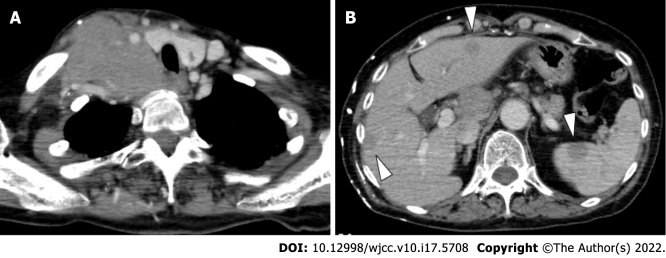
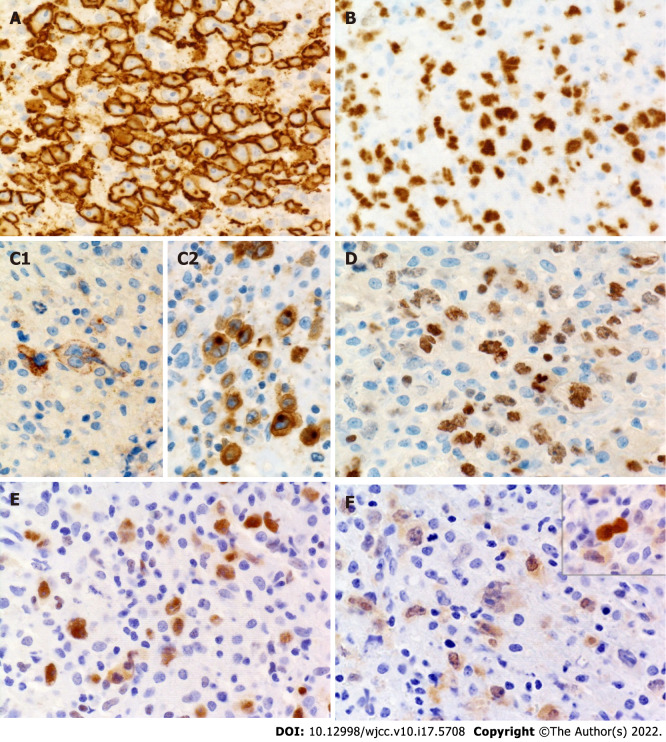
A 69-year-old female presented at our hospital with a growing mass on the right side of her neck. An elastic, soft mass measuring 9 cm × 6 cm was palpable in the right cervical region. Laboratory analyses showed pancytopenia, increased serum lactate dehydrogenase levels, and markedly increased levels of soluble interleukin-2 receptor. Enhanced computed tomography (CT) and fluorodeoxyglucose positron emission tomography (PET)/CT revealed multiple lesions throughout her body. She was diagnosed with GZL based on the characteristic pathological findings, the immunophenotype [CD20+, PAX5+, OCT2+/BOB1 (focal+), CD30+, CD15-], and the strong positive expression of neoplastic programmed cell death protein ligand 1 (PD-L1) in her lymphoma cells. The lymphoma was stage IV according to the Lugano classification and high-risk according to the International Prognostic Index for aggressive non-Hodgkin lymphoma. The patient received cyclophosphamide, doxorubicin, vincristine, prednisolone, and rituximab (R-CHOP) chemotherapy because the tumor cells were CD20+. She has remained in complete remission for 3 years.
GZL was diagnosed based on histopathology and immunophenotyping with ancillary PD-L1 positivity. R-CHOP chemotherapy was an effective treatment.
具有弥漫性大B细胞淋巴瘤和经典霍奇金淋巴瘤之间特征的不可分类B细胞淋巴瘤(BCLu-DLBCL/cHL),也称为灰色地带淋巴瘤(GZL),已知与cHL和DLBCL有共同特征。然而,GZL通常难以诊断。关于最佳治疗方案尚无共识。大多数报道的GZL病例发生在白种人和西班牙裔个体中,在非裔美国人和亚洲人群(包括日本人群)中的发病率较低。
一名69岁女性因颈部右侧肿物增大就诊于我院。在右颈部可触及一个9 cm×6 cm的弹性、柔软肿物。实验室分析显示全血细胞减少、血清乳酸脱氢酶水平升高以及可溶性白细胞介素-2受体水平显著升高。增强计算机断层扫描(CT)和氟脱氧葡萄糖正电子发射断层扫描(PET)/CT显示全身多处病变。根据特征性病理表现、免疫表型[CD20+、PAX5+、OCT2+/BOB1(局灶+)、CD30+、CD15-]以及淋巴瘤细胞中肿瘤程序性细胞死亡蛋白配体1(PD-L1)的强阳性表达,她被诊断为GZL。根据卢加诺分类,该淋巴瘤为IV期,根据侵袭性非霍奇金淋巴瘤国际预后指数为高危。由于肿瘤细胞为CD20+,患者接受了环磷酰胺、多柔比星、长春新碱、泼尼松龙和利妥昔单抗(R-CHOP)化疗。她已完全缓解3年。
基于组织病理学和免疫表型分析以及辅助性PD-L1阳性诊断为GZL。R-CHOP化疗是一种有效的治疗方法。