Department of General Surgery, Yangpu Hospital, Tongji University, Shanghai 200090, China.
Department of Urology, Ruijin Hospital, Shanghai Jiaotong University School of Medicine, Shanghai 200025, China.
World J Gastroenterol. 2022 Jun 28;28(24):2705-2732. doi: 10.3748/wjg.v28.i24.2705.
Stool DNA (sDNA) methylation analysis is a promising, noninvasive approach for colorectal cancer screening; however, reliable biomarkers for detecting early-stage colon cancer (ECC) are lacking, particularly in the Chinese population.
To identify a novel stool-based assay that can improve the effectiveness of ECC screening.
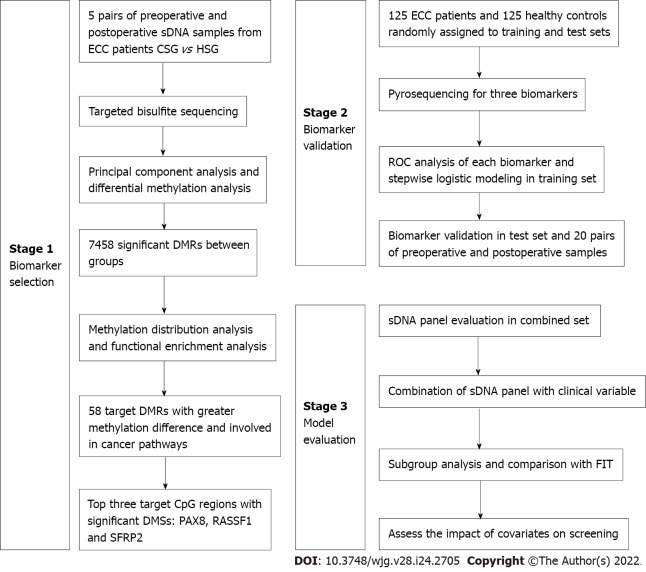
A blinded case-control study was performed using archived stool samples from 125 ECC patients, and 125 control subjects with normal colonoscopy. The cohort was randomly divided into training and test sets at a 1.5:1 ratio. Targeted bisulfite sequencing (TBSeq) was conducted on five pairs of preoperative and postop-erative sDNA samples from ECC patients to identify DNA methylation biomarkers, which were validated using pyrosequencing. By logistic regression analysis, a multiplex stool-based assay was developed in the training set, and the detection performance was further assessed in the test set and combined set. The test was used to investigate the association of detection sensitivity with clinico-pathological features.
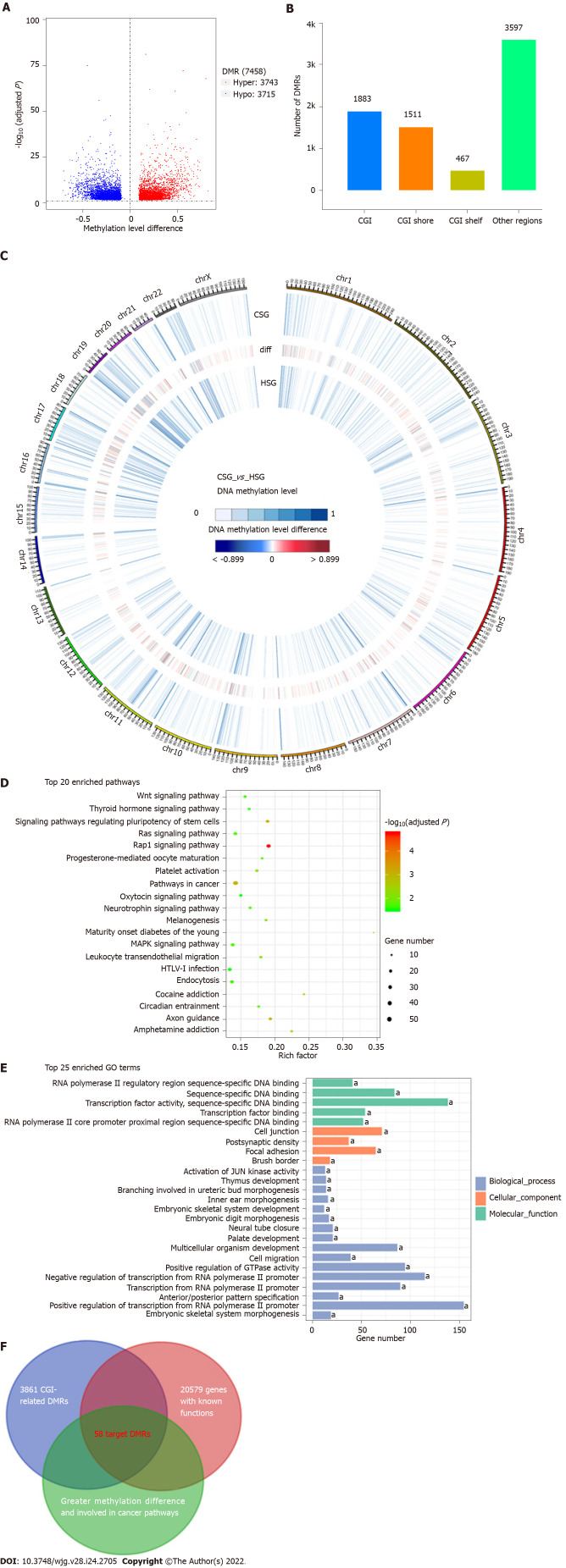
Following TBSeq, three hypermethylated cytosine-guanine sites were selected as biomarkers, including paired box 8, Ras-association domain family 1 and secreted frizzled-related protein 2, which differed between the groups and were involved in important cancer pathways. An sDNA panel containing the three biomarkers was constructed with a logistic model. Receiver operating characteristic (ROC) analysis revealed that this panel was superior to the fecal immunochemical test (FIT) or serum carcinoembryonic antigen for the detection of ECC. We further found that the combination of the sDNA panel with FIT could improve the screening effectiveness. In the combined set, the sensitivity, specificity and area under the ROC curve for this multiplex assay were 80.0%, 93.6% and 0.918, respectively, and the performance remained excellent in the subgroup analysis by tumor stage. In addition, the detection sensitivity did not differ with tumor site, tumor stage, histological differentiation, age or sex, but was significantly higher in T4 than in T1-3 stage tumors ( = 0.041).
We identified a novel multiplex stool-based assay combining sDNA methylation biomarkers and FIT, which could detect ECC with high sensitivity and specificity throughout the colon, showing a promising application perspective.
粪便 DNA(sDNA)甲基化分析是一种很有前途的、非侵入性的结直肠癌筛查方法;然而,目前缺乏可靠的生物标志物来检测早期结肠癌(ECC),特别是在中国人群中。
寻找一种新型的粪便检测方法,以提高 ECC 筛查的效果。
采用盲法病例对照研究,使用 125 例 ECC 患者和 125 例结肠镜检查正常的对照者的存档粪便样本。该队列按 1.5:1 的比例随机分为训练集和测试集。对 125 例 ECC 患者的 5 对术前和术后 sDNA 样本进行靶向亚硫酸氢盐测序(TBSeq),以鉴定 DNA 甲基化生物标志物,然后使用焦磷酸测序进行验证。通过逻辑回归分析,在训练集中开发了一种多重粪便检测方法,并在测试集和组合集中进一步评估了其检测性能。使用该测试方法来研究检测敏感性与临床病理特征的关系。
TBSeq 后,选择了三个超甲基化胞嘧啶-鸟嘌呤位点作为生物标志物,包括配对盒 8、Ras 相关结构域家族 1 和分泌卷曲相关蛋白 2,这些标志物在组间存在差异,并且与重要的癌症途径有关。利用逻辑模型构建了一个包含三个生物标志物的 sDNA 检测 panel。接受者操作特征(ROC)分析表明,该 panel 比粪便免疫化学试验(FIT)或血清癌胚抗原对 ECC 的检测更具优势。我们进一步发现,sDNA 检测 panel 与 FIT 联合应用可以提高筛查效果。在组合集中,该多重检测方法的敏感性、特异性和 ROC 曲线下面积分别为 80.0%、93.6%和 0.918,在按肿瘤分期进行的亚组分析中,该方法的性能仍然非常出色。此外,检测敏感性与肿瘤部位、肿瘤分期、组织学分化、年龄或性别无关,但在 T4 期肿瘤中明显高于 T1-3 期肿瘤(=0.041)。
我们鉴定了一种新型的多重粪便检测方法,该方法结合了 sDNA 甲基化生物标志物和 FIT,可用于整个结肠的 ECC 检测,具有较高的敏感性和特异性,具有广阔的应用前景。