Dorf Justyna, Zaręba Konrad, Matowicka-Karna Joanna, Pryczynicz Anna, Guzińska-Ustymowicz Katarzyna, Zalewska Anna, Maciejczyk Mateusz
Department of Clinical Laboratory Diagnostics, Medical University of Bialystok, Bialystok, Poland.
2nd Clinical Department of General and Gastroenterological Surgery, Medical University of Bialystok, Bialystok, Poland.
J Inflamm Res. 2022 Aug 11;15:4585-4600. doi: 10.2147/JIR.S374387. eCollection 2022.
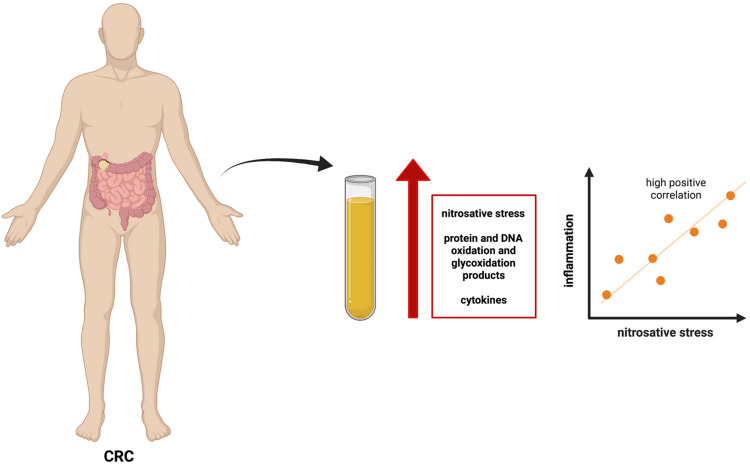
Overproduction of reactive nitrogen species (RNS) causes the nitrosative stress, which plays a vital role in the development of metabolic, inflammatory, and cancerous diseases. However, the role of nitrosative and carbonyl stress in the biology of colorectal cancer (CRC) is still not well understood. Therefore, this study evaluated nitrosative stress, protein and DNA oxidation/glycoxidation, and pro- and anti-inflammatory cytokines in CRC patients compared with healthy controls.
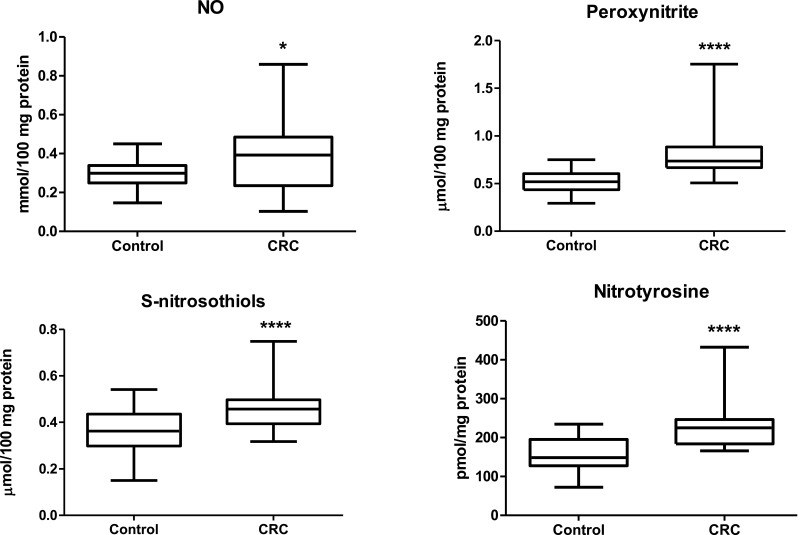
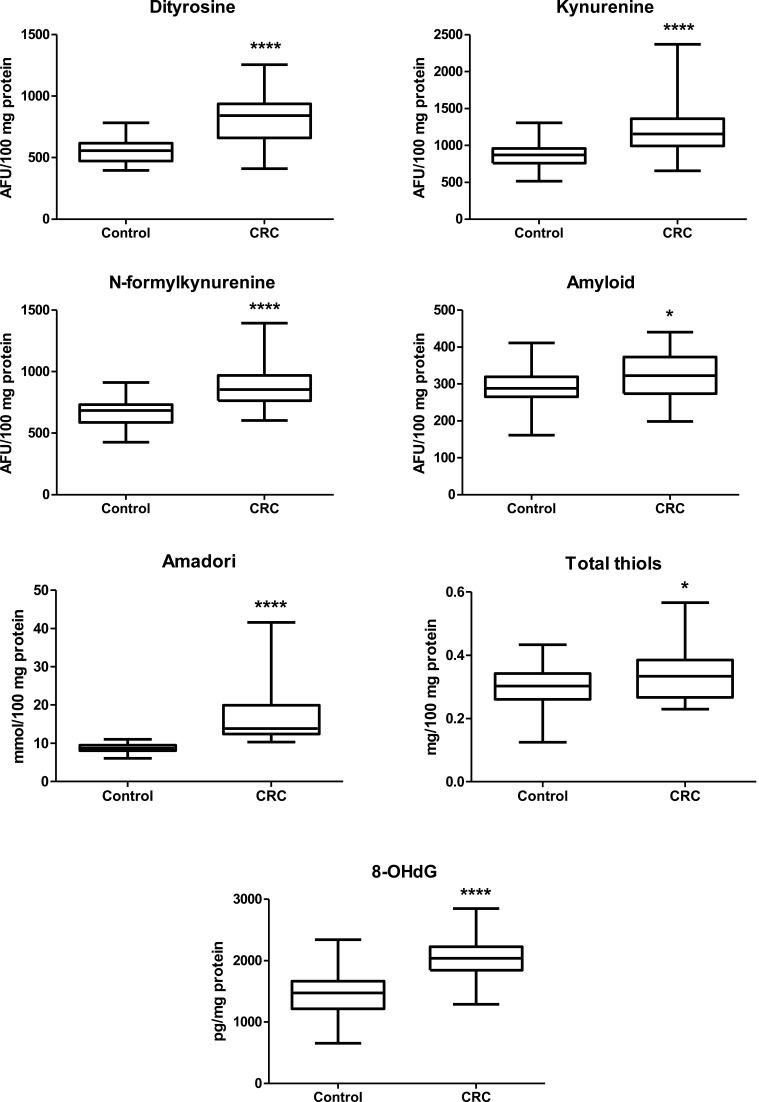
Fifty-five CRC patients (21 women, 34 men) and 55 healthy controls matched for sex and age were included in the experiment. Nitrosative stress parameters (nitric oxide (NO), peroxynitrite, S-nitrosothiols, and nitrotyrosine), protein oxidation (total thiols) and glycoxidation products (kynurenine N-formylkynurenine, dityrosine, Amadori products, and amyloid), and DNA damage markers (8-hydroxydeoxyguanosine (8-OHdG)), as well as levels of pro- and anti-inflammatory cytokines, were measured in serum or plasma samples.
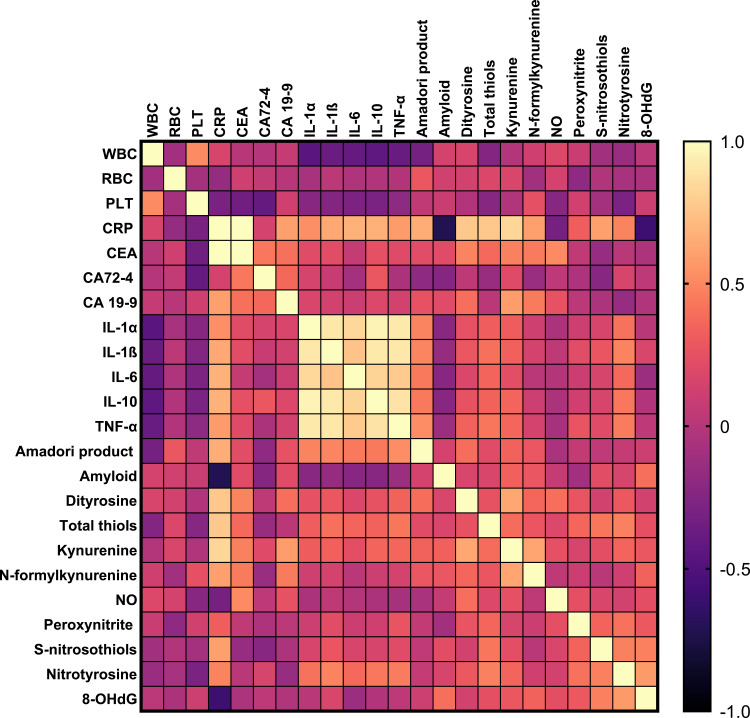
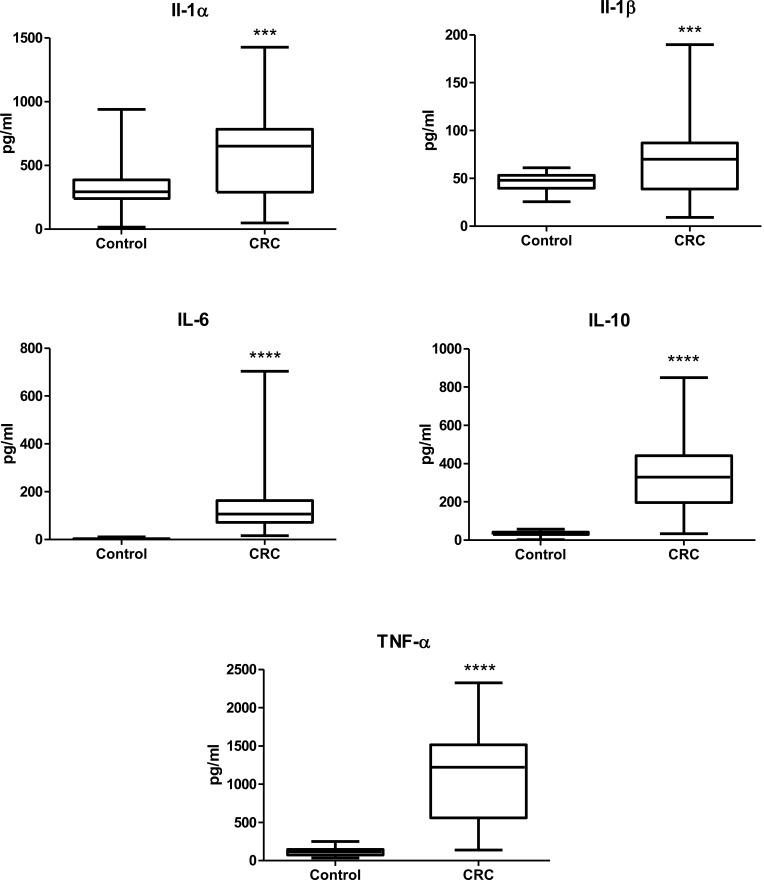
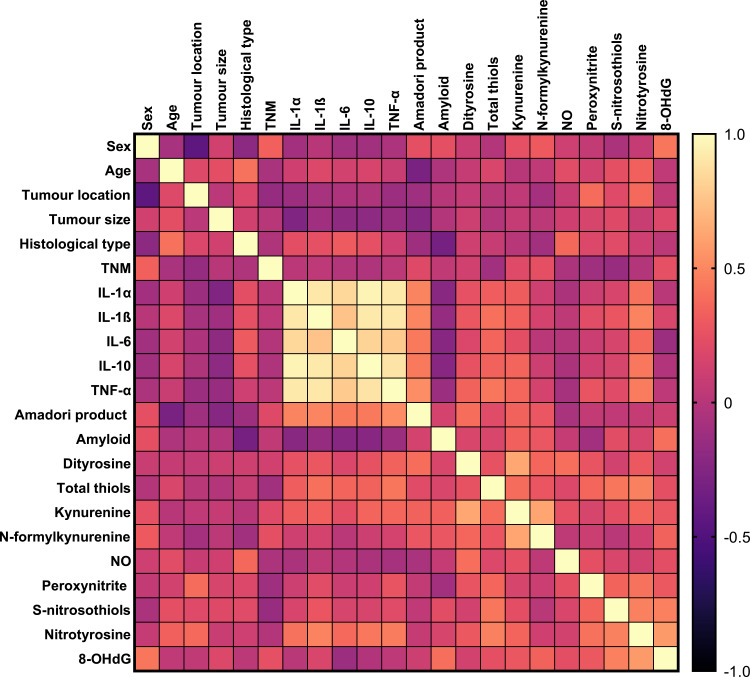
The levels of NO, peroxynitrite, S-nitrosothiols, nitrotyrosine, total thiols, kynurenine, N-formylkynurenine, dityrosine, Amadori product, amyloid, and 8-OHdG, as well as IL1α, IL1β, IL6, IL10, and TNF-α, were significantly higher in CRC patients than in controls. Oxidation and glycoxidation products were positively correlated with pro-inflammatory (IL1α, IL1β, IL6, TNFα) and anti-inflammatory cytokines (IL10), indicating that redox damages may promote inflammation in CRC patients. Many redox biomarkers differentiate patients with CRC from healthy individuals with high sensitivity and specificity.
Correlations of chosen oxidative products with pro-inflammatory (IL1α, IL1β, IL6, TNFα) and anti-inflammatory cytokines (IL10) suggest that redox damages may promote inflammation in CRC patients. Thus, our research is the first point for further clinical trials focusing on the evaluation of the diagnostic utility of nitrosative stress biomarkers in a larger group of CRC patients.
活性氮物质(RNS)的过量产生会导致亚硝化应激,这在代谢性、炎症性和癌症性疾病的发展中起着至关重要的作用。然而,亚硝化和羰基应激在结直肠癌(CRC)生物学中的作用仍未得到充分理解。因此,本研究评估了CRC患者与健康对照相比的亚硝化应激、蛋白质和DNA氧化/糖氧化以及促炎和抗炎细胞因子。
55例CRC患者(21名女性,34名男性)和55名年龄和性别匹配的健康对照纳入实验。在血清或血浆样本中测量亚硝化应激参数(一氧化氮(NO)、过氧亚硝酸盐、S-亚硝基硫醇和硝基酪氨酸)、蛋白质氧化(总硫醇)和糖氧化产物(犬尿氨酸、N-甲酰犬尿氨酸、二酪氨酸、阿马多里产物和淀粉样蛋白)、DNA损伤标志物(8-羟基脱氧鸟苷(8-OHdG))以及促炎和抗炎细胞因子水平。
CRC患者的NO、过氧亚硝酸盐、S-亚硝基硫醇、硝基酪氨酸、总硫醇、犬尿氨酸、N-甲酰犬尿氨酸、二酪氨酸、阿马多里产物、淀粉样蛋白和8-OHdG水平,以及IL1α、IL1β、IL6、IL10和TNF-α水平均显著高于对照组。氧化和糖氧化产物与促炎(IL1α, IL1β, IL6, TNFα)和抗炎细胞因子(IL10)呈正相关,表明氧化还原损伤可能促进CRC患者的炎症反应。许多氧化还原生物标志物能够以高灵敏度和特异性区分CRC患者与健康个体。
所选氧化产物与促炎(IL1α, IL1β, IL6, TNFα)和抗炎细胞因子(IL10)的相关性表明氧化还原损伤可能促进CRC患者的炎症反应。因此,我们的研究是进一步临床试验的首要切入点,该试验旨在评估亚硝化应激生物标志物在更大规模CRC患者群体中的诊断效用。